Icahn School of Medicine at Mount Sinai, New York, NY, USA.
Mailman School of Public Health, Columbia University, New York, NY, USA.
J Expo Sci Environ Epidemiol. 2021 Feb;31(1):108-116. doi: 10.1038/s41370-019-0183-9. Epub 2019 Oct 21.
Lead is a ubiquitous toxicant following three compartment kinetics with the longest half-life found in bones. Patella and tibia lead levels-validated measures of cumulative exposure-require specialized X-ray-fluorescence-spectroscopy available only in a few centers worldwide. We developed minimally invasive biomarkers reflecting individual cumulative lead exposure using blood DNA methylation profiles-obtainable via Illumina 450K or IlluminaEPIC bead-chip assays.
We developed and tested two methylation-based biomarkers from 348 Normative Aging Study (NAS) elderly men. We selected methylation sites with strong associations with bone lead levels via robust regressions analysis and constructed the biomarkers using elastic nets. Results were validated in a NAS subset, reporting specificity, and sensitivity.
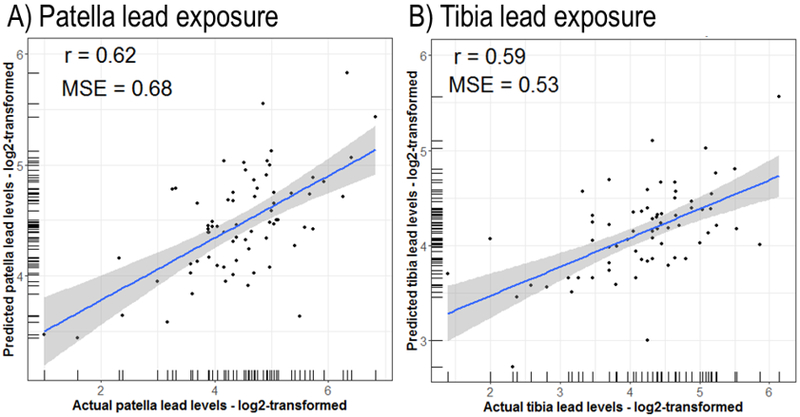
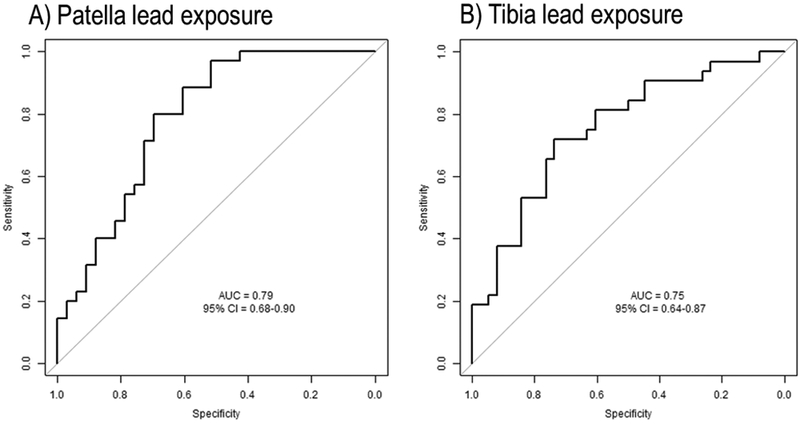
Participants were 73 years old on average (standard deviation, SD = 6), with moderate lead levels of (mean ± SD patella: 27 ± 18 µg/g; tibia:21 ± 13 µg/g). Methylation-based biomarkers for lead in patella and tibia included 59 and 138 DNA methylation sites, respectively. Estimated lead levels were significantly correlated with actual measured values, (r = 0.62 patella, r = 0.59 tibia) and had low mean square error (MSE) (MSE = 0.68 patella, MSE = 0.53 tibia). Means and distributions of the estimated and actual lead levels were not significantly different across patella and tibia bones (p > 0.05). Methylation-based biomarkers discriminated participants highly exposed (>median) to lead with a specificity of 74 and 73% for patella and tibia lead levels, respectively, with 70% sensitivity.
DNA methylation-based lead biomarkers are novel tools that can be used to reconstruct decades' worth of individual cumulative lead exposure using only blood DNA methylation profiles and may help identify the consequences of cumulative exposure.
铅是一种无处不在的有毒物质,具有三隔室动力学特征,半衰期最长的部分存在于骨骼中。髌骨和胫骨的铅含量——累积暴露的有效衡量标准——需要专门的 X 射线荧光光谱仪进行测量,而这种仪器在全球范围内仅有少数几个中心拥有。我们使用血液 DNA 甲基化谱图开发了反映个体累积铅暴露的微创生物标志物,该谱图可通过 Illumina 450K 或 IlluminaEPIC 珠芯片检测获得。
我们从 348 名正常衰老研究(NAS)老年男性中开发并测试了两个基于甲基化的生物标志物。我们通过稳健的回归分析选择与骨铅水平具有强关联的甲基化位点,并使用弹性网络构建生物标志物。在 NAS 子集中报告了特异性和敏感性,以验证结果。
参与者的平均年龄为 73 岁(标准差,SD=6),髌骨(平均+SD:27+18μg/g)和胫骨(平均+SD:21+13μg/g)的铅水平适中。用于髌骨和胫骨的基于甲基化的铅生物标志物分别包含 59 和 138 个 DNA 甲基化位点。估计的铅水平与实际测量值显著相关(r=0.62 髌骨,r=0.59 胫骨),且平均均方误差(MSE)较低(MSE=0.68 髌骨,MSE=0.53 胫骨)。估计和实际的铅水平在髌骨和胫骨之间的均值和分布没有显著差异(p>0.05)。基于甲基化的生物标志物可高度区分铅暴露水平较高(>中位数)的参与者,对髌骨和胫骨的铅水平的特异性分别为 74%和 73%,敏感性为 70%。
基于 DNA 甲基化的铅生物标志物是新颖的工具,仅使用血液 DNA 甲基化谱图就可以重建数十年的个体累积铅暴露量,并且可能有助于识别累积暴露的后果。