Key Laboratory of Animal Parasitology of Ministry of Agriculture, Shanghai Veterinary Research Institute, Chinese Academy of Agricultural Sciences, Shanghai, 200241, China.
Parasit Vectors. 2019 Oct 25;12(1):500. doi: 10.1186/s13071-019-3754-7.
The hard tick Haemaphysalis longicornis (Ixodidae) is widely distributed in East Asia, China, Australia and New Zealand. It can transmit many infectious pathogens, including the causative agents of human rickettsiosis, bovine theileriosis, bovine babesiosis and canine babesiosis. Therefore, a greater understanding of H. longicornis biology might aid in the development of more effective control measures against the tick and tick-borne pathogens.
We analyzed the expression of miR-184 in different developmental stages and various tissues of H. longicornis using real-time PCR (qRT-PCR). Antagomir (Ant-184) was used to knock-down miR-184, whilst Ms-Ant and non-injected ticks were used as the negative and blank controls, respectively. We used online software tools (RNAhybrid and TargetScan) to predict the putative target genes of miR-184.
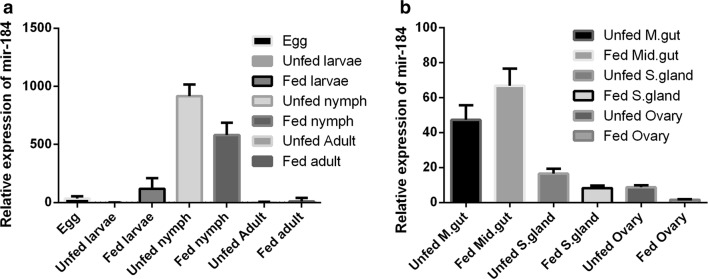
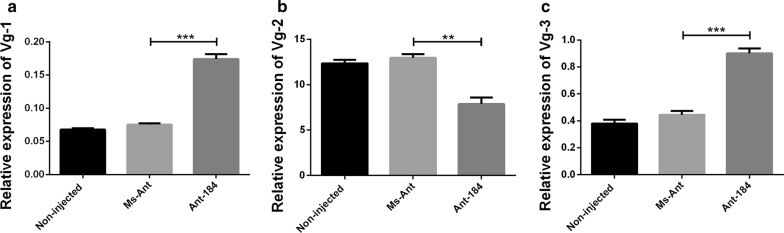
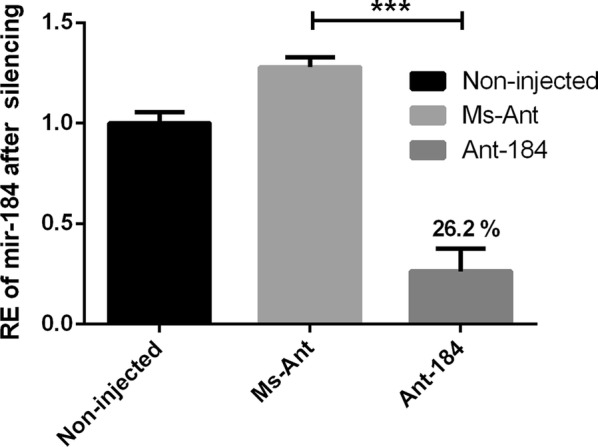
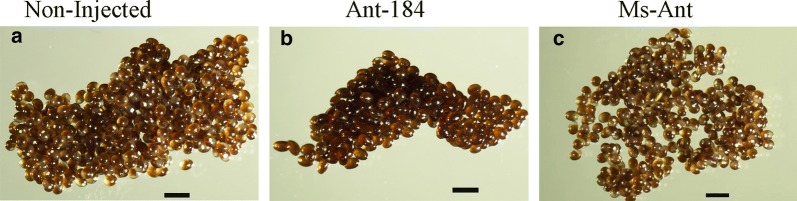
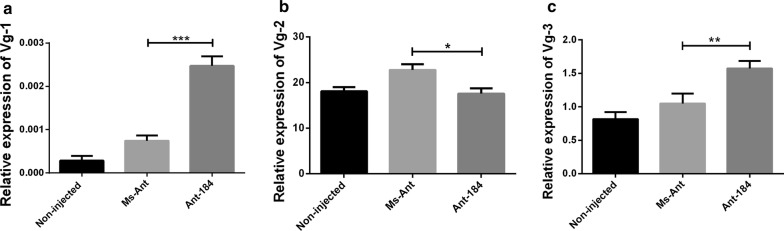
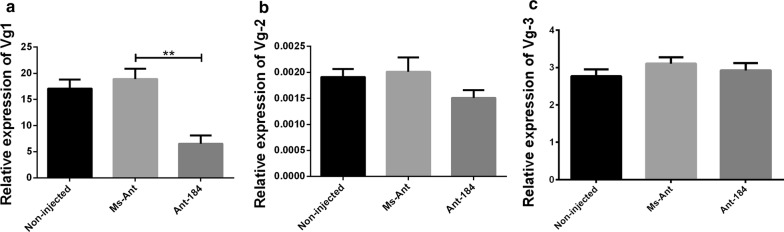
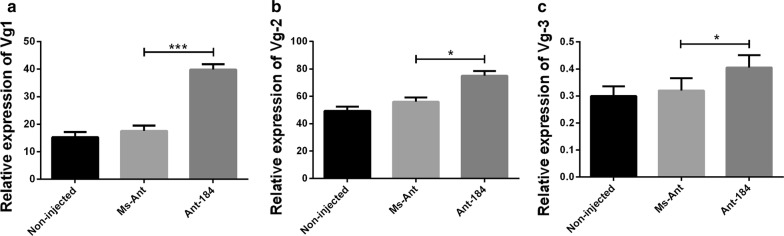
The expression of miR-184 was highest in unfed nymphs and lowest in unfed larvae. The tissue distribution of miR-184 showed abundant expression in the midgut. To investigate the probable roles of miR-184, antagomir (Ant-184) was used to knock-down miR-184 (t = 12.32, P = 0.0002). After inhibiting miR-184, other biological factors were examined in each group. The engorged body weight was significantly reduced in the treated group (Ant-184) in contrast to control groups (t = 2.19, P = 0.0388). The mean duration of the egg-laying days was significantly increased (33.5 ± 1.91) and the number of eggs (t = 3.147, P = 0.0137), and egg mass (t = 3.4472, P = 0.0063) were significantly reduced in the treated group. During oviposition, eggs were monitored and in half of the ticks of the Ant-184 group the eggs were completely desiccated, lacked embryo development and did not hatch. We analyzed the expression of Vg proteins (Vg1, Vg2, Vg3) in semi-engorged ticks, engorged ticks, ticks at day 2 after engorgement and egg stage in Ant-184, non-injected and Ms-Ant groups, and found significant variation.
This study provides information on the role of miR-184 in H. longicornis ticks. The data suggest that miR-184 targets Vg proteins and affects blood digestion and oviposition.
硬蜱长角血蜱(Ixodidae)广泛分布于东亚、中国、澳大利亚和新西兰。它可以传播许多传染性病原体,包括人类立克次体病、牛泰勒虫病、牛巴贝斯虫病和犬巴贝斯虫病的病原体。因此,对长角血蜱生物学的更深入了解可能有助于开发更有效的蜱和蜱传病原体控制措施。
我们使用实时 PCR(qRT-PCR)分析了不同发育阶段和长角血蜱不同组织中 miR-184 的表达。使用反义寡核苷酸(Ant-184)敲低 miR-184,而 Ms-Ant 和未注射的蜱分别作为阴性和空白对照。我们使用在线软件工具(RNAhybrid 和 TargetScan)预测 miR-184 的假定靶基因。
miR-184 在未喂食的若虫中表达最高,在未喂食的幼虫中表达最低。miR-184 的组织分布显示在中肠中大量表达。为了研究 miR-184 的可能作用,使用反义寡核苷酸(Ant-184)敲低 miR-184(t = 12.32,P = 0.0002)。抑制 miR-184 后,在每个组中检查其他生物学因素。与对照组(Ant-184)相比,处理组(Ant-184)的饱食体重显著降低(t = 2.19,P = 0.0388)。产卵天数的平均持续时间显著增加(33.5 ± 1.91),产卵数(t = 3.147,P = 0.0137)和卵质量(t = 3.4472,P = 0.0063)显著降低在处理组中。在产卵期间,监测了卵,在 Ant-184 组的一半蜱中,卵完全干燥,缺乏胚胎发育,并且没有孵化。我们分析了 Ant-184、未注射和 Ms-Ant 组中半饱食蜱、饱食蜱、饱食后 2 天的蜱和卵期的 Vg 蛋白(Vg1、Vg2、Vg3)的表达,发现有显著变化。
本研究提供了 miR-184 在长角血蜱中的作用信息。数据表明,miR-184 靶向 Vg 蛋白,影响血液消化和产卵。