Laboratory of Veterinary Parasitology, College of Veterinary Medicine and Bio-Safety Research Centre, Jeonbuk National University, Iksan 54596, Korea.
Department of Medicine Surgery & Obstetrics, Faculty of Veterinary and Animal Science, Hajee Mohammad Danesh Science and Technology University, Dinajpur 5200, Bangladesh.
J Vet Sci. 2024 May;25(3):e43. doi: 10.4142/jvs.24039.
is an obligate blood-sucking ectoparasite that has gained attention due its role of transmitting medically and veterinary significant pathogens and it is the most common tick species in Republic of Korea. The preferred strategy for controlling ticks is a multi-antigenic vaccination. Testing the efficiency of a combination antigen is a promising method for creating a tick vaccine.
The aim of the current research was to analyze the role of subolesin and enolase in feeding and reproduction of by gene silencing.
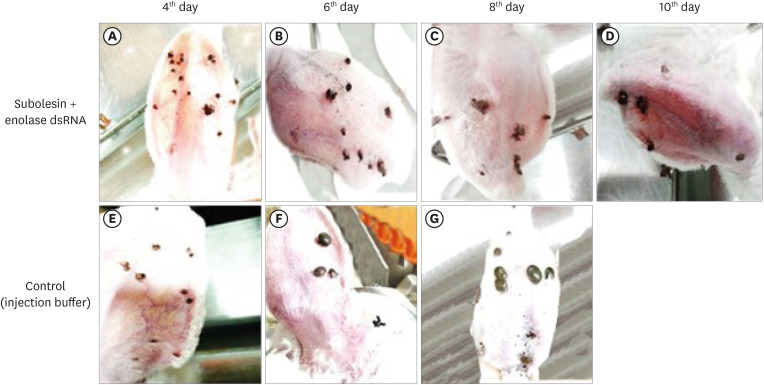
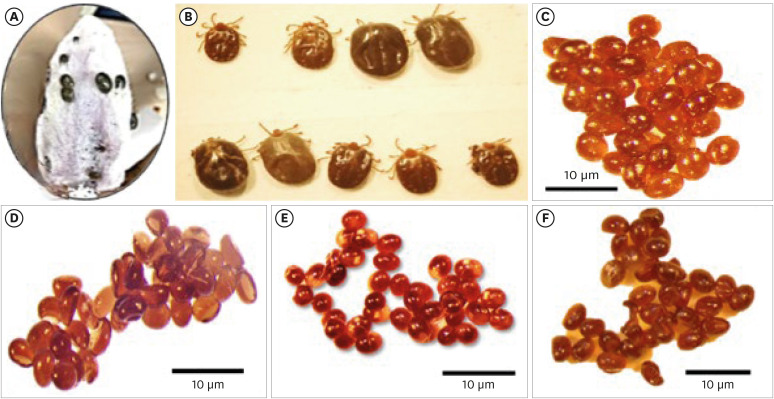
In this study, we used RNA interference to silence salivary enolase and subolesin in . Unfed female ticks injected with double-stranded RNA targeting subolesin and enolase were attached and fed normally on the rabbit's ear. Real-time polymerase chain reaction was used to confirm the extent of knockdown.
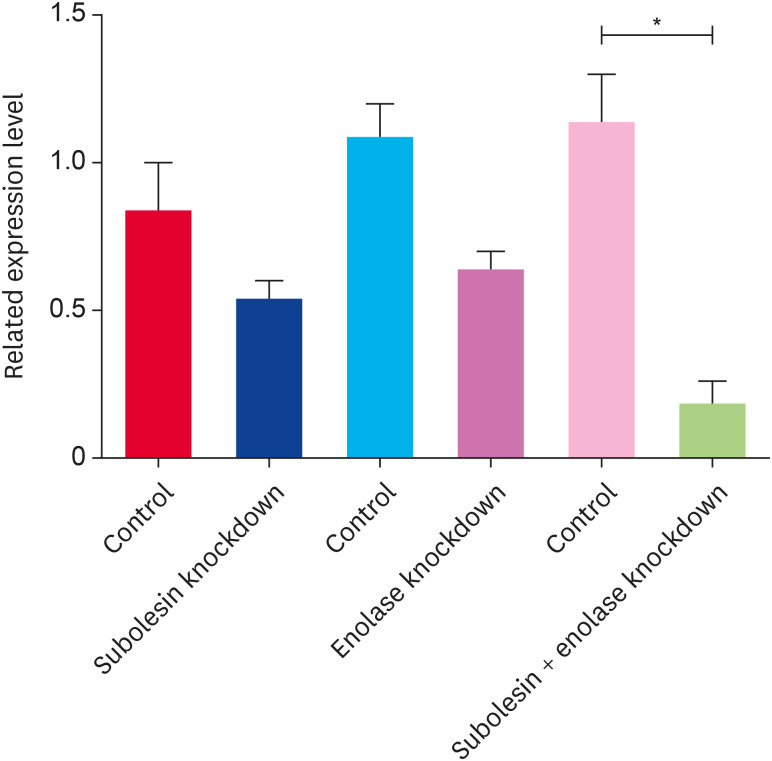
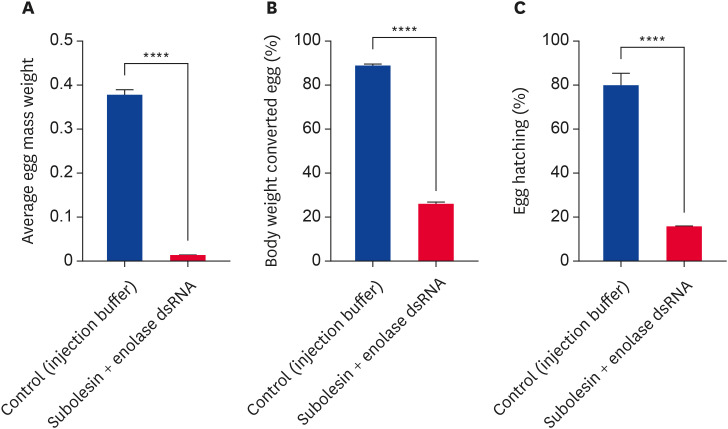
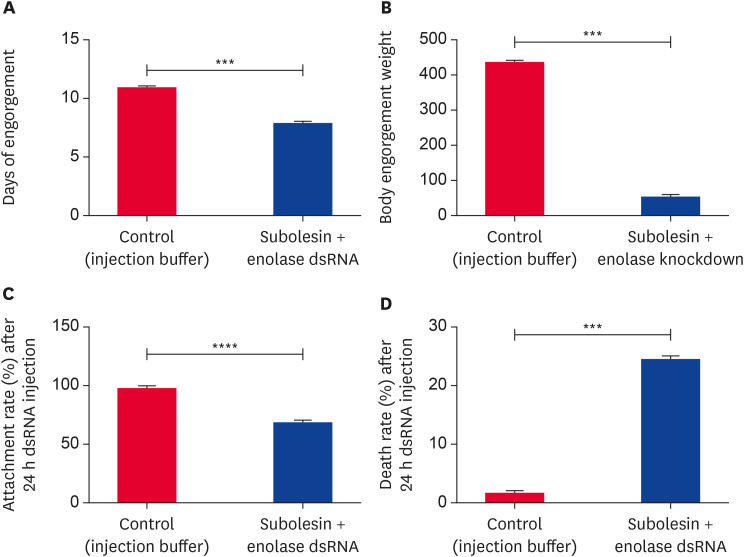
Ticks in the subolesin or enolase dsRNA groups showed knockdown rates of 80% and 60% respectively. Ticks in the combination dsRNA (subolesin and enolase) group showed an 80% knockdown. Knockdown of subolesin and enolase resulted in significant depletion in feeding, blood engorgement weight, attachment rate, and egg laying. Silencing of both resulted in a significant ( < 0.05) reduction in tick engorgement, egg laying, egg hatching (15%), and reproduction.
Our results suggest that subolesin and enolase are an exciting target for future tick control strategies.
它是一种专性吸血外寄生虫,由于其传播医学和兽医重要病原体的作用而受到关注,它是韩国最常见的蜱种。控制蜱的首选策略是多抗原疫苗接种。测试组合抗原的效率是开发蜱疫苗的一种有前途的方法。
本研究的目的是通过基因沉默分析亚油酸和烯醇酶在 中的摄食和繁殖中的作用。
在这项研究中,我们使用 RNA 干扰来沉默唾液烯醇酶和 中的亚油酸。用靶向亚油酸和烯醇酶的双链 RNA 注射的未进食雌性蜱虫正常附着并在兔子耳朵上进食。实时聚合酶链反应用于确认敲低的程度。
亚油酸或烯醇酶 dsRNA 组中的蜱虫分别显示出 80%和 60%的敲低率。组合 dsRNA(亚油酸和烯醇酶)组中的蜱虫显示出 80%的敲低率。亚油酸和烯醇酶的敲低导致摄食、血液饱食重量、附着率和产卵显著减少。两者的沉默导致蜱虫饱食、产卵、孵化(15%)和繁殖显著减少(<0.05)。
我们的结果表明,亚油酸和烯醇酶是未来蜱控制策略的一个令人兴奋的目标。