Department of Radiation Oncology, Fudan University Shanghai Cancer Center, Shanghai, 200032, China.
Department of Oncology, Shanghai Medical College, Fudan University, Shanghai, 200032, China.
Sci Rep. 2019 Oct 25;9(1):15346. doi: 10.1038/s41598-019-51629-4.
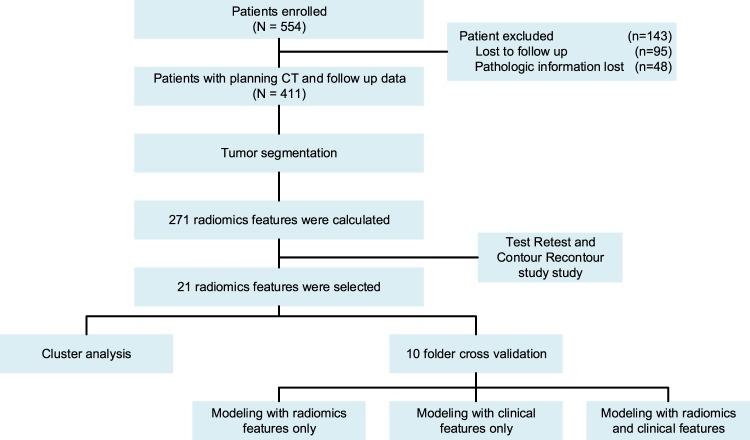
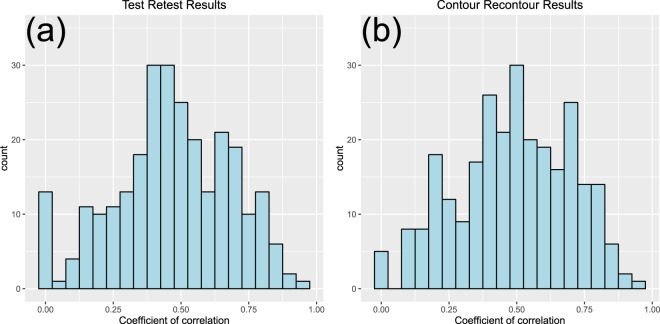
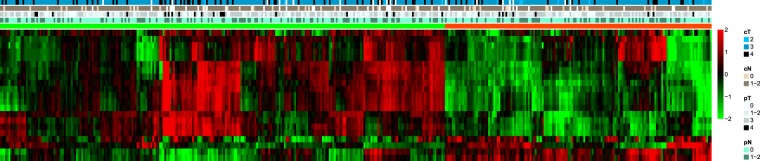
This retrospective study was to investigate whether radiomics feature come from radiotherapy treatment planning CT can predict prognosis in locally advanced rectal cancer patients treated with neoadjuvant chemoradiation followed by surgery. Four-hundred-eleven locally advanced rectal cancer patients which were treated with neoadjuvant chemoradiation enrolled in this study. All patients' radiotherapy treatment planning CTs were collected. Tumor was delineated on these CTs by physicians. An in-house radiomics software was used to calculate 271 radiomics features. The results of test-retest and contour-recontour studies were used to filter stable radiomics (Spearman correlation coefficient > 0.7). Twenty-one radiomics features were final enrolled. The performance of prediction model with the radiomics or clinical features were calculated. The clinical outcomes include local control, distant control, disease-free survival (DFS) and overall survival (OS). Model performance C-index was evaluated by C-index. Patients are divided into two groups by cluster results. The results of chi-square test revealed that the radiomics feature cluster is independent of clinical features. Patients have significant differences in OS (p = 0.032, log rank test) for these two groups. By supervised modeling, radiomics features can improve the prediction power of OS from 0.672 [0.617 0.728] with clinical features only to 0.730 [0.658 0.801]. In conclusion, the radiomics features from radiotherapy CT can potentially predict OS for locally advanced rectal cancer patients with neoadjuvant chemoradiation treatment.
这项回顾性研究旨在探讨接受新辅助放化疗后手术治疗的局部进展期直肠癌患者的放射组学特征是否能从放疗计划 CT 预测预后。本研究纳入了 411 例接受新辅助放化疗的局部进展期直肠癌患者。所有患者的放疗计划 CT 均被采集。医生在这些 CT 上勾画肿瘤。使用内部的放射组学软件计算了 271 个放射组学特征。通过测试-重测和勾画-重勾画图研究的结果来筛选稳定的放射组学(Spearman 相关系数>0.7)。最终纳入了 21 个放射组学特征。计算了基于放射组学或临床特征的预测模型的性能。临床结局包括局部控制、远处控制、无病生存(DFS)和总生存(OS)。通过 C 指数评估模型性能 C 指数。通过聚类结果将患者分为两组。卡方检验的结果表明,放射组学特征聚类与临床特征无关。这两组患者的 OS 存在显著差异(p=0.032,对数秩检验)。通过有监督建模,放射组学特征可以将 OS 的预测能力从仅基于临床特征的 0.672[0.617-0.728]提高到 0.730[0.658-0.801]。总之,放疗 CT 的放射组学特征可能有助于预测接受新辅助放化疗的局部进展期直肠癌患者的 OS。