School of Pharmacy, Anhui Medical University, Hefei 230032, China.
Anhui Institute of Innovative Drugs, Hefei 230032, China.
Molecules. 2019 Oct 28;24(21):3876. doi: 10.3390/molecules24213876.
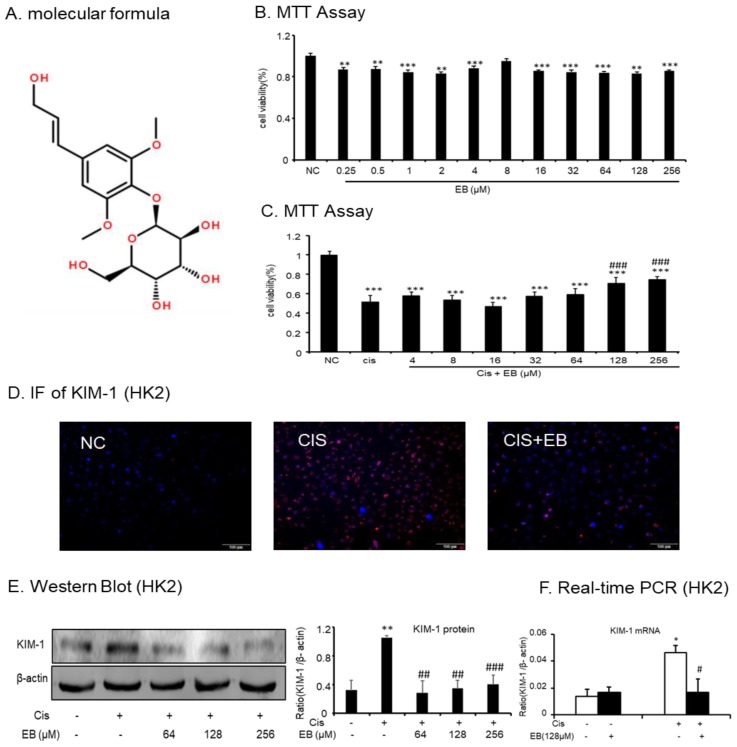
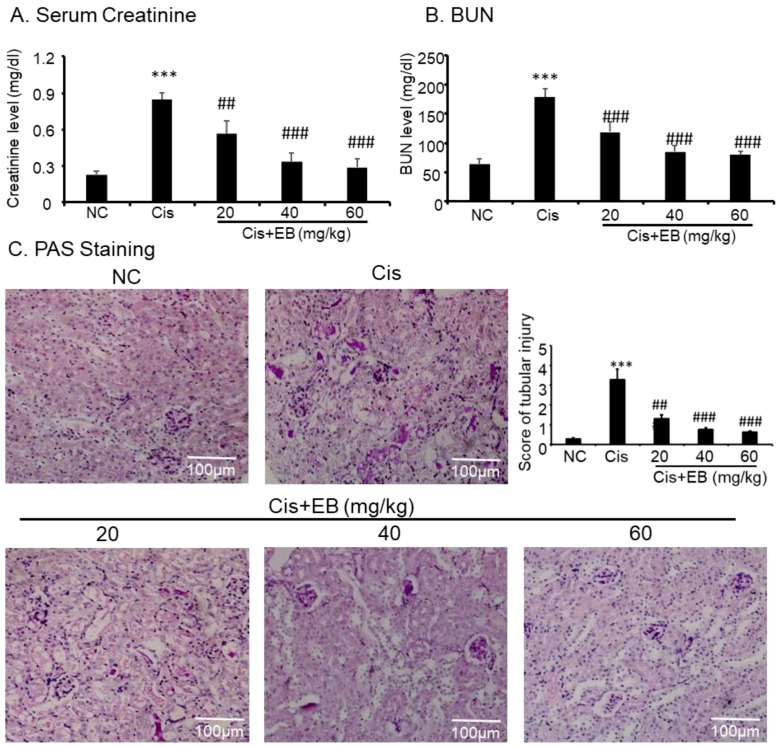
Acute kidney injury (AKI) is a common, complex, and severe clinical syndrome characterized by rapid decline in renal function, combined with tissue damage. Currently, the prevention and treatment of AKI are focused on symptomatic treatment, rather than treating the underlying causes. Therefore, there is no specific treatment to prevent renal injury except for renal dialysis. In this study, we used cisplatin-induced AKI mouse and human kidney-2 (HK-2) cell models to evaluate the renal protective effect of eleutheroside B, an active compound in traditional Chinese medicines. MTT assay was used to detect the effect of eleutheroside B on proliferation of human HK-2 cells in presence and in absence of cisplatin. Western blot and immunostaining were used to detect the protein level of kidney injury molecule-1 (KIM-1), cleaved caspase-3, receptor-interacting protein kinase (RIPK)-1, and RIPK-3. Real-time PCR was used to detect the mRNA levels of chemokines (like monocyte chemotactic protein 1, MCP-1) and pro-inflammatory cytokines including interleukin-6 (IL-6) and tumor necrosis factor (TNF-α). Flow cytometry assay was used to detect apoptosis of HK-2 cells. In vivo results showed that eleutheroside B reduced the increase in serum creatinine and blood urea nitrogen (BUN) levels in the AKI model. Periodic acid-Schiff staining and Western blot analysis of KIM-1 showed that eleutheroside B alleviated tubular cell injury. Further, eleutheroside B reduced macrophage infiltration and production of inflammatory cytokines, inhibited the activation of nuclear factor (NF)-κB, and inhibited apoptosis and programmed necrosis. The mechanism may be that eleutheroside B can activate the insulin-like growth factor (IGF) pathway and its downstream pathway by downregulating the expression of IGFBP-7, thus promoting cell proliferation. Therefore, our results suggest that eleutheroside B is a potential drug for AKI treatment.
急性肾损伤(AKI)是一种常见的、复杂的、严重的临床综合征,其特征是肾功能迅速下降,伴有组织损伤。目前,AKI 的预防和治疗侧重于症状治疗,而不是针对根本原因进行治疗。因此,除了肾透析之外,没有专门的治疗方法可以预防肾损伤。在这项研究中,我们使用顺铂诱导的 AKI 小鼠和人肾-2(HK-2)细胞模型来评估刺五加苷 B 这种中药活性化合物对肾脏的保护作用。MTT 测定法用于检测刺五加苷 B 在存在和不存在顺铂的情况下对人 HK-2 细胞增殖的影响。Western blot 和免疫染色用于检测肾损伤分子-1(KIM-1)、裂解的半胱天冬酶-3、受体相互作用蛋白激酶(RIPK)-1 和 RIPK-3 的蛋白水平。实时 PCR 用于检测趋化因子(如单核细胞趋化蛋白 1,MCP-1)和促炎细胞因子包括白细胞介素-6(IL-6)和肿瘤坏死因子(TNF-α)的 mRNA 水平。流式细胞术用于检测 HK-2 细胞的凋亡。体内结果表明,刺五加苷 B 降低了 AKI 模型中血清肌酐和血尿素氮(BUN)水平的升高。过碘酸希夫染色和 KIM-1 的 Western blot 分析表明,刺五加苷 B 减轻了肾小管细胞损伤。此外,刺五加苷 B 减少了巨噬细胞浸润和炎症细胞因子的产生,抑制了核因子(NF)-κB 的激活,并抑制了细胞凋亡和程序性坏死。其机制可能是刺五加苷 B 通过下调 IGFBP-7 的表达来激活胰岛素样生长因子(IGF)途径及其下游途径,从而促进细胞增殖。因此,我们的研究结果表明,刺五加苷 B 是治疗 AKI 的一种潜在药物。