National Engineering Laboratory for Animal Breeding, Key Laboratory of Animal Genetics, Breeding, and Reproduction of the Ministry of Agriculture and Rural Affairs, College of Animal Science and Technology, China Agricultural University, Beijing 100193, China.
Int J Mol Sci. 2019 Oct 28;20(21):5356. doi: 10.3390/ijms20215356.
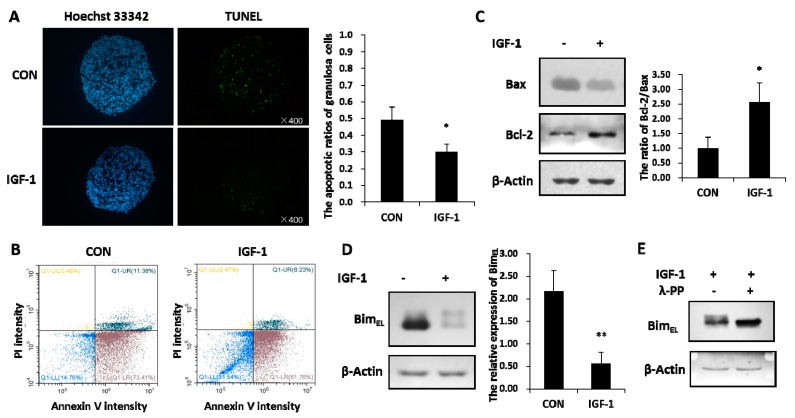
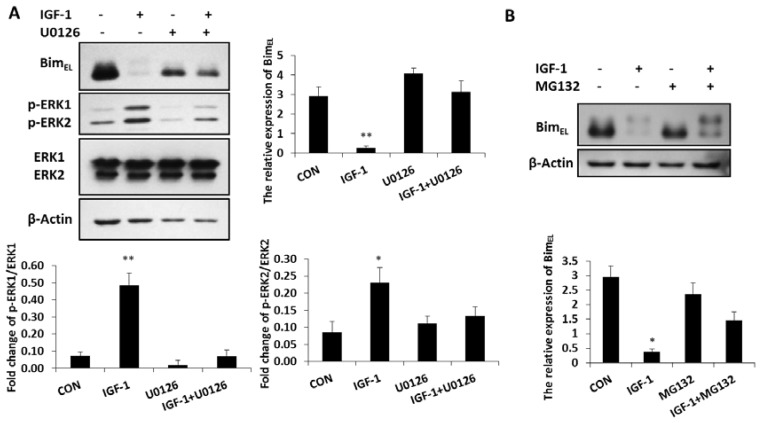
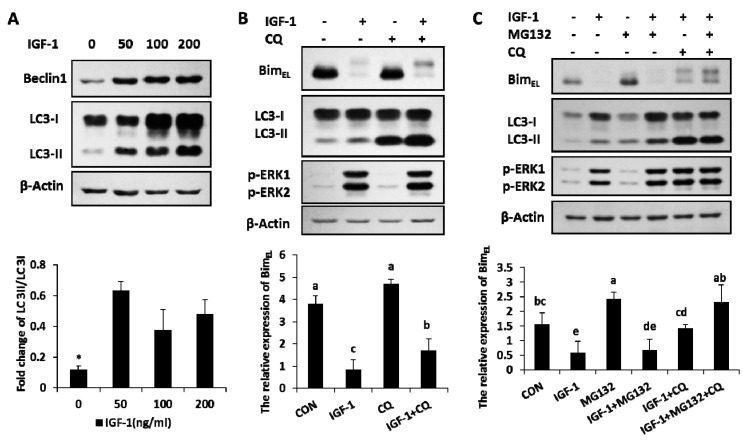
Insulin-like growth factor-1 (IGF-1) is an intra-ovarian growth factor that plays important endocrine or paracrine roles during ovarian development. IGF-1 affects ovarian function and female fertility through reducing apoptosis of granulosa cells, yet the underlying mechanism remains poorly characterized. Here, we aimed to address these knowledge gaps using porcine primary granulosa cells and examining the anti-apoptotic mechanisms of IGF-1. IGF-1 prevented the granulosa cell from apoptosis, as shown by TUNEL and Annexin V/PI detection, and gained the anti-apoptotic index, the ratio of Bcl-2/Bax. This process was partly mediated by reducing the pro-apoptotic Bim (Bcl-2 Interacting Mediator of Cell Death-Extra Long) protein level. Western blotting showed that IGF-1 promoted Bim phosphorylation through activating p-ERK1/2, and that the proteasome system was responsible for degradation of phosphorylated Bim. Meanwhile, IGF-1 enhanced the Beclin1 level and the rate of LC3 II/LC3 I, indicating that autophagy was induced by IGF-1. By blocking the proteolysis processes of both proteasome and autophagy flux with MG132 and chloroquine, respectively, the Bim did not reduce and the phosphorylated Bim protein accumulated, thereby indicating that both proteasome and autophagy pathways were involved in the degradation of Bim stimulated by IGF-1. In conclusion, IGF-1 inhibited porcine primary granulosa cell apoptosis via degradation of pro-apoptotic Bim. This study is critical for us to further understand the mechanisms of follicular survival and atresia regulated by IGF-1. Moreover, it provides a direction for the treatment of infertility caused by ovarian dysplasia, such as polycystic ovary syndrome and the improvement of assisted reproductive technology.
胰岛素样生长因子 1(IGF-1)是一种卵巢内生长因子,在卵巢发育过程中发挥重要的内分泌或旁分泌作用。IGF-1 通过减少颗粒细胞凋亡来影响卵巢功能和雌性生育能力,但其中的机制仍知之甚少。在这里,我们使用猪原代颗粒细胞来研究 IGF-1 的抗凋亡机制,旨在解决这些知识空白。IGF-1 通过 TUNEL 和 Annexin V/PI 检测,防止颗粒细胞凋亡,并获得抗凋亡指数,即 Bcl-2/Bax 的比值。这个过程部分是通过降低促凋亡 Bim(Bcl-2 相互作用介导细胞死亡的额外长)蛋白水平来介导的。Western blot 显示,IGF-1 通过激活 p-ERK1/2 来促进 Bim 的磷酸化,而蛋白酶体系统负责磷酸化 Bim 的降解。同时,IGF-1 增强了 Beclin1 水平和 LC3 II/LC3 I 的比率,表明自噬被 IGF-1 诱导。通过分别用 MG132 和氯喹阻断蛋白酶体和自噬通量的蛋白水解过程,Bim 没有减少,磷酸化 Bim 蛋白积累,这表明 IGF-1 刺激的 Bim 降解既涉及蛋白酶体途径,也涉及自噬途径。总之,IGF-1 通过降解促凋亡的 Bim 抑制猪原代颗粒细胞凋亡。这项研究对于我们进一步了解 IGF-1 调节卵泡存活和闭锁的机制至关重要。此外,它为多囊卵巢综合征等卵巢发育不良引起的不孕不育症的治疗和辅助生殖技术的改进提供了一个方向。