NIHR Nottingham Biomedical Research Centre, School of Medicine, University of Nottingham, Nottingham, East Midland, UK
NIHR Nottingham Biomedical Research Centre, School of Medicine, University of Nottingham, Nottingham, East Midland, UK.
BMJ Open. 2019 Oct 28;9(10):e030564. doi: 10.1136/bmjopen-2019-030564.
Knee osteoarthritis (OA) is the most common joint disease worldwide. As of today, there are no disease-modifying drugs, but there is evidence that muscle strengthening exercises can substantially reduce pain and improve function in this disorder, and one very well tested physiotherapy protocol is the 'Better Management of Patients with Osteoarthritis' developed in Sweden. Given the high prevalence of knee OA, a potentially cost-effective, digitally delivered approach to treat knee OA should be trialled. This study aims to explore the benefits of iBEAT-OA (Internet-Based Exercise programme Aimed at Treating knee Osteoarthritis) in modulating pain, function and other health-related outcomes in individuals with knee OA.
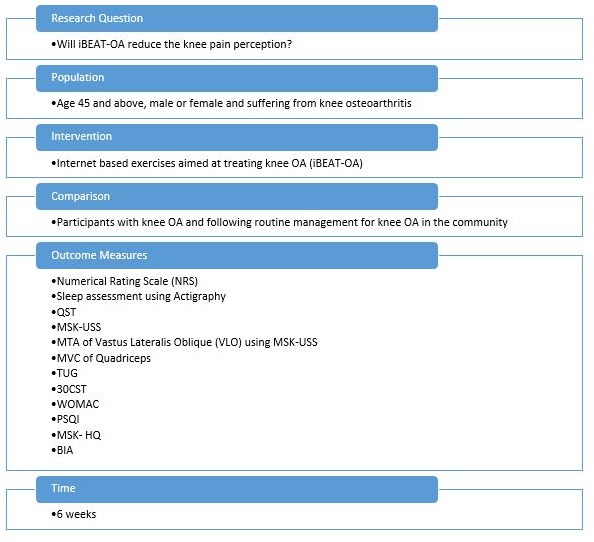
A randomised controlled trial was designed to evaluate the efficacy of a web-based exercise programme in a population with knee OA compared with standard community care provided by general practitioners (GPs) in the UK. We anticipate recruiting participants into equal groups. The intervention group (n=67) will exercise for 20-30 min daily for six consecutive weeks, whereas the control group (n=67) will follow GP-recommended routine care. The participants will be assessed using a Numerical Rating Scale, the Western Ontario and McMaster Universities Osteoarthritis Index, the Arthritis Research UK Musculoskeletal Health Questionnaire, the Pittsburgh Sleep Quality Index, 30 s sit to stand test, timed up and go test, quantitative sensory testing, musculoskeletal ultrasound scan, muscle thickness assessment of the vastus lateralis, and quadriceps muscles force generation during an isokinetic maximum voluntary contraction (MVC). Samples of urine, blood, faeces and synovial fluid will be collected to establish biomarkers associated with changes in pain and sleep patterns in individuals affected with knee OA. Standard parametric regression methods will be used for statistical analysis.
Ethical approval was obtained from the Research Ethics Committee (ref: 18/EM/0154) and the Health Research Authority (protocol no: 18021). The study was registered in June 2018. The results of the trial will be submitted for publication in a peer-reviewed journal.
NCT03545048.
膝骨关节炎(OA)是全球最常见的关节疾病。截至今日,尚无针对该疾病的治疗药物,但有证据表明,肌肉强化锻炼可以显著减轻疼痛并改善该疾病的功能,瑞典开发的“骨关节炎患者更好管理”(Better Management of Patients with Osteoarthritis)是一种经过充分验证的物理治疗方案。鉴于膝骨关节炎的高患病率,应该尝试采用一种潜在具有成本效益的、基于数字的方法来治疗膝骨关节炎。本研究旨在探讨 iBEAT-OA(针对治疗膝骨关节炎的基于互联网的锻炼计划)在调节疼痛、功能和其他健康相关结果方面对膝骨关节炎患者的益处。
设计了一项随机对照试验,以评估基于网络的锻炼计划在英国人群中的疗效,该人群患有膝骨关节炎,与全科医生(GPs)提供的标准社区护理进行比较。我们预计将参与者分为均等组。干预组(n=67)将每天进行 20-30 分钟的锻炼,连续进行六周,而对照组(n=67)将遵循 GPs 推荐的常规护理。将使用数字评分量表、西安大略和麦克马斯特大学骨关节炎指数、关节炎研究英国肌肉骨骼健康问卷、匹兹堡睡眠质量指数、30 秒坐站测试、计时起立行走测试、定量感觉测试、肌肉骨骼超声扫描、股外侧肌厚度评估和等速最大自主收缩(MVC)时的股四头肌肌力来评估参与者。将收集尿液、血液、粪便和滑液样本,以确定与膝骨关节炎患者疼痛和睡眠模式变化相关的生物标志物。将使用标准参数回归方法进行统计分析。
已从研究伦理委员会(注册号:18/EM/0154)和健康研究管理局(方案编号:18021)获得伦理批准。该研究于 2018 年 6 月注册。试验结果将提交给同行评议期刊发表。
NCT03545048。