Institute of Chemical Biology, National Hellenic Research Foundation, Athens 11635, Greece.
School of Chemical Engineering, National Technical University of Athens, Athens 15780, Greece.
Sci Adv. 2019 Oct 16;5(10):eaax5108. doi: 10.1126/sciadv.aax5108. eCollection 2019 Oct.
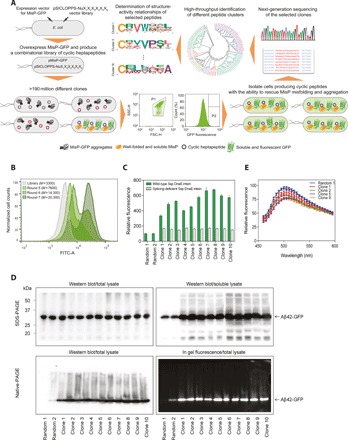
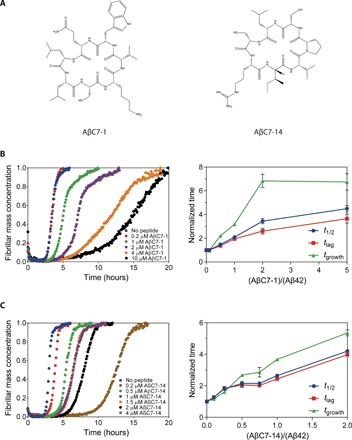
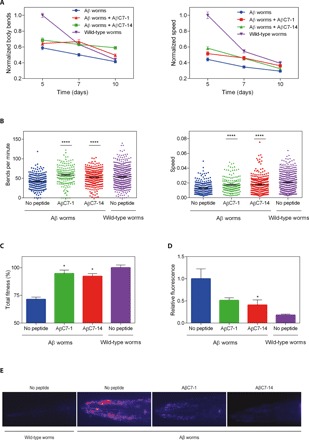
Protein misfolding and aggregation are associated with a many human disorders, including Alzheimer's and Parkinson's diseases. Toward increasing the effectiveness of early-stage drug discovery for these conditions, we report a bacterial platform that enables the biosynthesis of molecular libraries with expanded diversities and their direct functional screening for discovering protein aggregation inhibitors. We illustrate this approach by performing, what is to our knowledge, the largest functional screen of small-size molecular entities described to date. We generated a combinatorial library of ~200 million drug-like, cyclic peptides and rapidly screened it for aggregation inhibitors against the amyloid-β peptide (Aβ42), linked to Alzheimer's disease. Through this procedure, we identified more than 400 macrocyclic compounds that efficiently reduce Aβ42 aggregation and toxicity in vitro and in vivo. Finally, we applied a combination of deep sequencing and mutagenesis analyses to demonstrate how this system can rapidly determine structure-activity relationships and define consensus motifs required for bioactivity.
蛋白质错误折叠和聚集与许多人类疾病有关,包括阿尔茨海默病和帕金森病。为了提高这些疾病早期药物发现的效果,我们报告了一个细菌平台,该平台能够生物合成具有扩展多样性的分子文库,并直接对其进行功能筛选,以发现蛋白质聚集抑制剂。我们通过执行迄今为止描述的最大规模的小分子功能筛选,说明了这种方法。我们生成了一个组合文库,包含约 2 亿个类似药物的环状肽,并对其进行了快速筛选,以寻找与阿尔茨海默病相关的淀粉样β肽 (Aβ42) 聚集抑制剂。通过这个过程,我们鉴定了 400 多种大环化合物,它们能够有效地减少体外和体内 Aβ42 的聚集和毒性。最后,我们应用了深度测序和突变分析的组合,证明了这个系统如何能够快速确定结构-活性关系,并定义生物活性所需的共识基序。