Department of Structural Biochemistry, Max Planck Institute of Molecular Physiology, Otto-Hahn-Str. 11, 44227 Dortmund, Germany.
Department of Life Sciences and Chemistry, Jacobs University Bremen, Campusring 1, 28759 Bremen, Germany.
Sci Adv. 2019 Oct 16;5(10):eaax6497. doi: 10.1126/sciadv.aax6497. eCollection 2019 Oct.
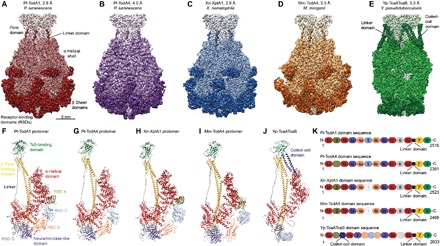
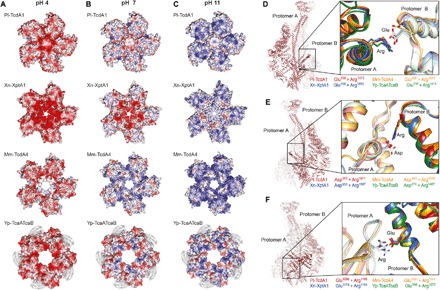
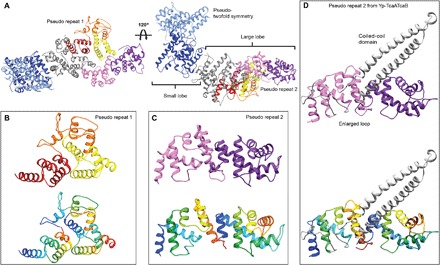
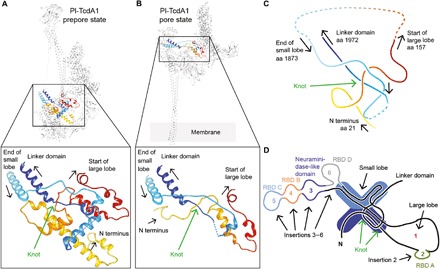
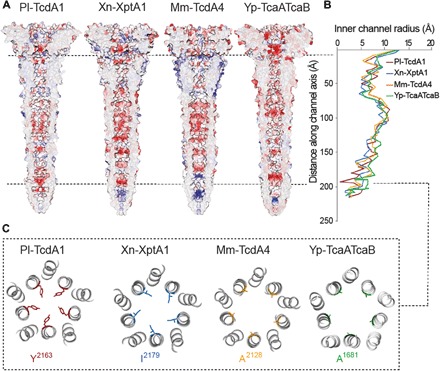
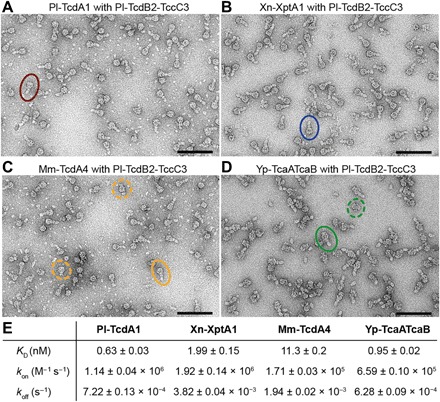
Tc toxins use a syringe-like mechanism to penetrate the membrane and translocate toxic enzymes into the host cytosol. They are composed of three components: TcA, TcB, and TcC. Low-resolution structures of TcAs from different bacteria suggest a considerable difference in their architecture and possibly in their mechanism of action. Here, we present high-resolution structures of five TcAs from insect and human pathogens, which show a similar overall composition and domain organization. Essential structural features, including a trefoil protein knot, are present in all TcAs, suggesting a common mechanism of action. All TcAs form functional pores and can be combined with TcB-TcC subunits from other species to form active chimeric holotoxins. We identified a conserved ionic pair that stabilizes the shell, likely operating as a strong latch that only springs open after destabilization of other regions. Our results provide new insights into the architecture and mechanism of the Tc toxin family.
Tc 毒素使用类似注射器的机制穿透细胞膜,并将毒性酶转移到宿主细胞质溶胶中。它们由三个成分组成:TcA、TcB 和 TcC。来自不同细菌的 TcAs 的低分辨率结构表明它们的结构和可能的作用机制有很大的差异。在这里,我们展示了来自昆虫和人类病原体的五种 TcAs 的高分辨率结构,它们显示出相似的整体组成和结构域组织。所有 TcAs 都存在基本的结构特征,包括三叶形蛋白结,这表明它们具有共同的作用机制。所有 TcAs 都形成功能性孔,并可以与来自其他物种的 TcB-TcC 亚基结合形成活性嵌合全毒素。我们鉴定出一个保守的离子对稳定外壳,可能作为一个强大的闩锁,只有在其他区域失稳后才会打开。我们的结果为 Tc 毒素家族的结构和机制提供了新的见解。