SMART initiative at Action Against Hunger Canada, 500-720 Bathurst St., Toronto, Ontario, ON M5S 2R4, Canada.
BMC Public Health. 2019 Oct 30;19(1):1419. doi: 10.1186/s12889-019-7677-1.
Childhood stunting is the most common manifestation of chronic malnutrition. A growing body of literature indicates that stunting can have negative repercussions on physical and cognitive development. There are increasing concerns that low- and middle-income countries (LMICs) are particularly susceptible to adverse consequences of stunting on economic development. The aim of this review is to synthesize current evidence on interventions and policies that have had success in reducing stunting and explore the impact of successes on economic indicators.
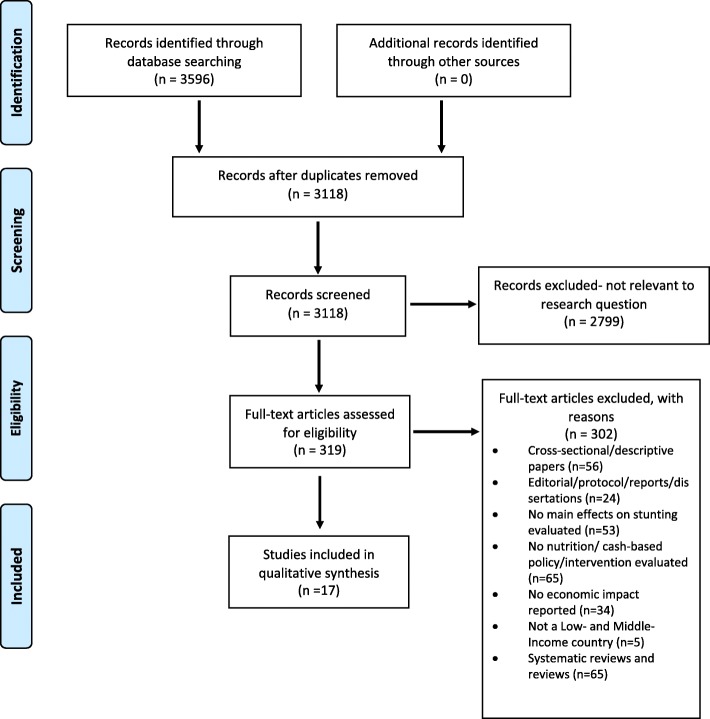
This review adheres to the Preferred Reporting Items for Systematic Reviews and Meta-Analyses guidelines. Articles were searched through MEDLINE via PubMed and Ovid, Cochrane Library, Web of Science and ProQuest. Only articles that addressed the effects of nutrition and cash-based interventions and/or policies on stunting and reported effects on childhood mortality and/or human capital indicators were included. Two reviewers independently abstracted data and assessed quality.
Seventeen studies from Africa (47%), South America (41%), and South Asia (12%) met the eligibility criteria: 8 cohort studies, 4 case studies, 4 Randomized Control Trials (RCTs) and 1 quasi-trial. Three types of interventions/policies were evaluated: multisectoral policies, nutritional supplementations and cash-based interventions (CCT). Overall, 76% of the included studies were successful in reducing stunting and 65% of interventions/policies reported successes on stunting reductions and economic successes. Five of the 11 successful studies reported on nutritional supplementation, 4 reported on multisectoral policies, and 2 reported on CCT interventions. Average Annual Rate of Reduction (AARR) was calculated to assess the impact of multisectoral policies on childhood mortality. AARR for under 5 mortality ranged from 5.2 to 6.2% and all countries aligned with the global target of 4.4% AARR. Quality assessment yielded positive results, with the biggest concerns being attrition bias for cohort studies, blinding for trials and generalizability of results for case studies.
Evidence suggests that investment in fighting chronic malnutrition through multisectoral policies, multi-year nutritional supplementation (protein or multiple micronutrient supplementation) and possibly CCTs can have a long-term impact on economic development of LMICs. More evidence is needed to inform practices in non-represented regions while prioritizing standardization of economic indicators in the literature.
儿童发育迟缓是慢性营养不良最常见的表现形式。越来越多的文献表明,发育迟缓会对身体和认知发育产生负面影响。人们越来越担心,中低收入国家(LMICs)特别容易受到发育迟缓对经济发展的不利影响。本综述的目的是综合目前关于成功减少发育迟缓的干预措施和政策的证据,并探讨成功对经济指标的影响。
本综述遵循系统评价和荟萃分析的首选报告项目(PRISMA)指南。通过 MEDLINE 通过 PubMed 和 Ovid、Cochrane 图书馆、Web of Science 和 ProQuest 进行了文章搜索。仅包括解决营养和基于现金的干预措施以及/或政策对发育迟缓的影响,并报告对儿童死亡率和/或人力资本指标影响的文章。两名评审员独立提取数据并评估质量。
来自非洲(47%)、南美洲(41%)和南亚(12%)的 17 项研究符合入选标准:8 项队列研究、4 项案例研究、4 项随机对照试验(RCT)和 1 项准试验。评估了三种类型的干预措施/政策:多部门政策、营养补充剂和基于现金的干预措施(CCT)。总体而言,76%的纳入研究成功降低了发育迟缓率,65%的干预措施/政策报告了在降低发育迟缓率和经济成功方面的成功。11 项成功研究中有 5 项报告了营养补充,4 项报告了多部门政策,2 项报告了 CCT 干预。为评估多部门政策对儿童死亡率的影响,计算了平均年度降低率(AARR)。5 岁以下儿童死亡率的 AARR 范围为 5.2%至 6.2%,所有国家都符合全球 4.4% AARR 的目标。质量评估结果为正,最大的问题是队列研究的失访偏倚、试验的盲法和案例研究结果的普遍性。
有证据表明,通过多部门政策、多年营养补充(蛋白质或多种微量营养素补充)和可能的 CCT 投资来对抗慢性营养不良,可以对中低收入国家的经济发展产生长期影响。需要更多的证据来为非代表性地区的实践提供信息,同时优先标准化文献中的经济指标。