Department of Environmental Medicine and Public Health, Icahn School of Medicine at Mount Sinai, One Gustave L. Levy Place, Box 1057, New York, NY, 10029, USA.
National Institute of Perinatology, Mexico City, Mexico.
Environ Health. 2019 Oct 30;18(1):92. doi: 10.1186/s12940-019-0526-y.
Humans are exposed to mixtures of chemicals across their lifetimes, a concept sometimes called the "exposome." Mixtures likely have temporal "critical windows" of susceptibility like single agents and measuring them repeatedly might help to define such windows. Common approaches to evaluate the effects of chemical mixtures have focused on their effects at a single time point. Our goal is to expand upon these previous techniques and examine the time-varying critical windows for metal mixtures on subsequent neurobehavior in children.
We propose two methods, joint weighted quantile sum regression (JWQS) and meta-weighted quantile sum regression (MWQS), to estimate the effects of chemical mixtures measured across multiple time points, while providing data on their critical windows of exposure. We compare the performance of both methods using simulations. We also applied both techniques to assess second and third trimester metal mixture effects in predicting performance in the Rapid Visual Processing (RVP) task from the Cambridge Neuropsychological Test Automated Battery (CANTAB) assessed at 6-9 years in children who are part of the PROGRESS (Programming Research in Obesity, GRowth, Environment and Social Stressors) longitudinal cohort study. The metals, arsenic, cadmium (Cd), cesium, chromium, lead (Pb) and antimony (Sb) were selected based on their toxicological profile.
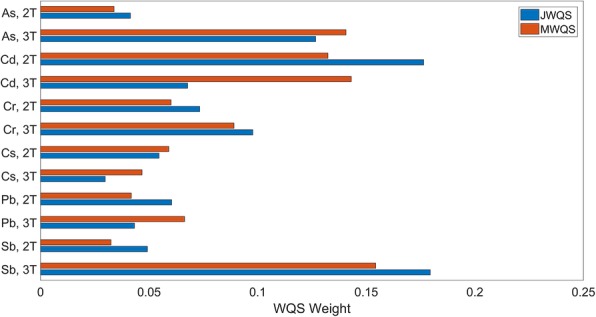
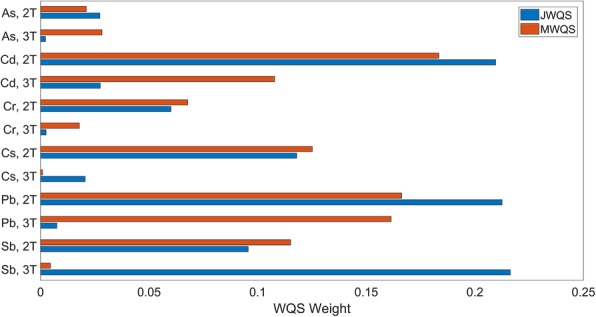
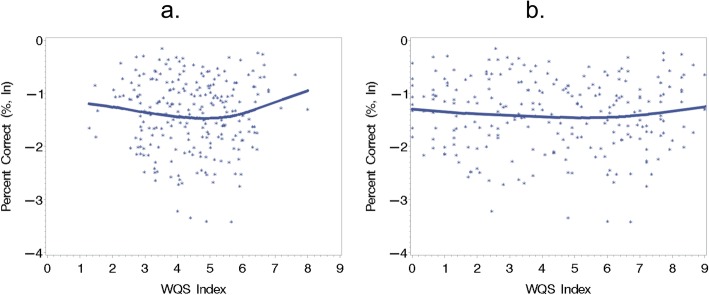
In simulations, JWQS and MWQS had over 80% accuracy in classifying exposures as either strongly or weakly contributing to an association. In real data, both JWQS and MWQS consistently found that Pb and Cd exposure jointly predicted longer latency in the RVP and that second trimester exposure better predicted the results than the third trimester. Additionally, both JWQS and MWQS highlighted the strong association Cd and Sb had with lower accuracy in the RVP and that third trimester exposure was a better predictor than second trimester exposure.
Our results indicate that metal mixtures effects vary across time, have distinct critical windows and that both JWQS and MWQS can determine longitudinal mixture effects including the cumulative contribution of each exposure and critical windows of effect.
人类在其一生中会接触到多种化学物质,这一概念有时被称为“暴露组”。混合物可能有类似于单一物质的时间“敏感窗口”,多次测量它们可能有助于定义这些窗口。评估化学混合物影响的常用方法侧重于单个时间点的影响。我们的目标是扩展这些先前的技术,并研究金属混合物对儿童随后神经行为的时变敏感窗口。
我们提出了两种方法,联合加权分位数总和回归(JWQS)和荟萃加权分位数总和回归(MWQS),以估计跨多个时间点测量的化学混合物的影响,同时提供有关其暴露敏感窗口的数据。我们使用模拟来比较这两种方法的性能。我们还应用这两种技术来评估第二和第三个三个月金属混合物对快速视觉处理(RVP)任务的影响,该任务来自剑桥神经心理测试自动化电池(CANTAB),在参与 PROGRESS(肥胖、生长、环境和社会压力因素的编程研究)纵向队列研究的儿童 6-9 岁时进行评估。选择砷、镉(Cd)、铯、铬、铅(Pb)和锑(Sb)这几种金属是基于它们的毒理学特征。
在模拟中,JWQS 和 MWQS 对暴露的分类准确率超过 80%,要么是强相关,要么是弱相关。在真实数据中,JWQS 和 MWQS 都发现 Pb 和 Cd 暴露共同预测了 RVP 的潜伏期延长,且第二个三个月的暴露比第三个三个月的暴露更能预测结果。此外,JWQS 和 MWQS 都突出了 Cd 和 Sb 与 RVP 较低准确性之间的强烈关联,以及第三个三个月的暴露比第二个三个月的暴露更能预测结果。
我们的结果表明,金属混合物的影响随时间变化,具有不同的敏感窗口,JWQS 和 MWQS 都可以确定纵向混合物的影响,包括每个暴露的累积贡献和影响的敏感窗口。