Lin Jia-Liang, Wu Yu-Hao, Shi Yi-Feng, Lin Hao, Nisar Majid, Meftah Zaher, Xu Cong, Chen Jiao-Xiang, Wang Xiang-Yang
Department of Orthopaedics, Key Laboratory of Orthopaedics of Zhejiang Province, The Second Affiliated Hospital and Yuying Children's Hospital of Wenzhou Medical University, 109# Xueyuan Road, Wenzhou, Zhejiang, 325027, PR China.
The Second School of Medicine, Wenzhou Medical University, Wenzhou, Zhejiang Province, 325027, PR China.
J Bone Oncol. 2019 Sep 11;19:100260. doi: 10.1016/j.jbo.2019.100260. eCollection 2019 Dec.
Malignant giant cell tumor of bone (MGCTB) is extremely rare. Currently, population-based prognosis studies are lacking. This study aimed to determine the impact of demographics, tumor characteristics, and treatment on prognosis among patients with MGCTB.
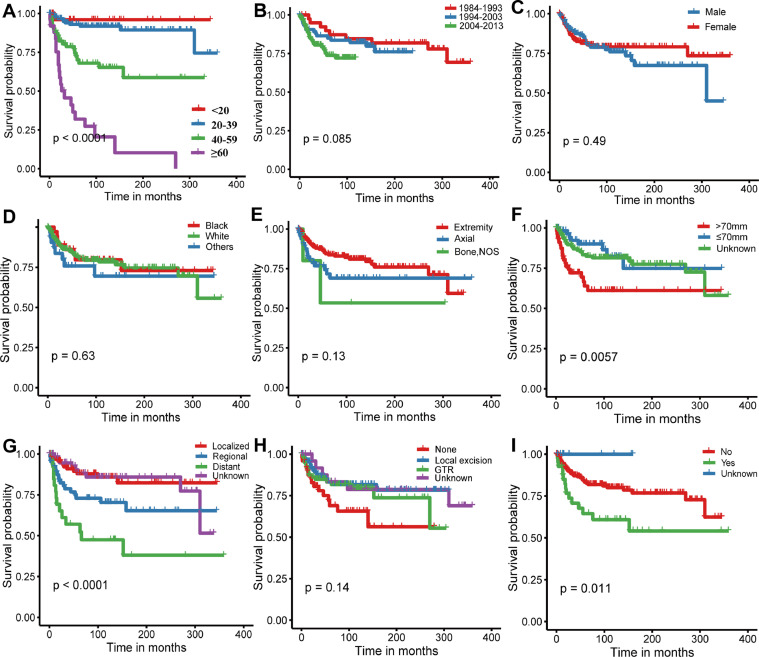
The Surveillance, Epidemiology, and End Results database was used to identify patients with MGCTB from 1984 to 2013. Kaplan-Meier analyses were performed to determine the overall survival (OS). Univariable and multivariable Cox analyses were conducted to identify prognostic factors.
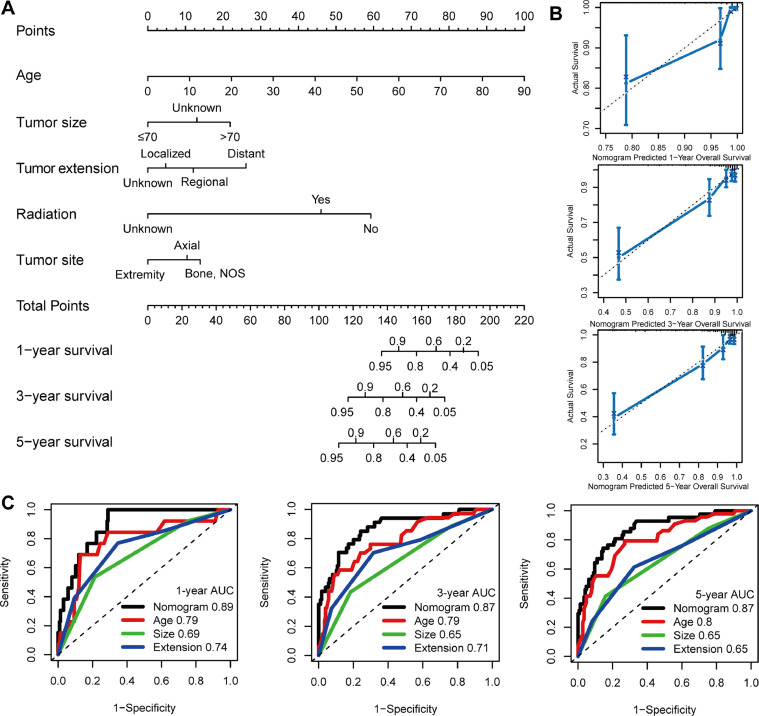
There were 250 patients with MGCTB included in our study. The multivariate Cox analysis revealed that age at diagnosis (hazard ratio [HR]: 1.09; 95% confidence interval [CI]: 1.07-1.11; < 0.001), tumor size (HR: 7.04; 95% CI: 2.38-20.77; < 0.001), tumor extension (regional vs. localized, HR: 2.64; 95% CI: 1.10-6.34; = 0.030; distant vs. localized, HR: 6.12; 95% CI: 2.27-16.49; < 0.001), and radiotherapy (HR: 0.41; 95% CI: 0.18-0.89; = 0.025) were independent risk factors of OS in patients with MGCTB. Notably, tumor site (HR: 1.98; 95% CI: 0.99-4.00; = 0.055) exhibited borderline significance. Additionally, we found that patients with tumors measuring >70 mm ( = 0.015), located in the axial skeleton ( < 0.001) and presented with distant metastasis ( < 0.001) tended to receive radiotherapy. Moreover, a nomogram model integrating independent predictors was established to estimate the OS of patients with MGCTB.
This study provides a population-based assessment of the largest number of patients with MGCTB. We found that older age, larger tumor size, regional or distant metastasis, and lack of radiotherapy was associated with poor OS. Surgical methods were not significantly associated with OS. Furthermore, we built a high-quality nomogram to predict 1-, 3-, and 5-year OS for patients with MGCTB. These findings may assist in the clinical diagnosis and treatment of MGCTB.
骨恶性巨细胞瘤(MGCTB)极为罕见。目前,缺乏基于人群的预后研究。本研究旨在确定人口统计学、肿瘤特征和治疗对MGCTB患者预后的影响。
利用监测、流行病学和最终结果数据库识别1984年至2013年期间的MGCTB患者。进行Kaplan-Meier分析以确定总生存期(OS)。进行单变量和多变量Cox分析以确定预后因素。
我们的研究纳入了250例MGCTB患者。多变量Cox分析显示,诊断时年龄(风险比[HR]:1.09;95%置信区间[CI]:1.07 - 1.11;<0.001)、肿瘤大小(HR:7.04;95%CI:2.38 - 20.77;<0.001)、肿瘤扩展(区域 vs. 局限,HR:2.64;95%CI:1.10 - 6.34;=0.030;远处 vs. 局限,HR:6.12;95%CI:2.27 - 16.49;<0.001)和放疗(HR:0.41;95%CI:0.18 - 0.89;=0.025)是MGCTB患者OS的独立危险因素。值得注意的是,肿瘤部位(HR:1.98;95%CI:0.99 - 4.00;=0.055)显示出临界显著性。此外,我们发现肿瘤大小>70mm(=0.015)、位于中轴骨骼(<0.001)且出现远处转移(<0.001)的患者倾向于接受放疗。此外,建立了一个整合独立预测因子的列线图模型来估计MGCTB患者的OS。
本研究提供了基于人群的最大规模MGCTB患者评估。我们发现年龄较大、肿瘤较大、区域或远处转移以及未接受放疗与较差的OS相关。手术方式与OS无显著关联。此外,我们构建了一个高质量列线图来预测MGCTB患者1年、3年和5年的OS。这些发现可能有助于MGCTB的临床诊断和治疗。