1Molecular Psychology, Institute for Psychology and Education, Ulm University, Ulm, Germany.
2neuSCAN Laboratory, The Clinical Hospital of the Chengdu Brain Science Institute and Key Laboratory for Neuroinformation, University of Electronic Science and Technology of China, Chengdu, China.
J Behav Addict. 2021 Jan 15;9(4):908-914. doi: 10.1556/2006.8.2019.59.
The present theoretical paper introduces the smartphone technology as a challenge for diagnostics in the study of Internet use disorders and reflects on the term "smartphone addiction."
Such a reflection is carried out against the background of a literature review and the inclusion of Gaming Disorder in ICD-11.
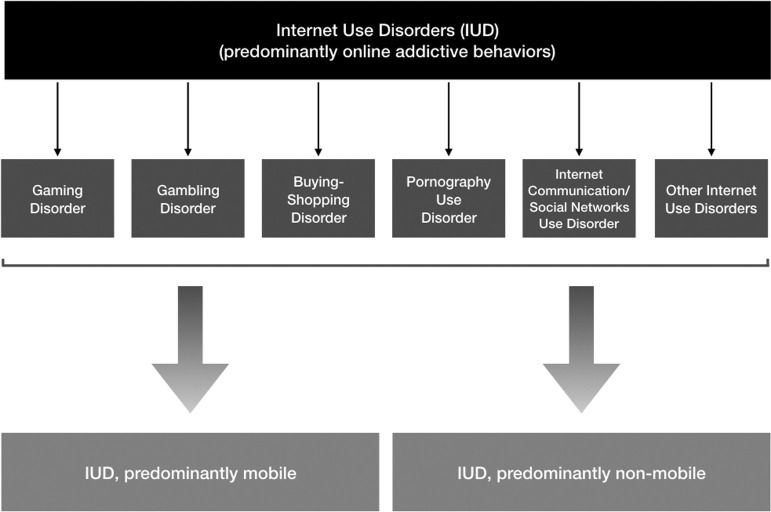
We believe that it is necessary to divide research on Internet use disorder (IUD) into a mobile and non-mobile IUD branch. This is important because certain applications such as the messenger application WhatsApp have originally been developed for smartphones and enfold their power and attractiveness mainly on mobile devices.
Going beyond the argumentation for distinguishing between mobile and non-mobile IUD, it is of high relevance for scientists to better describe and understand what persons are actually (over-)using. This is stressed by a number of examples, explicitly targeting not only the diverse contents used in the online world, but also the exact behavior on each platform. Among others, it matters if a person is more of an active producer of content or passive consumer of social media.
本理论论文将智能手机技术引入互联网使用障碍研究中的诊断挑战,并对“智能手机成瘾”一词进行反思。
这种反思是在文献回顾的背景下进行的,并纳入了 ICD-11 中的游戏障碍。
我们认为有必要将互联网使用障碍(IUD)的研究分为移动和非移动 IUD 分支。这很重要,因为某些应用程序,如信使应用程序 WhatsApp,最初是为智能手机开发的,并且主要在移动设备上发挥其功能和吸引力。
除了对区分移动和非移动 IUD 的论证之外,科学家们更准确地描述和理解人们实际上(过度)使用什么的问题非常重要。这通过一些例子得到了强调,这些例子明确针对的不仅是在线世界中使用的各种内容,还有每个平台上的具体行为。例如,如果一个人更多地是内容的积极生产者还是社交媒体的被动消费者,这很重要。