Department of Microbiology and Immunology, Drexel University College of Medicine, Philadelphia, PA 19129, USA; Center for Molecular Virology and Translational Neuroscience, Institute for Molecular Medicine and Infectious Disease, Drexel University College of Medicine, Philadelphia, PA 19129, USA.
Department of Microbiology and Immunology, Drexel University College of Medicine, Philadelphia, PA 19129, USA; Center for Molecular Virology and Translational Neuroscience, Institute for Molecular Medicine and Infectious Disease, Drexel University College of Medicine, Philadelphia, PA 19129, USA; Sidney Kimmel Cancer Center, Thomas Jefferson University, Philadelphia, PA 19107, USA.
Mol Ther. 2020 Jan 8;28(1):19-28. doi: 10.1016/j.ymthe.2019.10.008. Epub 2019 Oct 15.
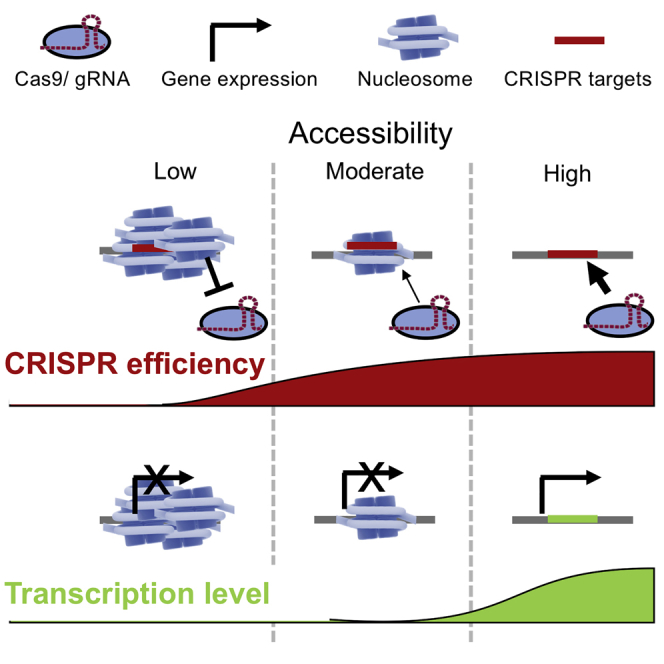
Defining the variables that impact the specificity of CRISPR/Cas9 has been a major research focus. Whereas sequence complementarity between guide RNA and target DNA substantially dictates cleavage efficiency, DNA accessibility of the targeted loci has also been hypothesized to be an important factor. In this study, functional data from two genome-wide assays, genome-wide, unbiased identification of DSBs enabled by sequencing (GUIDE-seq) and circularization for in vitro reporting of cleavage effects by sequencing (CIRCLE-seq), have been computationally analyzed in conjunction with DNA accessibility determined via DNase I-hypersensitive sequencing from the Encyclopedia of DNA Elements (ENCODE) Database and transcriptome from the Sequence Read Archive to determine whether cellular factors influence CRISPR-induced cleavage efficiency. CIRCLE-seq and GUIDE-seq datasets were selected to represent the absence and presence of cellular factors, respectively. Data analysis revealed that correlations between sequence similarity and CRISPR-induced cleavage frequency were altered by the presence of cellular factors that modulated the level of DNA accessibility. The above-mentioned correlation was abolished when cleavage sites were located in less accessible regions. Furthermore, CRISPR-mediated edits were permissive even at regions that were insufficient for most endogenous genes to be expressed. These results provide a strong basis to dissect the contribution of local chromatin modulation markers on CRISPR-induced cleavage efficiency.
定义影响 CRISPR/Cas9 特异性的变量一直是一个主要的研究重点。虽然指导 RNA 与目标 DNA 之间的序列互补性在很大程度上决定了切割效率,但靶向靶位的 DNA 可及性也被假设为一个重要因素。在这项研究中,通过测序实现的全基因组范围内无偏鉴定 DSB 的全基因组、无偏鉴定(GUIDE-seq)和用于测序报告体外切割效应的环化(CIRCLE-seq)这两个全基因组检测的功能数据,与通过 DNA 酶 I 超敏测序从 DNA 元件百科全书(ENCODE)数据库和序列读取档案确定的 DNA 可及性以及转录组进行了计算分析,以确定细胞因子是否影响 CRISPR 诱导的切割效率。CIRCLE-seq 和 GUIDE-seq 数据集分别被选择来代表细胞因子的存在和不存在。数据分析表明,序列相似性与 CRISPR 诱导的切割频率之间的相关性被调节 DNA 可及性水平的细胞因子改变。当切割位点位于可及性较低的区域时,上述相关性被消除。此外,即使在大多数内源性基因表达不足的区域,CRISPR 介导的编辑也是允许的。这些结果为剖析局部染色质调节标记物对 CRISPR 诱导的切割效率的贡献提供了强有力的依据。