Department of Public Health, Amsterdam Public Health Research Institute, Amsterdam UMC, University of Amsterdam, Amsterdam, the Netherlands.
Department of Clinical Genetics, Amsterdam UMC, University of Amsterdam, Amsterdam, the Netherlands.
J Glob Health. 2019 Dec;9(2):020426. doi: 10.7189/jogh.09.020426.
Exposure to adverse conditions earlier in life-course can predispose to type 2 diabetes in adulthood, irrespective of body mass index (BMI). However, the burden of type 2 diabetes in lean Africans is not well understood despite higher exposure to adverse early life conditions. Mirroring ongoing epidemiological transition, we assessed the burden and determinants of type 2 diabetes in a homogenous group of lean Ghanaians residing in rural and urban Ghana, and as migrants in Europe.
Baseline data from 2179 RODAM study participants with BMI<25kg/m (25-70 years) were analyzed. Prevalence and determinants of type 2 diabetes were estimated using logistic regression analysis. Adjustments were made for socio-demographic and lifestyle factors, use of anti-diabetic medication and optimal blood glucose control.
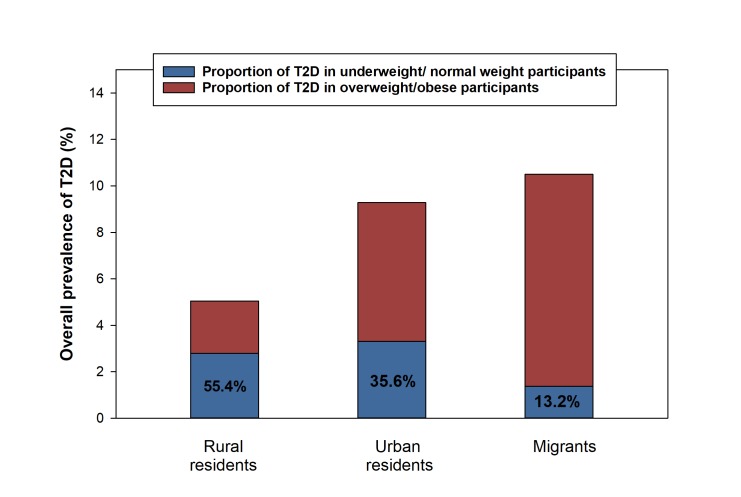
Prevalence of type 2 diabetes in rural, urban and migrant lean participants were 3.5%, 8.9% and 7.5% respectively, representing 55.4%, 35.6%, 13.2% of all participants with type 2 diabetes. Compared with lean rural participants, the odds of type 2 diabetes were higher in lean urban participants (adjusted OR = 8.81, 95% CI = 6.56-11.06), followed by migrants (5.27, 95% CI = 3.51-6.91). Irrespective of site, determinants of type 2 diabetes in lean participants include; presence of hypertension, physical inactivity, hypercholesterolemia and age (>45 years).
Our study shows a high prevalence of type 2 diabetes among lean African populations in different geographical settings. Future studies are needed in-order to examine how contextual differences are related to the pathophysiology of type 2 diabetes in lean individuals.
生命早期接触不良环境会增加成年后患 2 型糖尿病的风险,而不论体重指数(BMI)如何。然而,尽管瘦非洲人面临更高的不良早期生活条件暴露风险,但他们患 2 型糖尿病的负担却并不清楚。与正在进行的流行病学转变相呼应,我们评估了居住在加纳农村和城市以及作为移民在欧洲的同质瘦加纳人群中 2 型糖尿病的负担和决定因素。
对 2179 名 RODAM 研究参与者的基线数据进行了分析,这些参与者的 BMI<25kg/m(25-70 岁)。使用逻辑回归分析估计 2 型糖尿病的患病率和决定因素。调整了社会人口统计学和生活方式因素、抗糖尿病药物的使用以及最佳血糖控制。
农村、城市和移民瘦参与者中 2 型糖尿病的患病率分别为 3.5%、8.9%和 7.5%,分别占所有 2 型糖尿病参与者的 55.4%、35.6%和 13.2%。与农村瘦参与者相比,城市瘦参与者患 2 型糖尿病的几率更高(调整后的 OR=8.81,95%CI=6.56-11.06),其次是移民(5.27,95%CI=3.51-6.91)。无论地点如何,瘦参与者中 2 型糖尿病的决定因素包括;高血压、身体活动不足、高胆固醇血症和年龄(>45 岁)。
我们的研究表明,不同地理环境中的瘦非洲人群中 2 型糖尿病的患病率较高。需要进一步研究以检验环境差异与瘦个体 2 型糖尿病的病理生理学之间的关系。