Faculty of Medicine, Department of Circulation and Medical Imaging, NTNU, Norwegian University of Science and Technology, Trondheim, Norway.
Cardiology, St Olav University Hospital, Trondheim, Norway.
Open Heart. 2019 Sep 26;6(2):e001050. doi: 10.1136/openhrt-2019-001050. eCollection 2019.
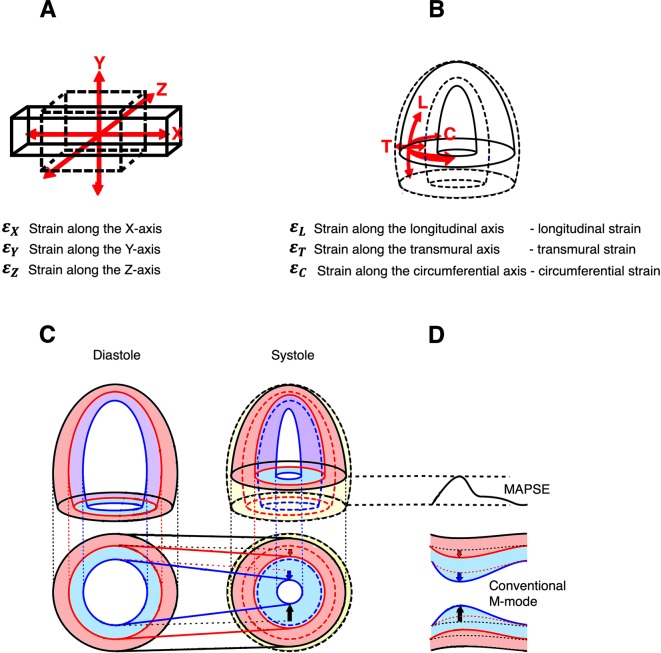
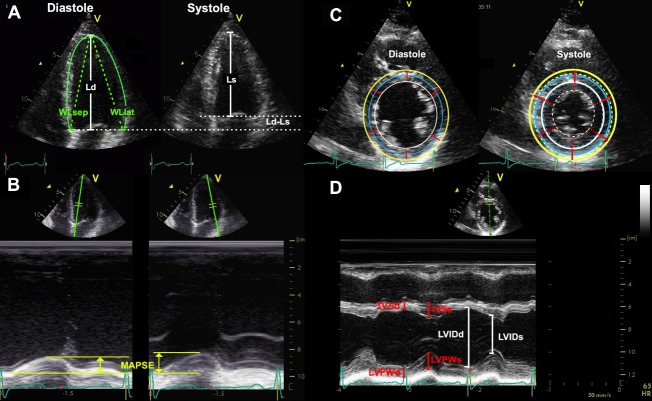
Strain is a relative deformation and has three dimensions, in the left ventricle (LV) usually longitudinal (ε), transmural (ε) and circumferential (ε) strain. All three components can be measured generically by the basic systolic and diastolic dimension measures of LV wall length, wall thickness and diameter. In this observational study we aimed to study the relations of normal generic strains to age, body size and gender, as well as the interrelations between the three strain components.
Generic strains derived from dimension measures by longitudinal and cross-sectional M-mode in all three dimensions were measured in 1266 individuals without heart disease from the Nord-Trøndelag Health Study.
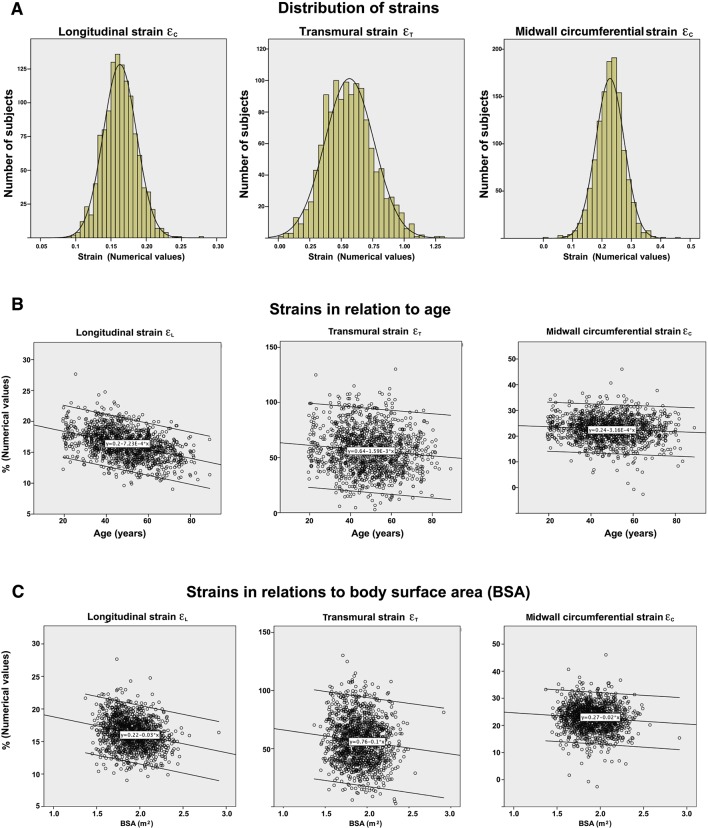
The mean ε was -16.3%, ε was -22.7% and ε was 56.5%. Normal values by age and gender are provided. There was a gradient of ε from the endocardial, via the midwall to the external level, lowest at the external. All strains decreased in absolute values by increasing body surface area (BSA) and age, relations were strongest for ε. Gender differences were mainly a function of BSA differences. The three strain components were strongly interrelated through myocardial incompressibility.
Global systolic strain is the total deformation of the myocardium; the three strain components are the spatial coordinates of this deformation, irrespective of the technology used for measurement. Normal values are method-dependent and not normative across methods. Interrelation of strains indicates a high degree of myocardial incompressibility and that longitudinal strain carries most of the total information.
应变是一种相对变形,具有三个维度,在左心室(LV)中通常为纵向(ε)、贯穿(ε)和周向(ε)应变。所有三个分量都可以通过 LV 壁长、壁厚和直径的基本收缩和舒张尺寸测量来通用地测量。在这项观察性研究中,我们旨在研究正常通用应变与年龄、体型和性别之间的关系,以及三个应变分量之间的相互关系。
通过纵向和横向 M 型在所有三个维度上从尺寸测量中得出的通用应变由来自 Nord-Trøndelag 健康研究的 1266 名无心脏病个体测量。
平均ε为-16.3%,ε为-22.7%,ε为 56.5%。提供了按年龄和性别划分的正常值。ε从心内膜逐渐减少,穿过中壁到达外膜水平,外膜水平最低。所有应变绝对值随体表面积(BSA)和年龄的增加而减小,与ε的关系最强。性别差异主要是 BSA 差异的函数。三个应变分量通过心肌不可压缩性紧密相关。
整体收缩期应变是心肌的总变形;三个应变分量是这种变形的空间坐标,与所使用的测量技术无关。正常值取决于方法,而不是跨方法的规范。应变的相互关系表明心肌具有很高的不可压缩性,并且纵向应变包含了大部分总信息。