• 文献检索
  • 文档翻译
  • 深度研究
  • 学术资讯
  • Suppr Zotero 插件Zotero 插件
  • 邀请有礼
  • 套餐&价格
  • 历史记录
应用&插件
Suppr Zotero 插件Zotero 插件浏览器插件Mac 客户端Windows 客户端微信小程序
定价
高级版会员购买积分包购买API积分包
服务
文献检索文档翻译深度研究API 文档MCP 服务
关于我们
关于 Suppr公司介绍联系我们用户协议隐私条款
关注我们

Suppr 超能文献

核心技术专利:CN118964589B侵权必究
粤ICP备2023148730 号-1Suppr @ 2026

文献检索

告别复杂PubMed语法,用中文像聊天一样搜索,搜遍4000万医学文献。AI智能推荐,让科研检索更轻松。

立即免费搜索

文件翻译

保留排版,准确专业,支持PDF/Word/PPT等文件格式,支持 12+语言互译。

免费翻译文档

深度研究

AI帮你快速写综述,25分钟生成高质量综述,智能提取关键信息,辅助科研写作。

立即免费体验

应用生态位模型预测塞内加尔致倦库蚊的分布,致倦库蚊是蓝舌病毒的潜在传播媒介。

Ecological niche modelling to estimate the distribution of Culicoides, potential vectors of bluetongue virus in Senegal.

机构信息

Institut Sénégalais de Recherches Agricoles/Laboratoire National de l'Elevage et de Recherches Vétérinaires, BP 2057, Dakar-Hann, Senegal.

Laboratoire d'Ecologie Vectorielle et Parasitaire, Département de Biologie Animale, Faculté des Sciences et Techniques, Université Cheikh Anta Diop, Dakar, Senegal.

出版信息

BMC Ecol. 2019 Nov 1;19(1):45. doi: 10.1186/s12898-019-0261-9.

DOI:10.1186/s12898-019-0261-9
PMID:31676006
原文链接:https://pmc.ncbi.nlm.nih.gov/articles/PMC6825335/
Abstract

BACKGROUND

Vector-borne diseases are among the leading causes of morbidity and mortality in humans and animals. In the Afrotropical region, some are transmitted by Culicoides, such as Akabane, bluetongue, epizootic haemorrhagic fever and African horse sickness viruses. Bluetongue virus infection has an enormous impact on ruminant production, due to its high morbidity and mortality rates.

METHODS

A nationwide Culicoides trapping campaign was organized at the end of the 2012 rainy season in Senegal. A Maximum Entropy approach (MaxEnt), Boosted Regression Tree (BRT) method and Ecological Niche Factor Analysis (ENFA) were used to develop a predictive spatial model for the distribution of Culicoides, using bio-climatic variables, livestock densities and altitude.

RESULTS

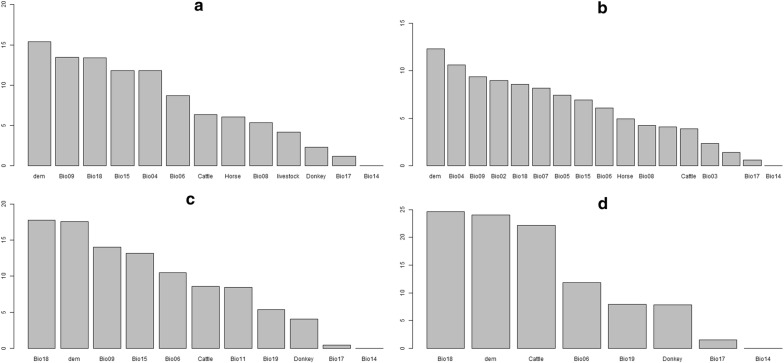
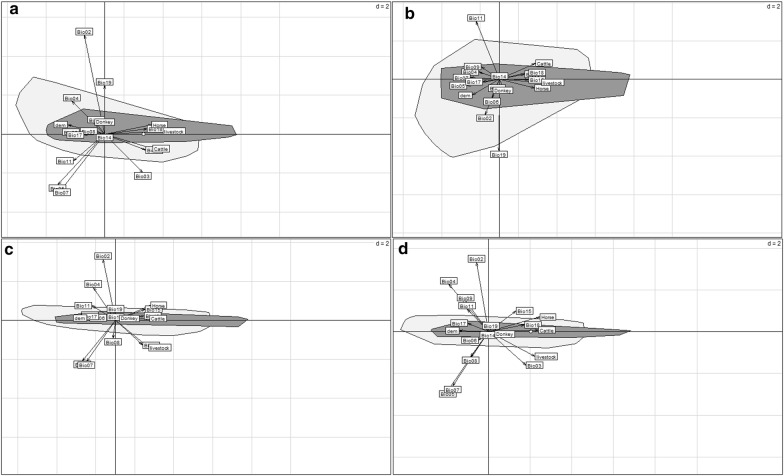
The altitude, maximum temperature of the warmest month, precipitation of the warmest quarter, mean temperature of the wettest quarter, temperature seasonality, precipitation of the wettest quarter and livestock density were among the most important factors to predict suitable habitats of Culicoides. Culicoides occurrences were, in most of the cases, positively correlated to precipitation variables and livestock densities; and negatively correlated to the altitude and temperature indices. The Niayes area and the Groundnut basin were the most suitable habitats predicted.

CONCLUSION

We present ecological niche models for different Culicoides species, namely C. imicola, C. oxystoma, C. enderleini and C. miombo, potential vectors of bluetongue virus, on a nationwide scale in Senegal. Through our modelling approach, we were able to determine the effect of bioclimatic variables on Culicoides habitats and were able to generate maps for the occurrence of Culicoides species. This information will be helpful in developing risk maps for disease outbreaks.

摘要

背景

虫媒传染病是人类和动物发病率和死亡率的主要原因之一。在热带非洲地区,有些疾病是由库蠓传播的,如阿卡斑病毒、蓝舌病、马传染性贫血病毒和非洲马瘟病毒。蓝舌病病毒感染对反刍动物的生产造成了巨大影响,因为其发病率和死亡率都很高。

方法

2012 年雨季结束时,塞内加尔组织了一次全国性的库蠓诱捕活动。采用最大熵法(MaxEnt)、增强回归树(BRT)方法和生态位因子分析(ENFA),利用生物气候变量、牲畜密度和海拔,建立了库蠓分布的预测空间模型。

结果

海拔、最热月最高温度、最暖季度降水量、最湿季度平均温度、温度季节性、最湿季度降水量和牲畜密度是预测库蠓适宜栖息地的最重要因素。库蠓的发生与降水变量和牲畜密度呈正相关,与海拔和温度指数呈负相关。尼耶斯地区和花生盆地是预测最适宜的栖息地。

结论

我们在塞内加尔全国范围内提出了不同库蠓物种(即 C. imicola、C. oxystoma、C. enderleini 和 C. miombo)的生态位模型,这些物种是蓝舌病病毒的潜在传播媒介。通过我们的建模方法,我们能够确定生物气候变量对库蠓栖息地的影响,并能够生成库蠓物种发生的地图。这些信息将有助于开发疾病爆发的风险地图。
https://cdn.ncbi.nlm.nih.gov/pmc/blobs/2962/6825335/0862e4383bf2/12898_2019_261_Fig6_HTML.jpg
https://cdn.ncbi.nlm.nih.gov/pmc/blobs/2962/6825335/606c6860d7ac/12898_2019_261_Fig1_HTML.jpg
https://cdn.ncbi.nlm.nih.gov/pmc/blobs/2962/6825335/7b5989406582/12898_2019_261_Fig2_HTML.jpg
https://cdn.ncbi.nlm.nih.gov/pmc/blobs/2962/6825335/3c59bb3689b5/12898_2019_261_Fig3_HTML.jpg
https://cdn.ncbi.nlm.nih.gov/pmc/blobs/2962/6825335/06dd034177a9/12898_2019_261_Fig4_HTML.jpg
https://cdn.ncbi.nlm.nih.gov/pmc/blobs/2962/6825335/b3fa0628a0c7/12898_2019_261_Fig5_HTML.jpg
https://cdn.ncbi.nlm.nih.gov/pmc/blobs/2962/6825335/0862e4383bf2/12898_2019_261_Fig6_HTML.jpg
https://cdn.ncbi.nlm.nih.gov/pmc/blobs/2962/6825335/606c6860d7ac/12898_2019_261_Fig1_HTML.jpg
https://cdn.ncbi.nlm.nih.gov/pmc/blobs/2962/6825335/7b5989406582/12898_2019_261_Fig2_HTML.jpg
https://cdn.ncbi.nlm.nih.gov/pmc/blobs/2962/6825335/3c59bb3689b5/12898_2019_261_Fig3_HTML.jpg
https://cdn.ncbi.nlm.nih.gov/pmc/blobs/2962/6825335/06dd034177a9/12898_2019_261_Fig4_HTML.jpg
https://cdn.ncbi.nlm.nih.gov/pmc/blobs/2962/6825335/b3fa0628a0c7/12898_2019_261_Fig5_HTML.jpg
https://cdn.ncbi.nlm.nih.gov/pmc/blobs/2962/6825335/0862e4383bf2/12898_2019_261_Fig6_HTML.jpg

相似文献

1
Ecological niche modelling to estimate the distribution of Culicoides, potential vectors of bluetongue virus in Senegal.应用生态位模型预测塞内加尔致倦库蚊的分布,致倦库蚊是蓝舌病毒的潜在传播媒介。
BMC Ecol. 2019 Nov 1;19(1):45. doi: 10.1186/s12898-019-0261-9.
2
Spatial distribution modelling of Culicoides (Diptera: Ceratopogonidae) biting midges, potential vectors of African horse sickness and bluetongue viruses in Senegal.塞内加尔塞氏虻(双翅目:蠓科)吸血蠓,即非洲马瘟和蓝舌病病毒潜在媒介的空间分布模型。
Parasit Vectors. 2018 Jun 8;11(1):341. doi: 10.1186/s13071-018-2920-7.
3
Seasonal dynamics of Culicoides (Diptera: Ceratopogonidae) biting midges, potential vectors of African horse sickness and bluetongue viruses in the Niayes area of Senegal.塞内加尔尼奥耶地区可能传播非洲马瘟和蓝舌病病毒的吸血蠓(双翅目:蠓科)的季节性动态。
Parasit Vectors. 2014 Mar 31;7:147. doi: 10.1186/1756-3305-7-147.
4
Modelling bluetongue and African horse sickness vector (Culicoides spp.) distribution in the Western Cape in South Africa using random forest machine learning.利用随机森林机器学习模型对南非西开普省(Western Cape)的蓝舌病和非洲马瘟媒介(Culicoides spp.)分布进行建模。
Parasit Vectors. 2024 Aug 21;17(1):354. doi: 10.1186/s13071-024-06446-8.
5
Altitudinal variation and bio-climatic variables influencing the potential distribution of Culicoides orientalis Macfie, 1932, suspected vector of Bluetongue virus across the North Eastern Himalayan belt of Sikkim.海拔变化和生物气候变量对东方库蠓(Culicoides orientalis Macfie,1932)潜在分布的影响,东方库蠓被怀疑是锡金喜马拉雅山东北部蓝舌病病毒的传播媒介。
Acta Trop. 2017 Dec;176:402-411. doi: 10.1016/j.actatropica.2017.09.008. Epub 2017 Sep 19.
6
Circadian activity of Culicoides oxystoma (Diptera: Ceratopogonidae), potential vector of bluetongue and African horse sickness viruses in the Niayes area, Senegal.塞内加尔尼亚耶斯地区库蠓(双翅目:蠓科)的昼夜活动,其为蓝舌病和非洲马瘟病毒的潜在传播媒介。
Parasitol Res. 2015 Aug;114(8):3151-8. doi: 10.1007/s00436-015-4534-8. Epub 2015 May 24.
7
Insight on the larval habitat of Afrotropical Culicoides Latreille (Diptera: Ceratopogonidae) in the Niayes area of Senegal, West Africa.对西非塞内加尔尼亚耶斯地区非洲热带库蠓(双翅目:蠓科)幼虫栖息地的洞察。
Parasit Vectors. 2016 Aug 22;9(1):462. doi: 10.1186/s13071-016-1749-1.
8
Host preferences and circadian rhythm of Culicoides (Diptera: Ceratopogonidae), vectors of African horse sickness and bluetongue viruses in Senegal.塞内加尔非洲马瘟和蓝舌病病毒的传播媒介库蠓(双翅目:蠓科)的宿主偏好和昼夜节律
Acta Trop. 2015 Sep;149:239-45. doi: 10.1016/j.actatropica.2015.06.012. Epub 2015 Jun 19.
9
Potential Distribution Map of Culicoides insignis (Diptera: Ceratopogonidae), Vector of Bluetongue Virus, in Northwestern Argentina.阿根廷西北部蓝舌病病毒传播媒介——澳库蠓(双翅目:蠓科)的潜在分布地图
J Insect Sci. 2016 Jul 1;16(1). doi: 10.1093/jisesa/iew028. Print 2016.
10
Potential roles of spp. () as biological vectors of bluetongue virus in Yuanyang of Yunnan, P. R. China.在中国云南省元阳,[物种名称]([具体物种])作为蓝舌病病毒生物传播媒介的潜在作用。
Front Cell Infect Microbiol. 2024 Jan 11;13:1283216. doi: 10.3389/fcimb.2023.1283216. eCollection 2023.

引用本文的文献

1
Bluetongue Risk Map for Vaccination and Surveillance Strategies in India.印度疫苗接种和监测策略的蓝舌病风险地图。
Pathogens. 2024 Jul 16;13(7):590. doi: 10.3390/pathogens13070590.
2
Effects of Climatic Change on Potential Distribution of (Diptera: Bombyliidae) in the Middle East Using Maxent Modelling.利用最大熵模型研究气候变化对中东地区(双翅目:蜂虻科)潜在分布的影响。
Insects. 2023 Jan 24;14(2):120. doi: 10.3390/insects14020120.
3
Role of eco-climatic factors in the distribution of bluetongue in endemic areas in Tunisia.生态气候因素在突尼斯地方性流行区蓝舌病分布中的作用。

本文引用的文献

1
Improving Species Distribution Modelling of freshwater invasive species for management applications.提高淡水入侵物种的物种分布模型,以应用于管理。
PLoS One. 2019 Jun 17;14(6):e0217896. doi: 10.1371/journal.pone.0217896. eCollection 2019.
2
Ecological niche modeling the potential geographic distribution of four Culicoides species of veterinary significance in Florida, USA.生态位模型预测美国佛罗里达州四种具有兽医重要性的库蠓的潜在地理分布。
PLoS One. 2019 Feb 15;14(2):e0206648. doi: 10.1371/journal.pone.0206648. eCollection 2019.
3
Dominant malaria vector species in Nigeria: Modelling potential distribution of Anopheles gambiae sensu lato and its siblings with MaxEnt.
Open Vet J. 2022 Jan-Feb;12(1):114-123. doi: 10.5455/OVJ.2022.v12.i1.14. Epub 2022 Feb 15.
4
Predicting the possibility of African horse sickness (AHS) introduction into China using spatial risk analysis and habitat connectivity of Culicoides.利用空间风险分析和媒介库蠓的生境连通性预测非洲马瘟传入中国的可能性。
Sci Rep. 2022 Mar 10;12(1):3910. doi: 10.1038/s41598-022-07512-w.
5
Spatial distribution and habitat selection of culicoides imicola: The potential vector of bluetongue virus in Tunisia.伊蚊在突尼斯的空间分布和栖息地选择:蓝舌病病毒的潜在载体。
Onderstepoort J Vet Res. 2021 Aug 16;88(1):e1-e9. doi: 10.4102/ojvr.v88i1.1861.
6
Assessing the Risk of Occurrence of Bluetongue in Senegal.评估塞内加尔蓝舌病的发病风险。
Microorganisms. 2020 Nov 11;8(11):1766. doi: 10.3390/microorganisms8111766.
7
Geographic abundance patterns explained by niche centrality hypothesis in two Chagas disease vectors in Latin America.地理丰度模式解释了拉丁美洲两种恰加斯病传播媒介的生态位中心性假说。
PLoS One. 2020 Nov 4;15(11):e0241710. doi: 10.1371/journal.pone.0241710. eCollection 2020.
尼日利亚主要疟疾媒介物种:利用最大熵模型对冈比亚按蚊复合体及其近缘种的潜在分布进行建模。
PLoS One. 2018 Oct 3;13(10):e0204233. doi: 10.1371/journal.pone.0204233. eCollection 2018.
4
Spatial distribution modelling of Culicoides (Diptera: Ceratopogonidae) biting midges, potential vectors of African horse sickness and bluetongue viruses in Senegal.塞内加尔塞氏虻(双翅目:蠓科)吸血蠓,即非洲马瘟和蓝舌病病毒潜在媒介的空间分布模型。
Parasit Vectors. 2018 Jun 8;11(1):341. doi: 10.1186/s13071-018-2920-7.
5
Ecological niche modeling of Aedes mosquito vectors of chikungunya virus in southeastern Senegal.塞内加尔东南部基孔肯雅热病毒病媒伊蚊的生态位建模。
Parasit Vectors. 2018 Apr 19;11(1):255. doi: 10.1186/s13071-018-2832-6.
6
Potential distribution of mosquito vector species in a primary malaria endemic region of Colombia.哥伦比亚一个主要疟疾流行地区蚊媒种类的潜在分布。
PLoS One. 2017 Jun 8;12(6):e0179093. doi: 10.1371/journal.pone.0179093. eCollection 2017.
7
Spatial, seasonal and climatic predictive models of Rift Valley fever disease across Africa.非洲裂谷热疾病的空间、季节和气候预测模型。
Philos Trans R Soc Lond B Biol Sci. 2017 Jul 19;372(1725). doi: 10.1098/rstb.2016.0165.
8
A pilot study to delimit tsetse target populations in Zimbabwe.一项界定津巴布韦采采蝇目标种群的试点研究。
PLoS Negl Trop Dis. 2017 May 3;11(5):e0005566. doi: 10.1371/journal.pntd.0005566. eCollection 2017 May.
9
Mapping the spatial distribution of the Japanese encephalitis vector, Culex tritaeniorhynchus Giles, 1901 (Diptera: Culicidae) within areas of Japanese encephalitis risk.绘制日本脑炎传播媒介三带喙库蚊(Culex tritaeniorhynchus Giles,1901年)(双翅目:蚊科)在日本脑炎风险区域内的空间分布。
Parasit Vectors. 2017 Mar 16;10(1):148. doi: 10.1186/s13071-017-2086-8.
10
Spatial Heterogeneity of Habitat Suitability for Rift Valley Fever Occurrence in Tanzania: An Ecological Niche Modelling Approach.坦桑尼亚裂谷热发生地适宜性的空间异质性:一种生态位建模方法
PLoS Negl Trop Dis. 2016 Sep 21;10(9):e0005002. doi: 10.1371/journal.pntd.0005002. eCollection 2016 Sep.