University of Nebraska Medical Center, Omaha, NE, USA.
Neurorehabil Neural Repair. 2019 Dec;33(12):1018-1028. doi: 10.1177/1545968319883880. Epub 2019 Nov 2.
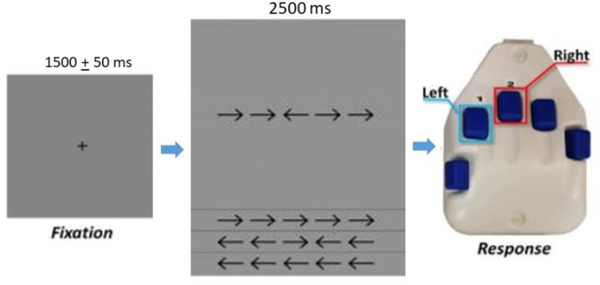
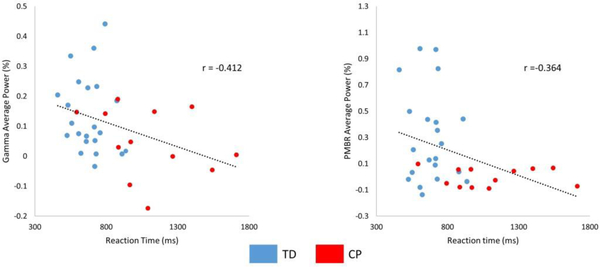
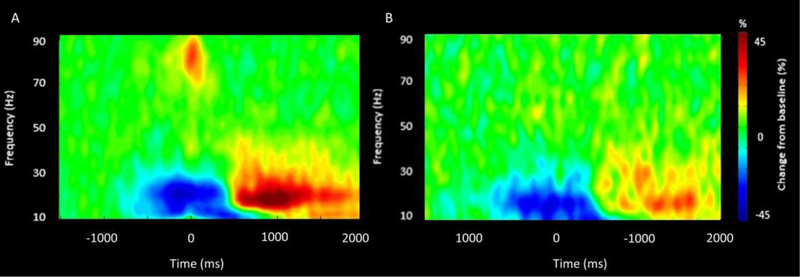
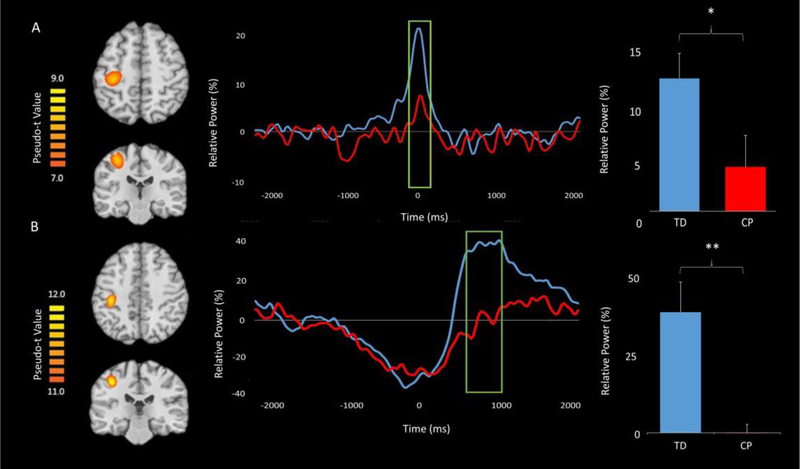
The neuroimaging literature on cerebral palsy (CP) has predominantly focused on identifying the structural aberrations (eg, fiber track integrity), with very few studies examining neural activity within the key networks that serve the production of hand movements. We aimed to start to fill this knowledge gap by using magnetoencephalographic brain imaging to quantify the temporal dynamics of the sensorimotor oscillations during a hand motor action. : Children with CP (n = 12; MACS [Manual Abilities Classification System] levels I-III) and typically developing (TD) children (n = 26) performed an arrow-based version of the Eriksen flanker task where a button press was performed with either the second or third digit of the right hand depending on the arrow's direction. : Overall, the children with CP were less accurate and had slower reaction times compared with the TD children. These behavioral differences were closely linked with aberrant sensorimotor cortical oscillations seen in the children with CP. Compared with the TD children, the children with CP had a weaker gamma (68-82 Hz) response during motor execution and a weaker post-movement beta rebound (PMBR; 14-26 Hz) response on movement termination. Moreover, we observed a significant correlation between the amplitude of the gamma and PMBR with reaction time, with weaker gamma and PMBR responses being linked with slower reaction times. : Overall, these results suggest that aberrations in motor-related gamma and beta cortical oscillations are associated with the impaired hand motor actions seen in children with CP.
脑瘫(CP)的神经影像学文献主要集中在识别结构异常(例如,纤维束完整性)上,很少有研究检查在手运动产生中起关键作用的神经网络内的神经活动。我们旨在通过使用脑磁图(MEG)脑成像来量化手运动动作期间感觉运动振荡的时间动态,从而开始填补这一知识空白。:患有脑瘫的儿童(n = 12;MACS [手动能力分类系统]级别 I-III)和典型发育的儿童(n = 26)执行了基于箭头的 Eriksen 侧翼任务,其中根据箭头的方向,用右手的第二个或第三个手指进行按钮按压。:总体而言,与典型发育的儿童相比,患有脑瘫的儿童准确性较低,反应时间较慢。这些行为差异与脑瘫儿童中观察到的异常感觉运动皮质振荡密切相关。与典型发育的儿童相比,脑瘫儿童在运动执行过程中伽马(68-82 Hz)反应较弱,运动结束时β后反弹(PMBR;14-26 Hz)反应较弱。此外,我们观察到伽马和 PMBR 的振幅与反应时间之间存在显著相关性,伽马和 PMBR 的反应较弱与反应时间较慢有关。:总体而言,这些结果表明,与脑瘫儿童手运动动作受损相关的运动相关伽马和β皮质振荡异常与受损的手运动动作有关。