Miller Kathleen B, Howery Anna J, Rivera-Rivera Leonardo A, Johnson Sterling C, Rowley Howard A, Wieben Oliver, Barnes Jill N
Bruno Balke Biodynamics Laboratory, Department of Kinesiology, University of Wisconsin-Madison, Madison, WI, United States.
Department of Medical Physics, School of Medicine and Public Health, University of Wisconsin-Madison, Madison, WI, United States.
Front Aging Neurosci. 2019 Oct 17;11:281. doi: 10.3389/fnagi.2019.00281. eCollection 2019.
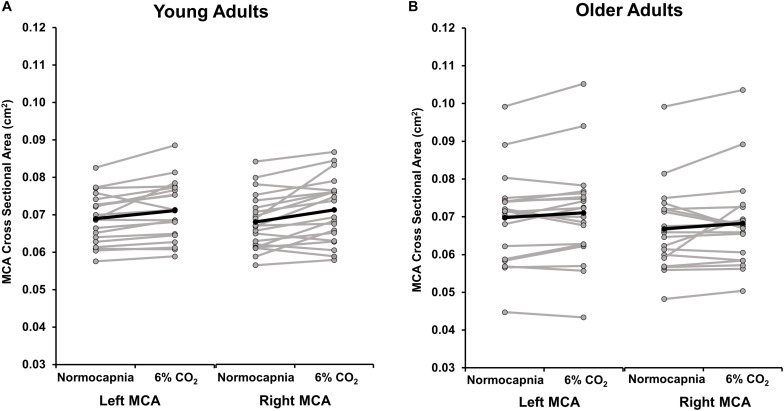
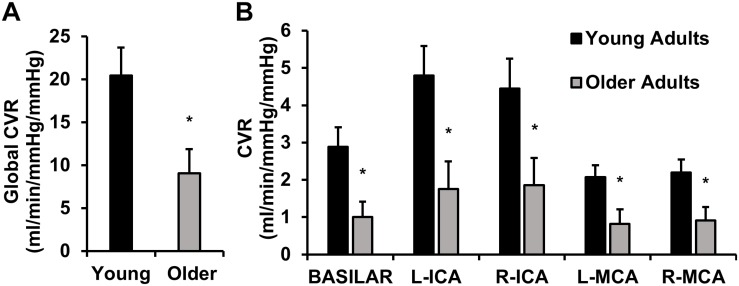
Cerebrovascular reactivity (CVR), is important for determining future risk of cerebrovascular disease. It is unclear if primary aging is associated with reductions in CVR because previous studies often include participants with vascular risk factors. Additionally, the inconsistency in the literature may be due to the inherent difficulty in quantifying intracranial cerebral blood flow and CVR. To address these limitations, we determined the effect of age on CVR in the large intracranial vessels in adults with low vascular risk using state-of-the-art MRI techniques. We also determined if the effect of age on CVR was sex-specific. Young ( = 20; 25 ± 3 years) and older ( = 19; 61 ± 5 years) healthy, physically active adults participated in the study. CVR was measured in response to hypercapnia using 4D flow MRI, which allows for simultaneous angiographic and quantitative blood flow measurements in the intracranial arteries. Older adults had lower global CVR and CVR in multiple intracranial arteries [right and left internal carotid arteries (ICA), right and left middle cerebral arteries (MCA), and basilar artery (BA)] compared with young adults ( < 0.05 for all). In addition, the MCA dilated significantly in response to hypercapnia in young ( < 0.05), but not older adults. Young men demonstrated higher global CVR and CVR in multiple intracranial arteries (ICAs, MCAs, and BA) compared with young women and older men ( < 0.05 for both); however, CVR did not differ between young women and older women. Our results demonstrate that, using 4D flow MRI, primary aging is associated with lower CVR in adults with low vascular risk. In addition, the effect of age on CVR may be driven by men. The 4D flow MRI technique may provide a promising new alternative to measure cerebrovascular physiology without the limitations of commonly used techniques. Future studies could utilize this MRI technique to examine interventions to maintain CVR with advancing age. This study was registered under clinicaltrials.gov # NCT02840851.
脑血管反应性(CVR)对于确定未来脑血管疾病风险至关重要。目前尚不清楚原发性衰老是否与CVR降低有关,因为先前的研究通常纳入了有血管危险因素的参与者。此外,文献中的不一致性可能是由于量化颅内脑血流和CVR存在内在困难。为了解决这些局限性,我们使用最先进的MRI技术确定了年龄对低血管风险成年人颅内大血管CVR的影响。我们还确定了年龄对CVR的影响是否存在性别差异。年轻(n = 20;25±3岁)和年长(n = 19;61±5岁)的健康、身体活跃的成年人参与了该研究。使用4D血流MRI测量对高碳酸血症的CVR,该技术可同时进行颅内动脉的血管造影和定量血流测量。与年轻成年人相比,年长成年人的整体CVR以及多条颅内动脉[左右颈内动脉(ICA)、左右大脑中动脉(MCA)和基底动脉(BA)]的CVR较低(均P < 0.05)。此外,年轻成年人的MCA对高碳酸血症有显著扩张反应(P < 0.05),而年长成年人则无。与年轻女性和年长男性相比,年轻男性在多条颅内动脉(ICA、MCA和BA)中的整体CVR和CVR更高(均P < 0.05);然而,年轻女性和年长女性之间的CVR没有差异。我们的结果表明,使用4D血流MRI,原发性衰老与低血管风险成年人的CVR降低有关。此外,年龄对CVR的影响可能由男性驱动。4D血流MRI技术可能为测量脑血管生理学提供一种有前景的新方法,而没有常用技术的局限性。未来的研究可以利用这种MRI技术来研究随着年龄增长维持CVR的干预措施。本研究已在clinicaltrials.gov上注册,编号为# NCT02840851。