Burley Claire V, Francis Susan T, Thomas Kate N, Whittaker Anna C, Lucas Samuel J E, Mullinger Karen J
School of Sport, Exercise and Rehabilitation Sciences, University of Birmingham, Birmingham, United Kingdom.
Centre for Human Brain Health, University of Birmingham, Birmingham, United Kingdom.
Front Physiol. 2021 Apr 12;12:656746. doi: 10.3389/fphys.2021.656746. eCollection 2021.
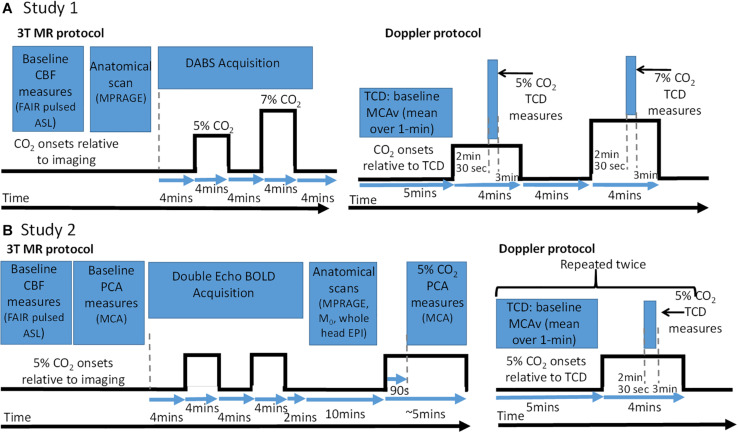
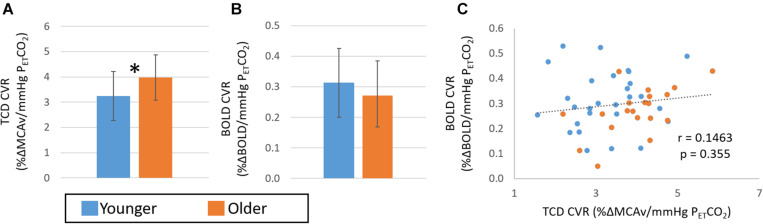
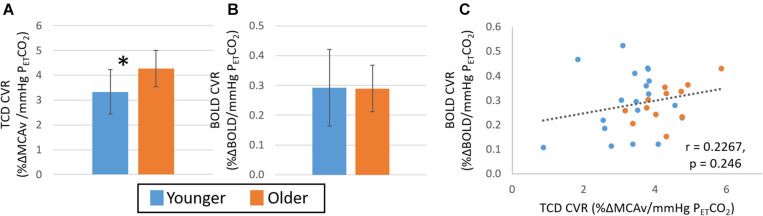
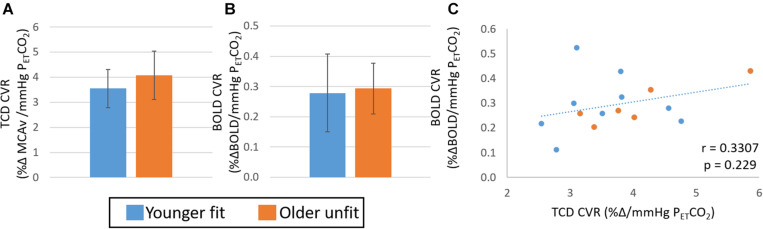
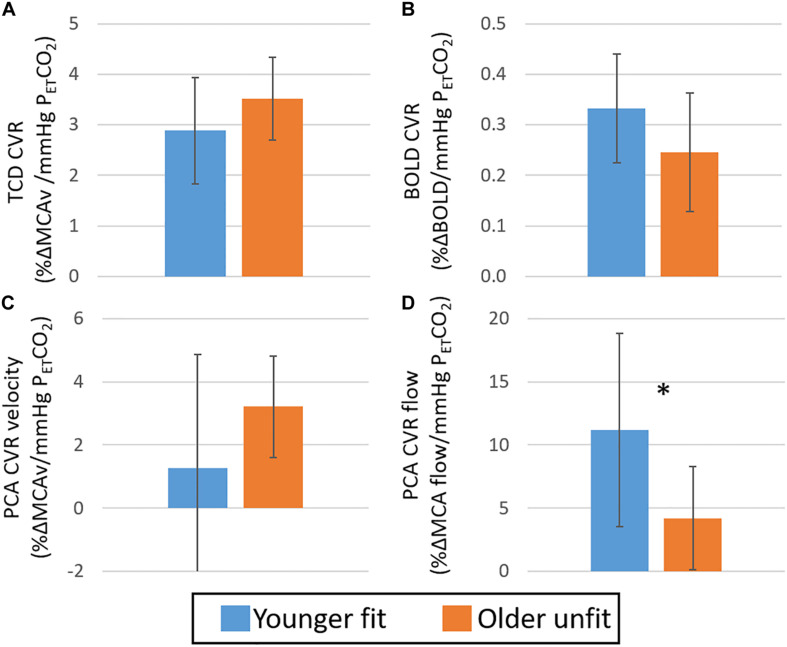
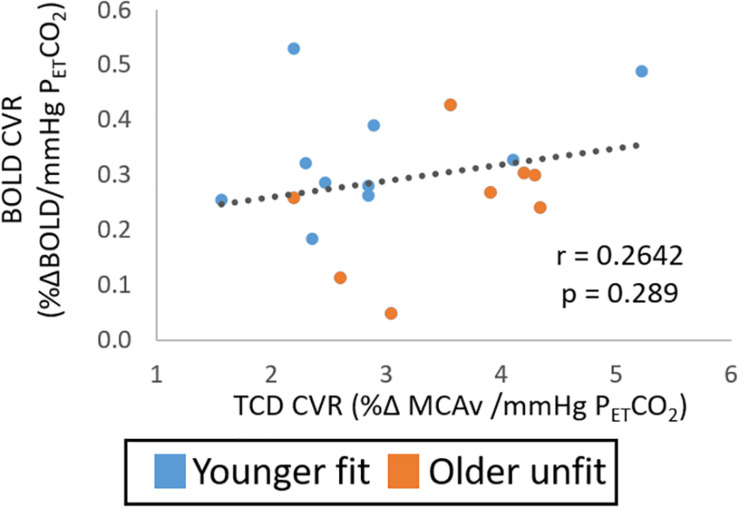
Cerebrovascular reactivity (CVR) is used as an outcome measure of brain health. Traditionally, lower CVR is associated with ageing, poor fitness and brain-related conditions (e.g. stroke, dementia). Indeed, CVR is suggested as a biomarker for disease risk. However, recent findings report conflicting associations between ageing or fitness and CVR measures. Inconsistent findings may relate to different neuroimaging modalities used, which include transcranial Doppler (TCD) and blood-oxygen-level-dependant (BOLD) contrast magnetic resonance imaging (MRI). We assessed the relationship between CVR metrics derived from two common imaging modalities, TCD and BOLD MRI, within the same individuals and with expected significant differences (i.e., younger vs. older) to maximise the expected spread in measures. We conducted two serial studies using TCD- and MRI-derived measures of CVR (via inspired 5% CO in air). Study 1 compared 20 younger (24 ± 7 years) with 15 older (66 ± 7 years) participants, Study 2 compared 10 younger (22 ± 2 years) with 10 older (72 ± 4 years) participants. Combining the main measures across studies, no significant correlation ( = 0.15, = 0.36) was observed between individual participant TCD- and BOLD-CVR measures. Further, these measures showed differential effects between age groups; with TCD-CVR higher in the older compared to younger group (4 ± 1 vs. 3 ± 1 %MCAv/mmHg P CO; < 0.05, = 0.75), whereas BOLD-CVR showed no difference ( = 0.104, = 0.38). In Study 2 additional measures were obtained to understand the origin of the discrepancy: phase contrast angiography (PCA) MRI of the middle cerebral artery, showed a significantly lower blood flow (but not velocity) CVR response in older compared with younger participants ( > 0.05, = 1.08). The PCA CVR metrics did not significantly correlate with the BOLD- or TCD-CVR measures. The differing CVR observations between imaging modalities were despite expected, correlated ( = 0.62-0.82), age-related differences in resting CBF measures across modalities. Taken together, findings across both studies show no clear relationship between TCD- and BOLD-CVR measures. We hypothesize that CVR differences between imaging modalities are in part due to the aspects of the vascular tree that are assessed (TCD:arteries; BOLD:venules/veins). Further work is needed to understand the between-modality CVR response differences, but caution is needed when comparing CVR metrics derived from different imaging modalities.
脑血管反应性(CVR)被用作衡量大脑健康的一项指标。传统上,较低的CVR与衰老、身体不健康以及大脑相关疾病(如中风、痴呆)有关。事实上,CVR被认为是疾病风险的一个生物标志物。然而,最近的研究结果报告了衰老或身体状况与CVR测量值之间相互矛盾的关联。研究结果不一致可能与所使用的不同神经成像方式有关,这些方式包括经颅多普勒(TCD)和血氧水平依赖(BOLD)对比磁共振成像(MRI)。我们评估了来自两种常见成像方式TCD和BOLD MRI的CVR指标在同一人群中的关系,以及与预期的显著差异(即年轻人与老年人)之间的关系,以最大限度地扩大测量值的预期范围。我们进行了两项系列研究,使用TCD和MRI得出的CVR测量值(通过吸入空气中5%的一氧化碳)。研究1比较了20名年轻参与者(24±7岁)和15名年长参与者(66±7岁),研究2比较了10名年轻参与者(22±2岁)和10名年长参与者(72±4岁)。综合两项研究的主要测量结果,未观察到个体参与者的TCD和BOLD - CVR测量值之间存在显著相关性(r = 0.15,p = 0.36)。此外,这些测量值在不同年龄组之间显示出不同的影响;与年轻组相比,年长组的TCD - CVR更高(4±1 vs. 3±1 %MCAv/mmHg PCO;p < 0.05,r = 0.75),而BOLD - CVR没有差异(p = 0.104,r = 0.38)。在研究2中,还获取了额外的测量值以了解差异的来源:大脑中动脉的相位对比血管造影(PCA)MRI显示,与年轻参与者相比,年长参与者的血流(但不是速度)CVR反应显著更低(p > 0.05,r = 1.08)。PCA CVR指标与BOLD或TCD - CVR测量值没有显著相关性。尽管跨模态静息脑血流量测量值存在预期的、相关的(r = 0.62 - 0.82)、与年龄相关的差异,但不同成像方式之间的CVR观察结果仍存在差异。综合来看,两项研究的结果均表明TCD和BOLD - CVR测量值之间没有明确的关系。我们推测成像方式之间的CVR差异部分是由于所评估的血管树的不同方面(TCD:动脉;BOLD:小静脉/静脉)。需要进一步开展工作来理解不同模态之间的CVR反应差异,但在比较来自不同成像方式的CVR指标时需要谨慎。