Shi Da, Wang Xiaobo, Shi Hongyan, Zhang Jiyu, Han Yuru, Chen Jianfei, Zhang Xin, Liu Jianbo, Zhang Jialin, Ji Zhaoyang, Jing Zhaoyang, Feng Li
State Key Laboratory of Veterinary Biotechnology, Harbin Veterinary Research Institute, Chinese Academy of Agricultural Sciences, Xiangfang District, Haping Road 678, Harbin 150069, China.
Vaccines (Basel). 2019 Nov 2;7(4):173. doi: 10.3390/vaccines7040173.
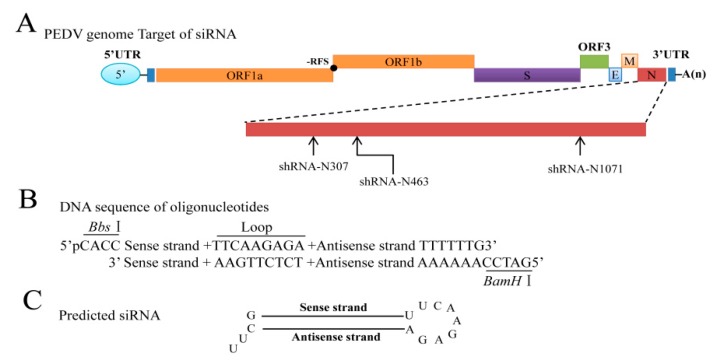
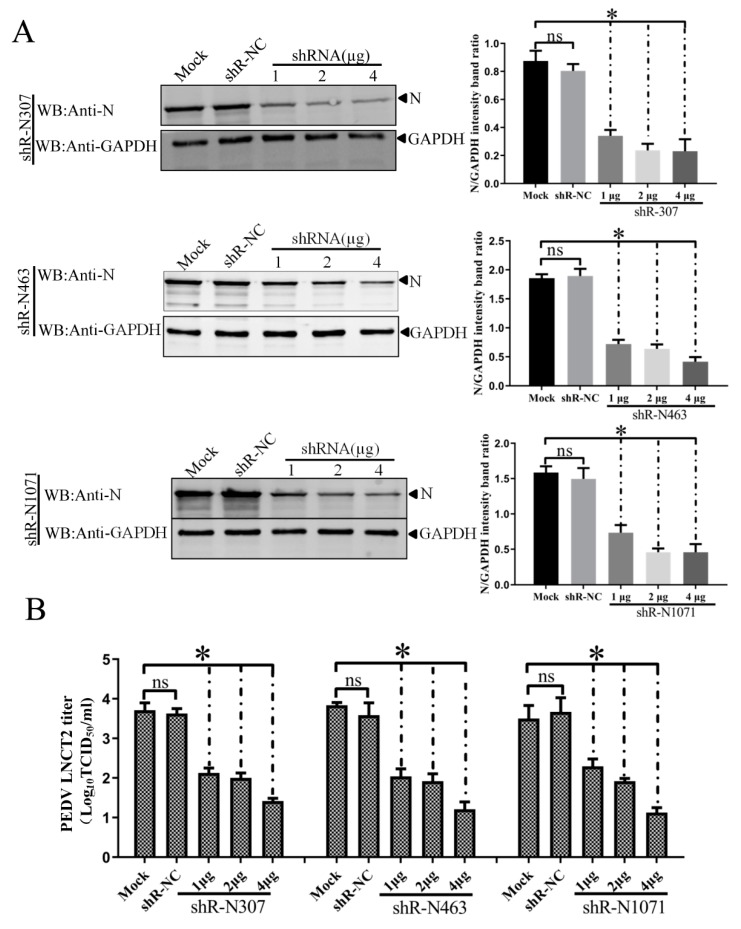
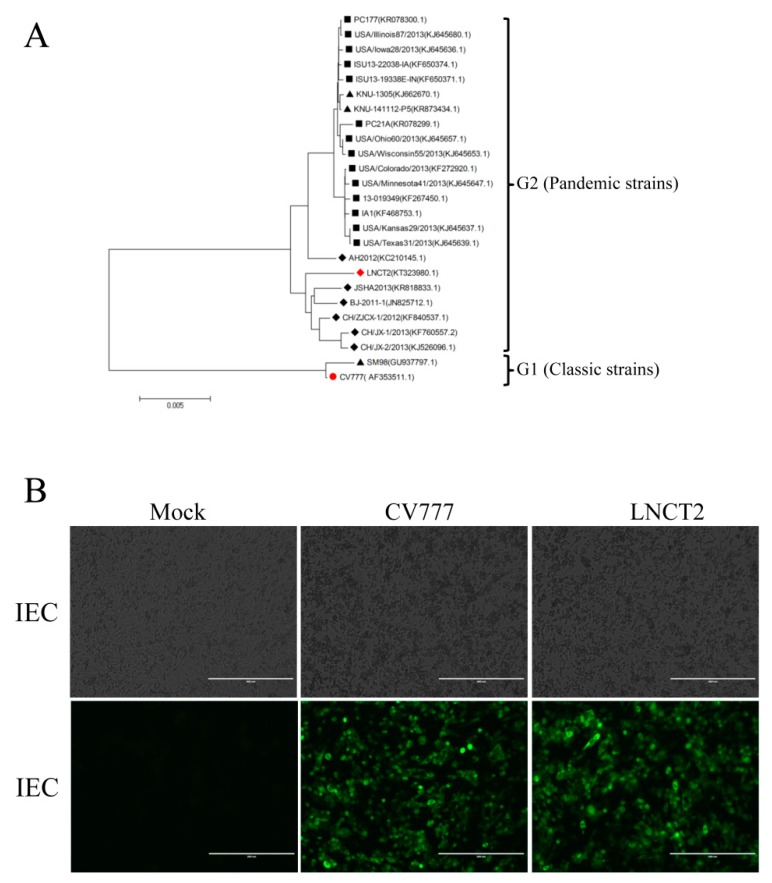
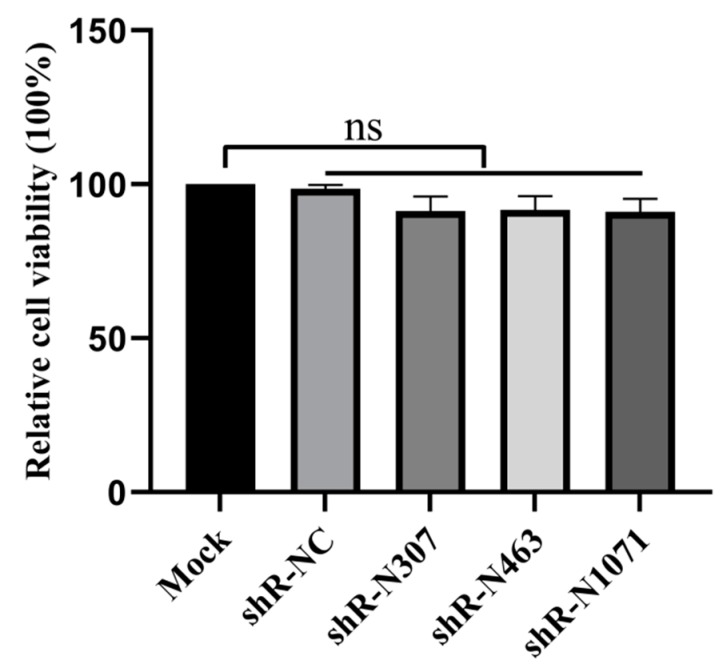
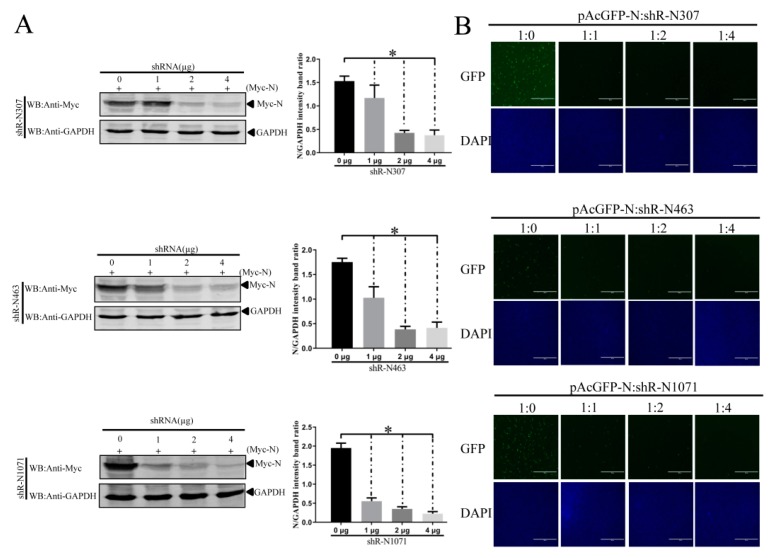
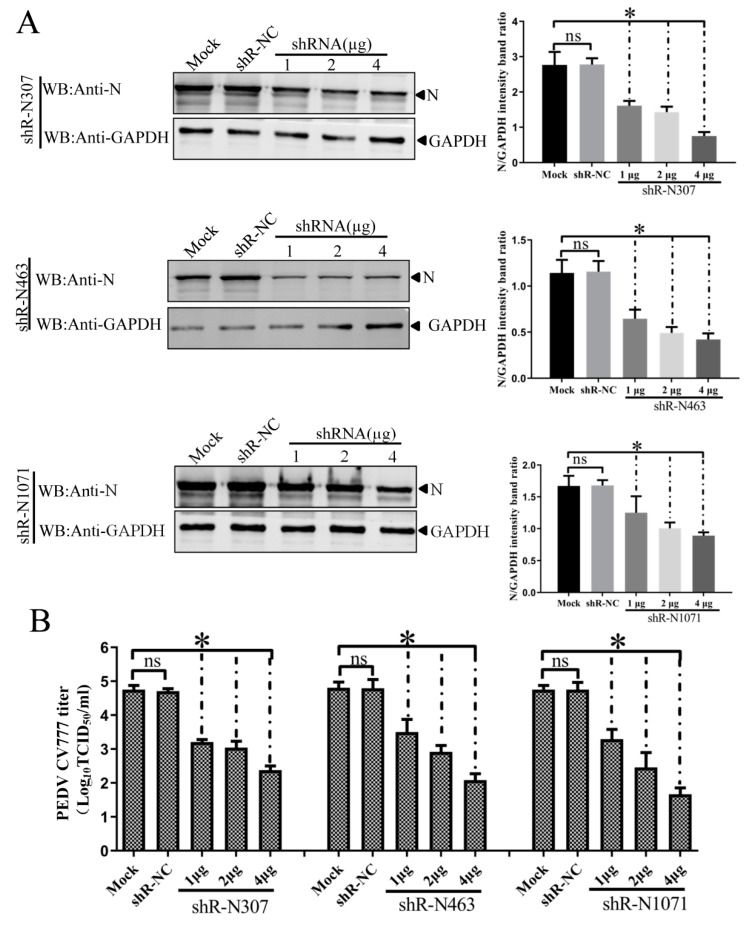
Porcine epidemic diarrhea (PED) re-emerged in China in 2010 and is now widespread. Evidence indicates that highly virulent porcine epidemic diarrhea virus (PEDV) strains belonging to genotype G2 caused a large-scale outbreak of diarrhea. Currently, vaccines derived from PEDV classical strains do not effectively prevent infection by virulent PEDV strains, and no specific drug is available to treat the disease. RNA interference (RNAi) is a novel and effective way to cure a wide range of viruses. We constructed three short hairpin RNA (shRNA)-expressing plasmids (shR-N307, shR-N463, and shR-N1071) directed against nucleocapsid (N) and determined their antiviral activities in intestine epithelial cells infected with a classical CV777 strain and LNCT2. We verified that shR-N307, shR-N463, and shR-N1071 effectively inhibited the expression of the transfected gene in vitro, comparable to the control shRNA. We further demonstrated the shRNAs markedly reduced PEDV CV777 and LNCT2 replication upon downregulation of N production. Therefore, this study provides a new strategy for the design of antiviral methods against coronaviruses by targeting their processivity factors.
猪流行性腹泻(PED)于2010年在中国再度出现,目前已广泛传播。有证据表明,属于G2基因型的高致病性猪流行性腹泻病毒(PEDV)毒株引发了大规模腹泻疫情。目前,源自PEDV经典毒株的疫苗无法有效预防强毒株PEDV的感染,且尚无特效药物可治疗该疾病。RNA干扰(RNAi)是一种治疗多种病毒的新颖且有效的方法。我们构建了三种针对核衣壳(N)的短发夹RNA(shRNA)表达质粒(shR-N307、shR-N463和shR-N1071),并在感染经典CV777毒株和LNCT2的肠上皮细胞中测定了它们的抗病毒活性。我们证实,shR-N307、shR-N463和shR-N1071在体外能有效抑制转染基因的表达,与对照shRNA相当。我们进一步证明,在下调N蛋白产生后,这些shRNA能显著降低PEDV CV777和LNCT2的复制。因此,本研究为通过靶向冠状病毒的持续合成因子来设计抗病毒方法提供了一种新策略。