The Jackson Laboratory, ME 04609 and Farmington, Bar Harbor, CT, 06032, USA.
Baylor University, Waco, TX, 76798, USA.
BMC Cancer. 2019 Nov 4;19(1):1039. doi: 10.1186/s12885-019-6278-9.
Understanding mechanisms underlying specific chemotherapeutic responses in subtypes of cancer may improve identification of treatment strategies most likely to benefit particular patients. For example, triple-negative breast cancer (TNBC) patients have variable response to the chemotherapeutic agent cisplatin. Understanding the basis of treatment response in cancer subtypes will lead to more informed decisions about selection of treatment strategies.
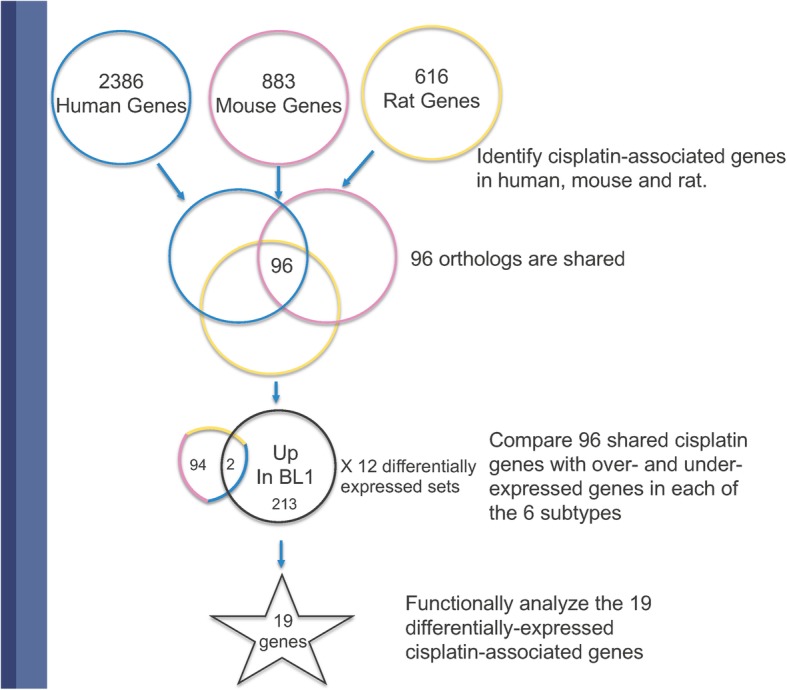
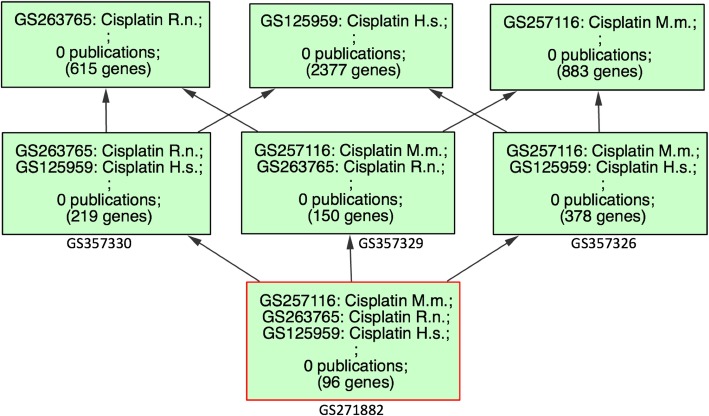
In this study we used an integrative functional genomics approach to investigate the molecular mechanisms underlying known cisplatin-response differences among subtypes of TNBC. To identify changes in gene expression that could explain mechanisms of resistance, we examined 102 evolutionarily conserved cisplatin-associated genes, evaluating their differential expression in the cisplatin-sensitive, basal-like 1 (BL1) and basal-like 2 (BL2) subtypes, and the two cisplatin-resistant, luminal androgen receptor (LAR) and mesenchymal (M) subtypes of TNBC.
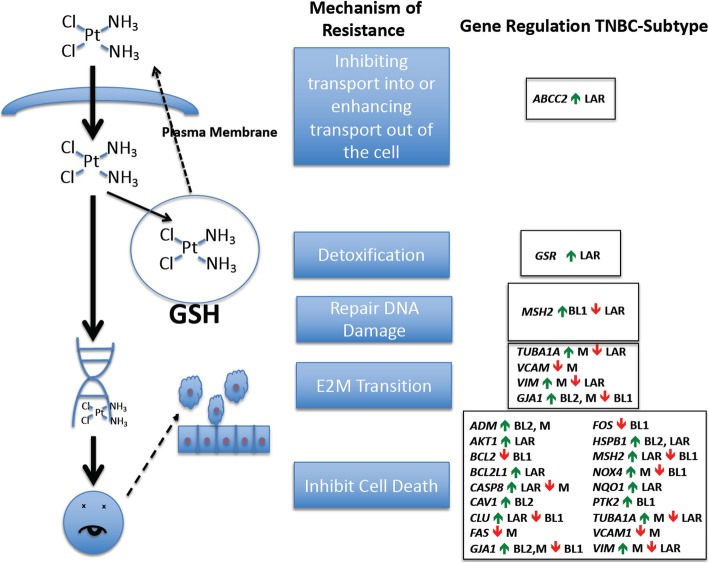
We found 20 genes that were differentially expressed in at least one subtype. Fifteen of the 20 genes are associated with cell death and are distributed among all TNBC subtypes. The less cisplatin-responsive LAR and M TNBC subtypes show different regulation of 13 genes compared to the more sensitive BL1 and BL2 subtypes. These 13 genes identify a variety of cisplatin-resistance mechanisms including increased transport and detoxification of cisplatin, and mis-regulation of the epithelial to mesenchymal transition.
We identified gene signatures in resistant TNBC subtypes indicative of mechanisms of cisplatin. Our results indicate that response to cisplatin in TNBC has a complex foundation based on impact of treatment on distinct cellular pathways. We find that examination of expression data in the context of heterogeneous data such as drug-gene interactions leads to a better understanding of mechanisms at work in cancer therapy response.
了解癌症亚类中特定化疗反应的机制可以改善识别最有可能使特定患者受益的治疗策略。例如,三阴性乳腺癌(TNBC)患者对化疗药物顺铂的反应各不相同。了解癌症亚类治疗反应的基础将导致更明智地选择治疗策略。
在这项研究中,我们使用综合功能基因组学方法研究了已知 TNBC 亚型中顺铂反应差异的分子机制。为了确定可以解释耐药机制的基因表达变化,我们检查了 102 个进化上保守的与顺铂相关的基因,评估了它们在顺铂敏感的基底样 1(BL1)和基底样 2(BL2)亚型以及两种顺铂耐药的腔雄激素受体(LAR)和间充质(M)亚型中的差异表达。
我们发现至少在一种亚型中差异表达的 20 个基因。这 20 个基因中的 15 个与细胞死亡有关,分布在所有 TNBC 亚型中。与更敏感的 BL1 和 BL2 亚型相比,LAR 和 M TNBC 亚型对顺铂的反应性较低,其 13 个基因的调节不同。这 13 个基因确定了各种顺铂耐药机制,包括顺铂的转运和解毒增加,以及上皮间质转化的错误调节。
我们在耐药性 TNBC 亚型中鉴定了与顺铂相关的基因特征。我们的结果表明,TNBC 对顺铂的反应具有复杂的基础,基于治疗对不同细胞途径的影响。我们发现,在异构数据(如药物-基因相互作用)的上下文中检查表达数据可以更好地了解癌症治疗反应中的作用机制。