Institute of Molecular Life Sciences and Swiss Institute of Bioinformatics, University of Zurich, 8057 Zurich, Switzerland.
Novo Nordisk Foundation Center for Protein Research, University of Copenhagen, 2200 Copenhagen N, Denmark.
Nucleic Acids Res. 2019 Jan 8;47(D1):D607-D613. doi: 10.1093/nar/gky1131.
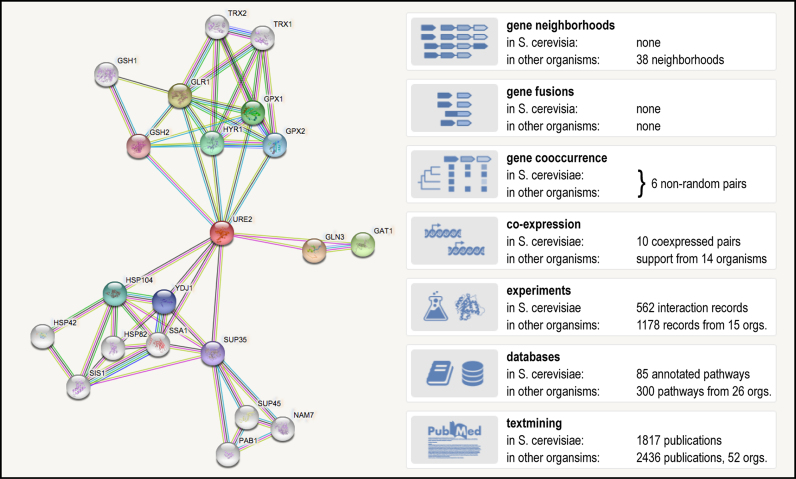
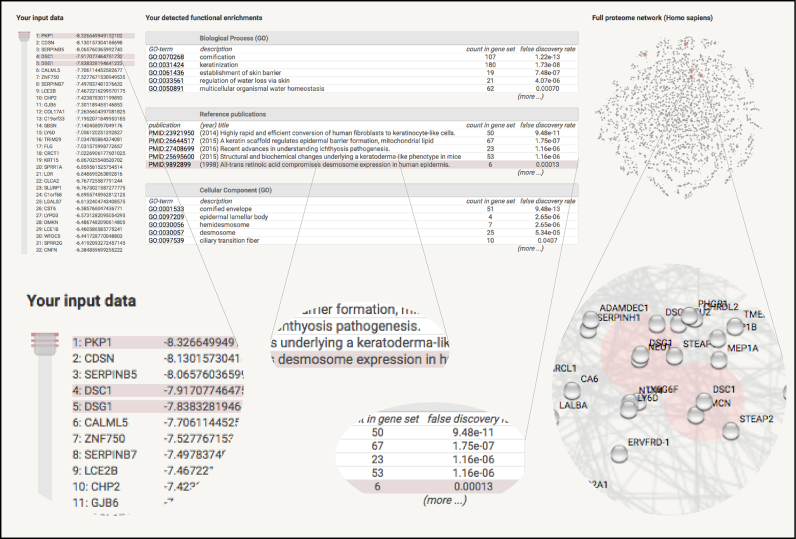
Proteins and their functional interactions form the backbone of the cellular machinery. Their connectivity network needs to be considered for the full understanding of biological phenomena, but the available information on protein-protein associations is incomplete and exhibits varying levels of annotation granularity and reliability. The STRING database aims to collect, score and integrate all publicly available sources of protein-protein interaction information, and to complement these with computational predictions. Its goal is to achieve a comprehensive and objective global network, including direct (physical) as well as indirect (functional) interactions. The latest version of STRING (11.0) more than doubles the number of organisms it covers, to 5090. The most important new feature is an option to upload entire, genome-wide datasets as input, allowing users to visualize subsets as interaction networks and to perform gene-set enrichment analysis on the entire input. For the enrichment analysis, STRING implements well-known classification systems such as Gene Ontology and KEGG, but also offers additional, new classification systems based on high-throughput text-mining as well as on a hierarchical clustering of the association network itself. The STRING resource is available online at https://string-db.org/.
蛋白质及其功能相互作用构成了细胞机制的骨干。为了全面理解生物学现象,需要考虑它们的连接网络,但目前可用的蛋白质-蛋白质相互作用信息并不完整,并且表现出不同程度的注释粒度和可靠性。STRING 数据库旨在收集、评分和整合所有公开的蛋白质-蛋白质相互作用信息,并通过计算预测来补充这些信息。其目标是构建一个全面、客观的全局网络,包括直接(物理)和间接(功能)相互作用。最新版本的 STRING(11.0)涵盖的生物体数量增加了一倍多,达到 5090 个。最重要的新功能是可以上传整个基因组数据集作为输入的选项,允许用户将数据集可视化成相互作用网络,并对整个输入进行基因集富集分析。对于富集分析,STRING 实现了众所周知的分类系统,如基因本体论和 KEGG,还提供了基于高通量文本挖掘以及关联网络本身的层次聚类的其他新分类系统。STRING 资源可在 https://string-db.org/ 在线获取。