• 文献检索
  • 文档翻译
  • 深度研究
  • 学术资讯
  • Suppr Zotero 插件Zotero 插件
  • 邀请有礼
  • 套餐&价格
  • 历史记录
应用&插件
Suppr Zotero 插件Zotero 插件浏览器插件Mac 客户端Windows 客户端微信小程序
定价
高级版会员购买积分包购买API积分包
服务
文献检索文档翻译深度研究API 文档MCP 服务
关于我们
关于 Suppr公司介绍联系我们用户协议隐私条款
关注我们

Suppr 超能文献

核心技术专利:CN118964589B侵权必究
粤ICP备2023148730 号-1Suppr @ 2026

文献检索

告别复杂PubMed语法,用中文像聊天一样搜索,搜遍4000万医学文献。AI智能推荐,让科研检索更轻松。

立即免费搜索

文件翻译

保留排版,准确专业,支持PDF/Word/PPT等文件格式,支持 12+语言互译。

免费翻译文档

深度研究

AI帮你快速写综述,25分钟生成高质量综述,智能提取关键信息,辅助科研写作。

立即免费体验

静脉注射与静脉注射/口服抗生素治疗小儿穿孔性阑尾炎的疗效比较:系统评价和荟萃分析。

Intravenous versus intravenous/oral antibiotics for perforated appendicitis in pediatric patients: a systematic review and meta-analysis.

机构信息

Department of Pediatric Surgery, West China Hospital of Sichuan University, #37 Guo-Xue-Xiang, Chengdu, 610041, China.

出版信息

BMC Pediatr. 2019 Nov 4;19(1):407. doi: 10.1186/s12887-019-1799-6.

DOI:10.1186/s12887-019-1799-6
PMID:31684906
原文链接:https://pmc.ncbi.nlm.nih.gov/articles/PMC6827245/
Abstract

BACKGROUND

The use of oral (PO) antibiotics following a course of certain intravenous (IV) antibiotics is proposed in order to avoid the complications of IV medications and to decrease the cost. However, the efficacy and safety of sequential IV/PO antibiotics is unclear and requires further study.

METHODS

The databases, including PubMed, EMBASE and Cochrane Library, were searched. Studies comparing outcomes in patients with perforated appendicitis receiving sequential IV/PO and PO antibiotics therapy were screened. The Newcastle-Ottawa Scale (NOS) and the Jadad score were used to evaluate the quality of the cohort and the randomized controlled portions of the trial, respectively. Statistical heterogeneity was assessed using the I value. A fixed or random-effect model was applied according to the I value.

RESULTS

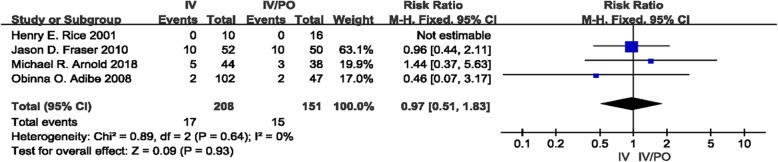
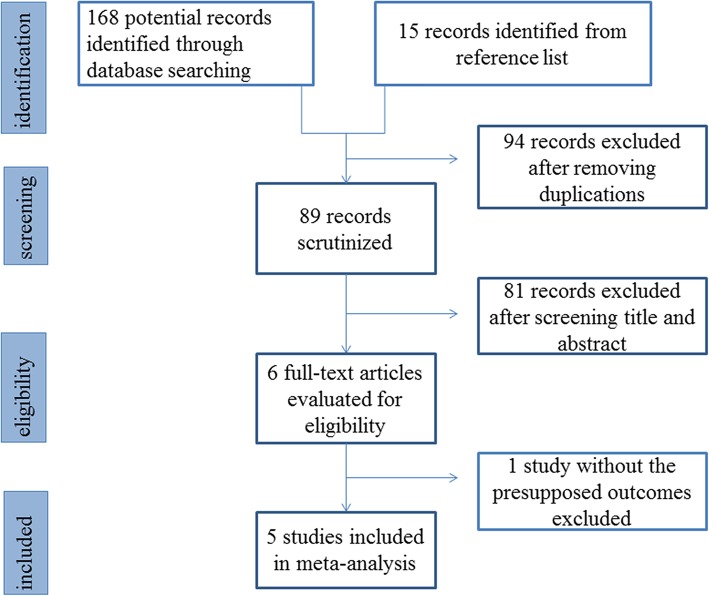
Five controlled studies including a total of 580 patients were evaluated. The pooled estimates revealed that sequential IV/PO antibiotic therapy did not increase the risk of complications, with a risk ratio (RR) of 0.97 (95% CI 0.51-1.83, P = 0.93) for postoperative abscess, 1.04 (95% CI 0.25-4.36, P = 0.96) for wound infection and 0.62 (95% CI 0.33-1.16, P = 0.13) for readmission.

CONCLUSIONS

Our study demonstrates that sequential IV/PO antibiotic therapy is noninferior to IV antibiotic therapy regarding postoperative abscess, wound infection and readmission.

摘要

背景

为了避免静脉(IV)药物治疗的并发症和降低成本,在使用某些静脉抗生素治疗后,建议使用口服(PO)抗生素。然而,序贯 IV/PO 抗生素的疗效和安全性尚不清楚,需要进一步研究。

方法

检索了包括 PubMed、EMBASE 和 Cochrane Library 在内的数据库。筛选了比较接受序贯 IV/PO 和 PO 抗生素治疗的穿孔性阑尾炎患者结局的研究。使用纽卡斯尔-渥太华量表(NOS)和 Jadad 评分分别评估队列研究和随机对照部分的质量。使用 I ²值评估统计异质性。根据 I ²值应用固定或随机效应模型。

结果

评估了 5 项包括 580 名患者的对照研究。汇总估计表明,序贯 IV/PO 抗生素治疗不会增加并发症的风险,术后脓肿的风险比(RR)为 0.97(95%CI 0.51-1.83,P=0.93),伤口感染的 RR 为 1.04(95%CI 0.25-4.36,P=0.96),再入院的 RR 为 0.62(95%CI 0.33-1.16,P=0.13)。

结论

我们的研究表明,序贯 IV/PO 抗生素治疗在术后脓肿、伤口感染和再入院方面与 IV 抗生素治疗无差异。
https://cdn.ncbi.nlm.nih.gov/pmc/blobs/557c/6827245/64c441a86397/12887_2019_1799_Fig4_HTML.jpg
https://cdn.ncbi.nlm.nih.gov/pmc/blobs/557c/6827245/942ae1692dbc/12887_2019_1799_Fig1_HTML.jpg
https://cdn.ncbi.nlm.nih.gov/pmc/blobs/557c/6827245/d50791cfea6b/12887_2019_1799_Fig2_HTML.jpg
https://cdn.ncbi.nlm.nih.gov/pmc/blobs/557c/6827245/b6eb7fce6c19/12887_2019_1799_Fig3_HTML.jpg
https://cdn.ncbi.nlm.nih.gov/pmc/blobs/557c/6827245/64c441a86397/12887_2019_1799_Fig4_HTML.jpg
https://cdn.ncbi.nlm.nih.gov/pmc/blobs/557c/6827245/942ae1692dbc/12887_2019_1799_Fig1_HTML.jpg
https://cdn.ncbi.nlm.nih.gov/pmc/blobs/557c/6827245/d50791cfea6b/12887_2019_1799_Fig2_HTML.jpg
https://cdn.ncbi.nlm.nih.gov/pmc/blobs/557c/6827245/b6eb7fce6c19/12887_2019_1799_Fig3_HTML.jpg
https://cdn.ncbi.nlm.nih.gov/pmc/blobs/557c/6827245/64c441a86397/12887_2019_1799_Fig4_HTML.jpg

相似文献

1
Intravenous versus intravenous/oral antibiotics for perforated appendicitis in pediatric patients: a systematic review and meta-analysis.静脉注射与静脉注射/口服抗生素治疗小儿穿孔性阑尾炎的疗效比较:系统评价和荟萃分析。
BMC Pediatr. 2019 Nov 4;19(1):407. doi: 10.1186/s12887-019-1799-6.
2
Pediatric appendicitis and need for antibiotics at time of discharge: Does route of administration matter?小儿阑尾炎与出院时对抗生素的需求:给药途径重要吗?
J Pediatr Surg. 2016 Jul;51(7):1170-3. doi: 10.1016/j.jpedsurg.2016.03.004. Epub 2016 Mar 12.
3
Home intravenous versus oral antibiotics following appendectomy for perforated appendicitis in children: a randomized controlled trial.儿童穿孔性阑尾炎阑尾切除术后家庭静脉注射与口服抗生素治疗:一项随机对照试验
Pediatr Surg Int. 2018 Dec;34(12):1257-1268. doi: 10.1007/s00383-018-4343-0. Epub 2018 Sep 14.
4
Eliminating Use of Home Oral Antibiotics in Pediatric Complicated Appendicitis.消除小儿复杂性阑尾炎中家庭口服抗生素的使用。
J Surg Res. 2021 Jul;263:151-154. doi: 10.1016/j.jss.2020.12.059. Epub 2021 Feb 27.
5
Postoperative antibiotic therapy for children with perforated appendicitis: long course of intravenous antibiotics versus early conversion to an oral regimen.小儿穿孔性阑尾炎术后抗生素治疗:静脉用抗生素长疗程与早期转换为口服方案的比较
Am J Surg. 2008 Feb;195(2):141-3. doi: 10.1016/j.amjsurg.2007.10.002.
6
A complete course of intravenous antibiotics vs a combination of intravenous and oral antibiotics for perforated appendicitis in children: a prospective, randomized trial.儿童穿孔性阑尾炎行静脉用抗生素全程治疗与静脉用和口服抗生素联合治疗的前瞻性随机试验。
J Pediatr Surg. 2010 Jun;45(6):1198-202. doi: 10.1016/j.jpedsurg.2010.02.090.
7
Oral Antibiotics and Abscess Formation After Appendectomy for Perforated Appendicitis in Children.儿童穿孔性阑尾炎切除术后口服抗生素与脓肿形成。
J Surg Res. 2020 Dec;256:56-60. doi: 10.1016/j.jss.2020.05.082. Epub 2020 Jul 16.
8
Evaluation of white blood cell count at time of discharge is associated with limited oral antibiotic therapy in children with complicated appendicitis.在患有复杂性阑尾炎的儿童中,出院时的白细胞计数评估与有限的口服抗生素治疗相关。
Am J Surg. 2019 Jun;217(6):1099-1101. doi: 10.1016/j.amjsurg.2018.12.071. Epub 2019 Jan 3.
9
Treatment of perforated appendicitis: an analysis of 362 patients treated during 8 years.穿孔性阑尾炎的治疗:对8年间362例接受治疗患者的分析。
Dig Surg. 1998;15(6):683-6. doi: 10.1159/000018678.
10
Complicated appendicitis: is there a minimum intravenous antibiotic requirement? A prospective randomized trial.复杂性阑尾炎:静脉注射抗生素有最低用量要求吗?一项前瞻性随机试验。
Am Surg. 2000 Sep;66(9):887-90.

引用本文的文献

1
Exploring oral antibiotics for antibiotic stewardship in nonoperative management of complicated appendicitis in pediatric patients.探索口服抗生素在小儿复杂性阑尾炎非手术治疗中对抗生素管理的作用。
Antimicrob Steward Healthc Epidemiol. 2025 Apr 25;5(1):e101. doi: 10.1017/ash.2025.74. eCollection 2025.
2
Perforated Appendicitis in Children: Management, Microbiology, and Antibiotic Stewardship.儿童穿孔性阑尾炎:处理、微生物学和抗生素管理。
Paediatr Drugs. 2024 May;26(3):277-286. doi: 10.1007/s40272-024-00630-0. Epub 2024 Apr 24.
3
Oral vs Intravenous Discharge Antibiotic Regimens in the Management of Intra-abdominal Abscesses in Penetrating Crohn's Disease.

本文引用的文献

1
Efficacy of oral antibiotics in children with post-operative abscess from perforated appendicitis.口服抗生素对穿孔性阑尾炎术后脓肿患儿的疗效。
Pediatr Surg Int. 2019 Mar;35(3):329-333. doi: 10.1007/s00383-018-4424-0. Epub 2018 Dec 3.
2
Home intravenous versus oral antibiotics following appendectomy for perforated appendicitis in children: a randomized controlled trial.儿童穿孔性阑尾炎阑尾切除术后家庭静脉注射与口服抗生素治疗:一项随机对照试验
Pediatr Surg Int. 2018 Dec;34(12):1257-1268. doi: 10.1007/s00383-018-4343-0. Epub 2018 Sep 14.
3
Early Predictors of Abscess Development after Perforated Pediatric Appendicitis.
口服与静脉注射出院抗生素方案在穿透性克罗恩病腹腔脓肿治疗中的应用
Inflamm Bowel Dis. 2024 Dec 5;30(12):2280-2288. doi: 10.1093/ibd/izad299.
4
Management of complicated acute appendicitis in children: Still an existing controversy.儿童复杂性急性阑尾炎的管理:仍然存在争议。
World J Gastrointest Surg. 2020 Apr 27;12(4):129-137. doi: 10.4240/wjgs.v12.i4.129.
小儿穿孔性阑尾炎后脓肿形成的早期预测因素
Surg Infect (Larchmt). 2017 Nov/Dec;18(8):886-889. doi: 10.1089/sur.2017.134. Epub 2017 Oct 10.
4
Intravenous Versus Oral Antibiotics for the Prevention of Treatment Failure in Children With Complicated Appendicitis: Has the Abandonment of Peripherally Inserted Catheters Been Justified?静脉用与口服抗生素用于预防复杂性阑尾炎患儿治疗失败:是否有理由放弃外周静脉置入中心静脉导管?
Ann Surg. 2017 Aug;266(2):361-368. doi: 10.1097/SLA.0000000000001923.
5
Pediatric appendicitis and need for antibiotics at time of discharge: Does route of administration matter?小儿阑尾炎与出院时对抗生素的需求:给药途径重要吗?
J Pediatr Surg. 2016 Jul;51(7):1170-3. doi: 10.1016/j.jpedsurg.2016.03.004. Epub 2016 Mar 12.
6
Early transition to oral antibiotics for treatment of perforated appendicitis in pediatric patients: Confirmation of the safety and efficacy of a growing national trend.小儿穿孔性阑尾炎治疗中早期过渡至口服抗生素:对一种全国性增长趋势的安全性和有效性的确认
J Pediatr Surg. 2016 Jun;51(6):903-7. doi: 10.1016/j.jpedsurg.2016.02.057. Epub 2016 Mar 2.
7
Morbidity of peripherally inserted central catheters in pediatric complicated appendicitis.儿童复杂性阑尾炎患者外周静脉置入中心静脉导管的并发症。
J Surg Res. 2014 Jul;190(1):235-41. doi: 10.1016/j.jss.2014.03.014. Epub 2014 Mar 13.
8
Risk factors for peripherally inserted central venous catheter complications in children.儿童外周置入中心静脉导管并发症的危险因素。
JAMA Pediatr. 2013 May;167(5):429-35. doi: 10.1001/jamapediatrics.2013.775.
9
The effects of irrigation on outcomes in cases of perforated appendicitis in children.灌洗对儿童穿孔性阑尾炎结局的影响。
J Surg Res. 2013 Apr;180(2):222-5. doi: 10.1016/j.jss.2012.04.043. Epub 2012 May 11.
10
Frequency of peripherally inserted central catheter complications in children.儿童外周置入中心静脉导管并发症的频率。
Pediatr Infect Dis J. 2012 May;31(5):519-21. doi: 10.1097/INF.0b013e31824571b0.