Walker Jacob A, Friesen Joshua D, Peters Steven J, Jones Marjorie A, Friesen Jon A
Department of Chemistry, Illinois State University, Normal, IL, 61790, United States.
Heliyon. 2019 Oct 22;5(10):e02585. doi: 10.1016/j.heliyon.2019.e02585. eCollection 2019 Oct.
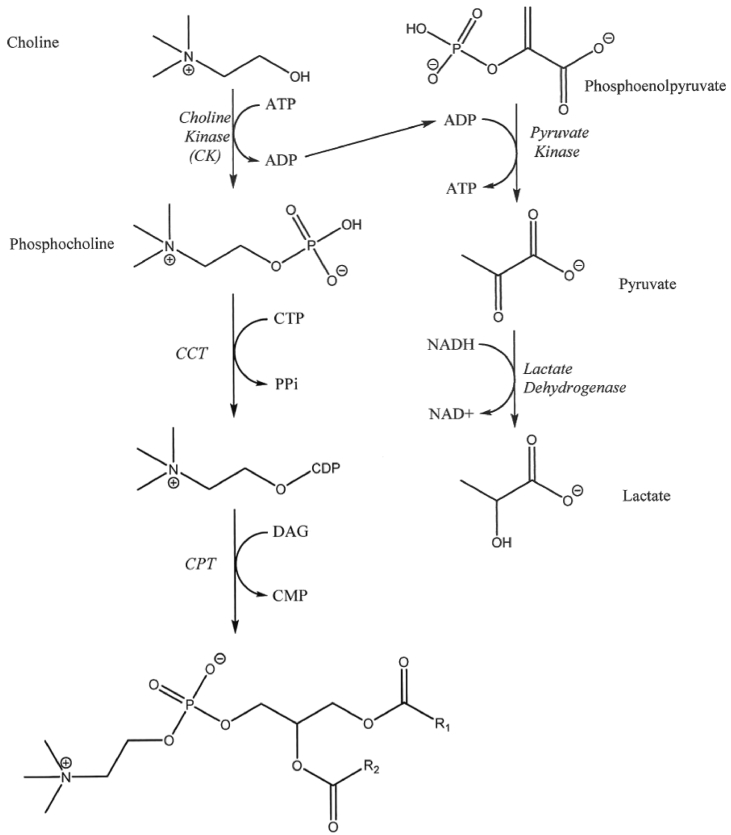
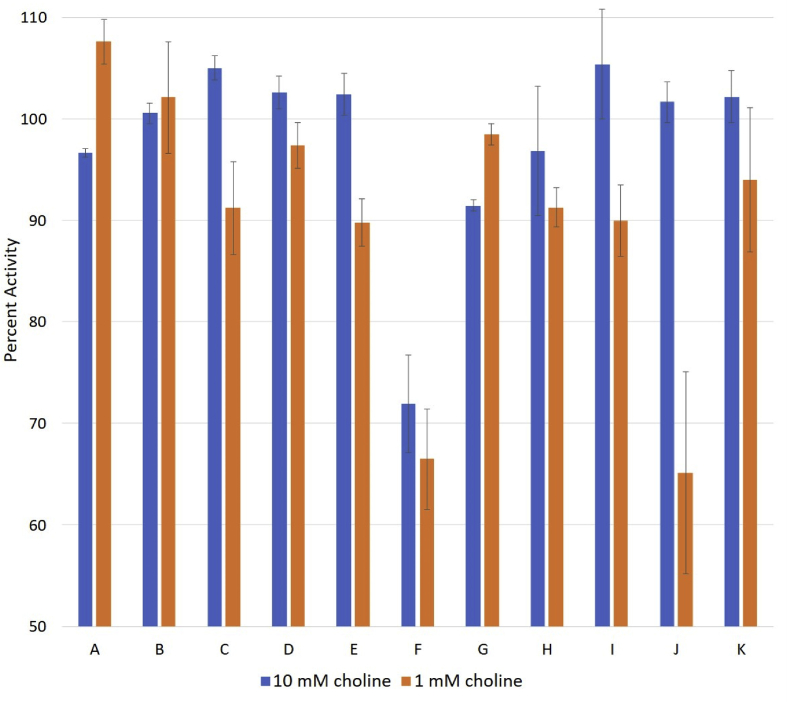
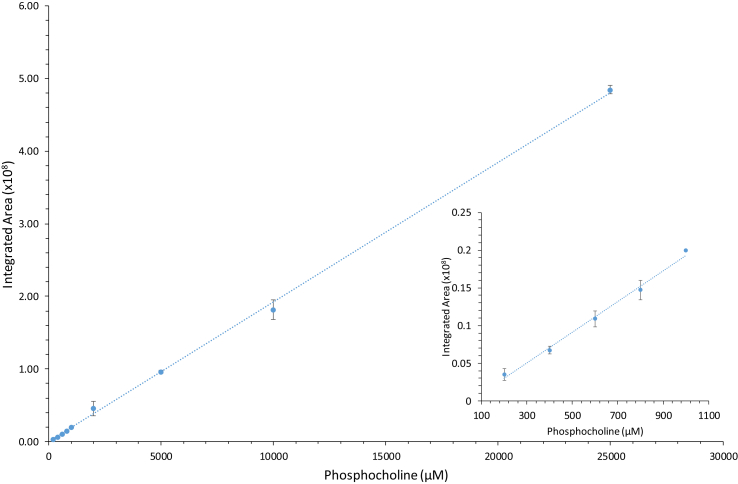
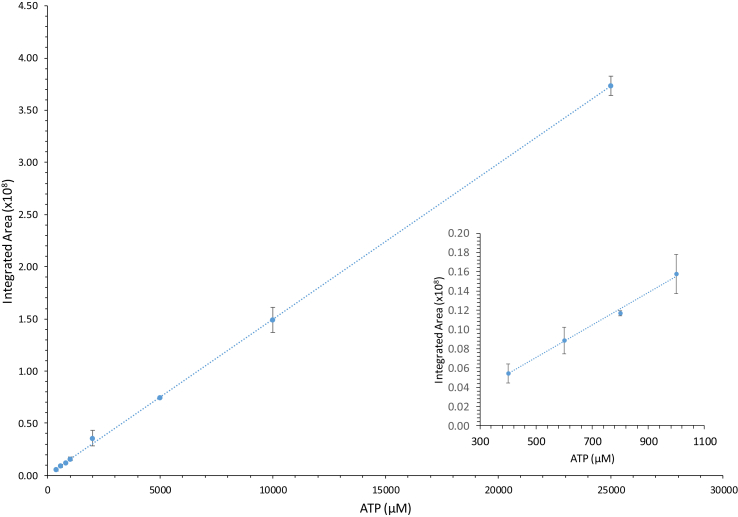
Choline kinase catalyzes the conversion of choline to phosphocholine (PC) by transferring a phosphate group from adenosine triphosphate (ATP) as the first step in the biosynthetic pathway for the membrane phospholipid phosphatidylcholine, an essential pathway in the parasitic protozoan. Commonly used methods for kinetically quantifying the enzyme include a radioisotope assay utilizing labeled choline and a coupled spectrophotometric assay with multiple enzymes and substrates that indirectly measures choline kinase activity. When testing potential inhibitors with the coupled assay, results can cast doubt on whether choline kinase is being inhibited or one of the coupled enzymes. Therefore, P NMR spectroscopy was used to quantitatively measure the formation of the key product, phosphocholine, and to evaluate choline kinase activity. Interrogation of P NMR spectroscopy offers a number of benefits. Since this isotope is 100% abundant and has a relatively large gyromagnetic ratio, it is considered one of the more sensitive nuclides. As such, the need for costly isotopic enriched phosphorous is not required and detection of the P signal is possible even at relatively low concentrations. The enzymatic activity of choline kinase was able to be directly measured via integration of the P resonance associated with the phosphocholine product ( = 3.94 ppm). These initial studies reveal that a P NMR spectroscopic-based assay could be used for testing substrate or transition state analogs as competitive inhibitors of choline kinase that may prevent phosphatidylcholine synthesis in the parasite.
胆碱激酶通过从三磷酸腺苷(ATP)转移磷酸基团,催化胆碱转化为磷酸胆碱(PC),这是膜磷脂磷脂酰胆碱生物合成途径的第一步,而磷脂酰胆碱生物合成途径是寄生原生动物中的一条重要途径。常用的动力学定量该酶的方法包括利用标记胆碱的放射性同位素测定法和使用多种酶与底物的偶联分光光度测定法,后者间接测量胆碱激酶活性。在用偶联测定法测试潜在抑制剂时,结果可能会让人怀疑是胆碱激酶受到了抑制还是其中一种偶联酶受到了抑制。因此,采用³¹P核磁共振波谱法来定量测量关键产物磷酸胆碱的形成,并评估胆碱激酶活性。³¹P核磁共振波谱法有诸多优点。由于这种同位素丰度为100%且具有相对较大的旋磁比,它被认为是较为灵敏的核素之一。因此,无需使用昂贵的同位素富集磷,即使在相对较低的浓度下也能检测到³¹P信号。胆碱激酶的酶活性能够通过对与磷酸胆碱产物相关的³¹P共振峰(δ = 3.94 ppm)进行积分直接测量。这些初步研究表明,基于³¹P核磁共振波谱的测定法可用于测试底物或过渡态类似物作为胆碱激酶的竞争性抑制剂,这些抑制剂可能会阻止寄生虫中磷脂酰胆碱的合成。