Department of Ophthalmology, Amsterdam University Medical Centers, Vrije Universiteit, Amsterdam, The Netherlands.
Amsterdam Public Health Research Institute, Amsterdam, The Netherlands.
Ophthalmic Physiol Opt. 2019 Nov;39(6):399-413. doi: 10.1111/opo.12647.
The aim was to compare fatigue levels between patients with visual impairment and controls with normal sight and to examine the association between fatigue and vision loss severity.
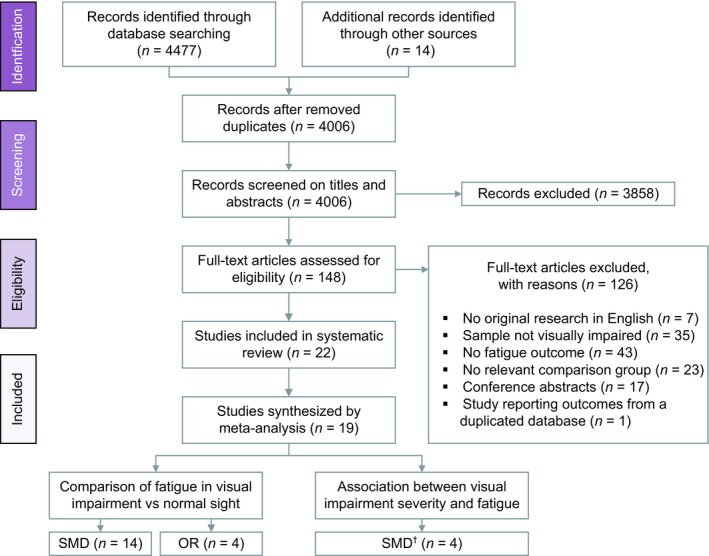
A systematic literature search was performed using databases of PubMed, Embase, PsycINFO and Cochrane to identify observational studies with outcomes related to fatigue (e.g. vitality subscale of the Short-Form 36, Fatigue Assessment Scale). A meta-analysis was performed using standardised mean differences (SMDs) and odds ratios (OR) to quantitatively summarise the association between visual impairment and fatigue. Sources of heterogeneity were explored by subgroup and sensitivity analyses. Study quality was assessed with the Newcastle-Ottawa scale.
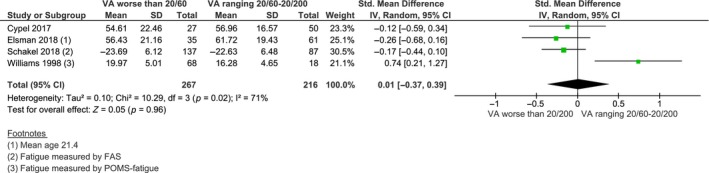
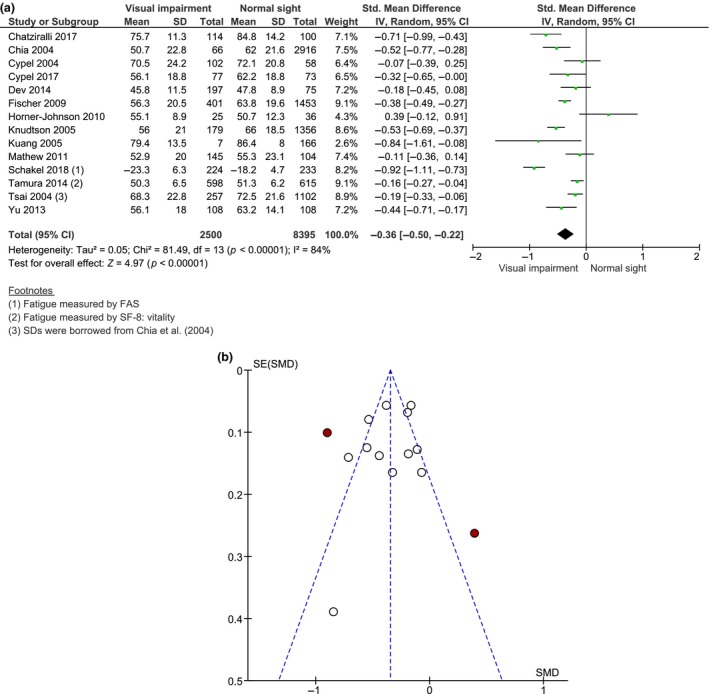
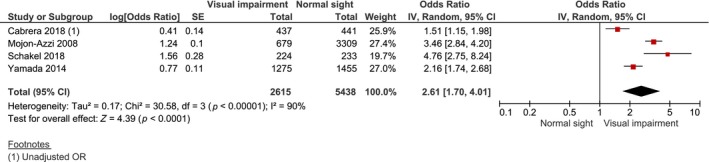
After reviewing 4477 studies, 22 studies with a total of 40 004 participants were included, of which 18 contributed to meta-analysis. Among these, eight were assessed as moderate quality studies and 10 as high quality studies. Pooled analysis involving 2500 patients and 8395 controls showed higher fatigue severity levels (S.M.D. = -0.36, 95% CI -0.50 to -0.22, 14 studies) among visually impaired patients compared to normally sighted controls. This effect size was small and persisted in sensitivity analyses that involved study quality, fatigue assessment tools and visual acuity data. Furthermore, pooled analysis of four studies including 2615 patients and 5438 controls showed a significant association between visual impairment and fatigue (OR = 2.61, 95% CI 1.69 to 4.04). Secondary meta-analysis of four studies showed no significant difference in fatigue severity (S.M.D. = 0.01, 95% CI -0.37 to 0.39) between patients with moderate visual impairment and patients with severe visual impairment or blindness.
Current moderate to high quality evidence suggest that patients with visual impairment experience more severe fatigue symptoms than persons with normal sight. However, a limited number of available studies indicates that fatigue is not associated with severity of vision loss. Future studies are required to determine which factors and underlying mechanisms may explain the association between visual impairment and fatigue. Discussing fatigue at an early stage and developing intervention options for vision-related fatigue should be considered within the field of low vision rehabilitation.
比较视力障碍患者与视力正常对照者的疲劳水平,并探讨疲劳与视力丧失严重程度之间的关系。
系统检索 PubMed、Embase、PsycINFO 和 Cochrane 数据库,以确定与疲劳相关结局的观察性研究(例如,简明 36 项健康调查量表的活力分量表、疲劳评估量表)。采用标准化均数差(SMD)和比值比(OR)对视觉障碍与疲劳之间的关联进行定量汇总。通过亚组和敏感性分析探讨异质性来源。采用纽卡斯尔-渥太华量表评估研究质量。
在对 4477 篇研究进行审查后,纳入了 22 项研究,共计 40004 名参与者,其中 18 项研究纳入了荟萃分析。其中,8 项研究被评估为中等质量研究,10 项研究为高质量研究。纳入 2500 名患者和 8395 名对照者的汇总分析显示,与视力正常对照者相比,视力障碍患者的疲劳严重程度更高(SMD=-0.36,95%CI-0.50 至-0.22,14 项研究)。该效应量较小,且在纳入研究质量、疲劳评估工具和视力数据的敏感性分析中仍存在。此外,纳入 2615 名患者和 5438 名对照者的 4 项研究的汇总分析显示,视觉障碍与疲劳之间存在显著关联(OR=2.61,95%CI1.69 至 4.04)。对 4 项研究的二次荟萃分析显示,中度视力障碍患者与重度视力障碍或失明患者的疲劳严重程度(SMD=0.01,95%CI-0.37 至 0.39)无显著差异。
目前的中高质量证据表明,视力障碍患者的疲劳症状比视力正常者更严重。然而,现有研究数量有限,表明疲劳与视力丧失严重程度无关。需要进一步研究确定哪些因素和潜在机制可能解释视觉障碍与疲劳之间的关联。在低视力康复领域,应考虑早期讨论疲劳问题,并为与视力相关的疲劳制定干预措施。