
不同气道上皮细胞系在三维细胞培养中纤毛功能的研究。
Investigation on Ciliary Functionality of Different Airway Epithelial Cell Lines in Three-Dimensional Cell Culture.
机构信息
Chair of Tissue Engineering and Regenerative Medicine, University Hospital Würzburg, Würzburg, Germany.
Department of Oto-Rhino-Laryngology, Plastic, Aesthetic and Reconstructive Head and Neck Surgery, University Hospital Würzburg, Würzburg, Germany.
出版信息
Tissue Eng Part A. 2020 Apr;26(7-8):432-440. doi: 10.1089/ten.TEA.2019.0188. Epub 2019 Dec 27.
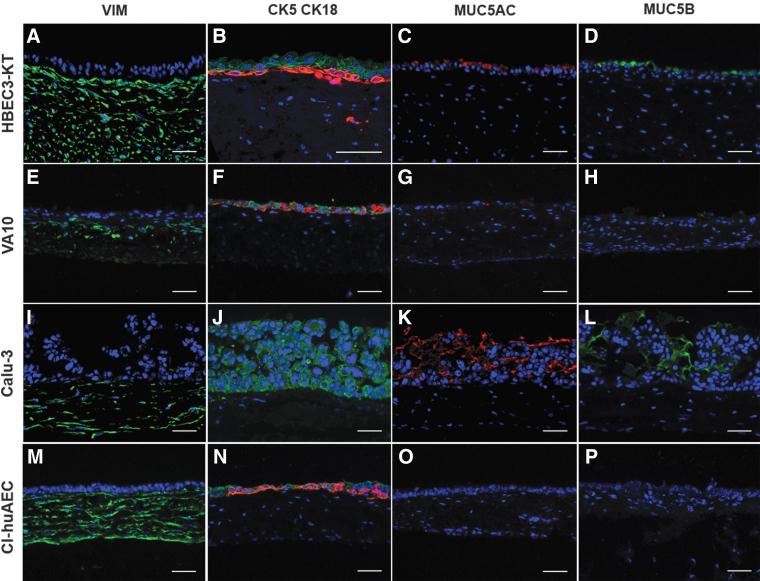
Three-dimensional respiratory tissue models have been generated using, for example, human primary airway epithelial cells (hAEC) or respective cell lines. To investigate ciliopathies, such as primary ciliary dyskinesia, the presence of functional kinocilia is an essential prerequisite. Since access to hAEC of healthy donors is limited, we aimed to identify a respiratory epithelial cell line that is capable to display functional kinocilia on at least 60% of the apical surface. Thus, we cultured four different human respiratory cell lines with human primary airway fibroblasts under airlift conditions, characterized the morphology, and analyzed ciliary function. Only one of the tested cell lines showed beating kinocilia; however, <10% of the whole surface was covered and ciliary beating was undirected. Positive control tissue models using hAEC and fibroblasts displayed expected directed ciliary beating pattern around 11 Hz. Our data show that the available cell lines are not suitable for basic and applied research questions whenever functional kinocilia are required and that, rather, hAEC- or human induced pluripotent stem cell-derived tissue models need to be generated. Impact Statement To study ciliopathies or infection , three-dimensional respiratory tissue models with functional kinocilia covering at least 60% of the model's surface are mandatory. We cultured four respiratory cell lines on a fibroblast-loaded biological scaffold and showed that none of them met this requirement. In contrast, primary airway cell-derived models sufficiently reflected the mucociliary phenotype. To further search for an alternative to primary respiratory cells, investigations on other cell lines should be conducted or even new cell lines have to be generated.
已经使用例如人原代气道上皮细胞(hAEC)或相应的细胞系生成了三维呼吸组织模型。为了研究纤毛病变,例如原发性纤毛运动障碍,功能性纤毛的存在是必不可少的前提条件。由于获得健康供体的 hAEC 受到限制,我们旨在鉴定一种能够在至少 60%的顶表面上显示功能性纤毛的呼吸上皮细胞系。因此,我们在气升条件下培养了四种不同的人呼吸细胞系与人原代气道成纤维细胞,对其形态进行了特征分析,并分析了纤毛功能。只有一种测试的细胞系显示出纤毛跳动,但整个表面的覆盖率<10%,并且纤毛跳动无定向。使用 hAEC 和成纤维细胞的阳性对照组织模型显示出预期的约 11 Hz 的定向纤毛跳动模式。我们的数据表明,只要需要功能性纤毛,现有的细胞系就不适合进行基础和应用研究问题,而需要生成 hAEC 或人诱导多能干细胞衍生的组织模型。 影响说明 为了研究纤毛病变或感染,具有至少 60%的模型表面覆盖功能性纤毛的三维呼吸组织模型是强制性的。我们在负载有成纤维细胞的生物支架上培养了四种呼吸细胞系,结果表明它们均不符合该要求。相比之下,原代气道细胞衍生的模型充分反映了黏液纤毛表型。为了进一步寻找替代原代呼吸细胞的方法,应进行对其他细胞系的研究,甚至需要生成新的细胞系。




 Zotero 插件