Eichler Sarah, Salzwedel Annett, Rabe Sophie, Mueller Steffen, Mayer Frank, Wochatz Monique, Hadzic Miralem, John Michael, Wegscheider Karl, Völler Heinz
Center of Rehabilitation Research, University of Potsdam, Potsdam, Germany.
Department of Computer Science and Therapy Science, Trier University of Applied Science, Trier, Germany.
JMIR Rehabil Assist Technol. 2019 Nov 7;6(2):e14236. doi: 10.2196/14236.
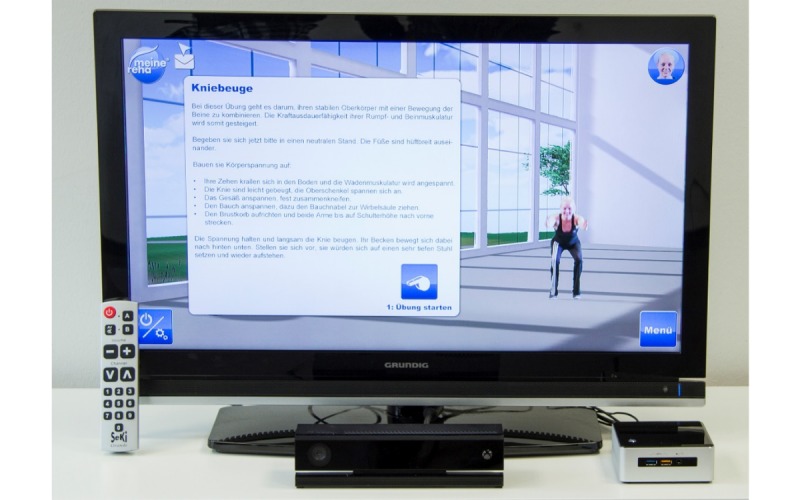
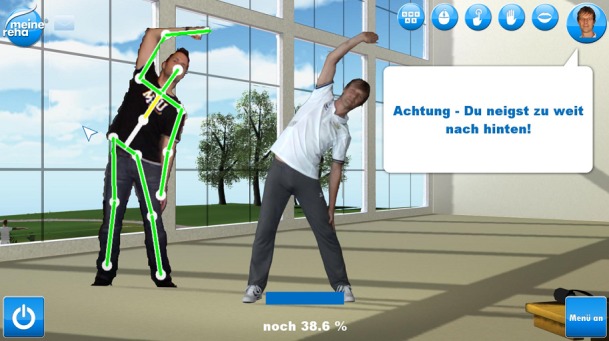
Telerehabilitation can contribute to the maintenance of successful rehabilitation regardless of location and time. The aim of this study was to investigate a specific three-month interactive telerehabilitation routine regarding its effectiveness in assisting patients with physical functionality and with returning to work compared to typical aftercare.
The aim of the study was to investigate a specific three-month interactive telerehabilitation with regard to effectiveness in functioning and return to work compared to usual aftercare.
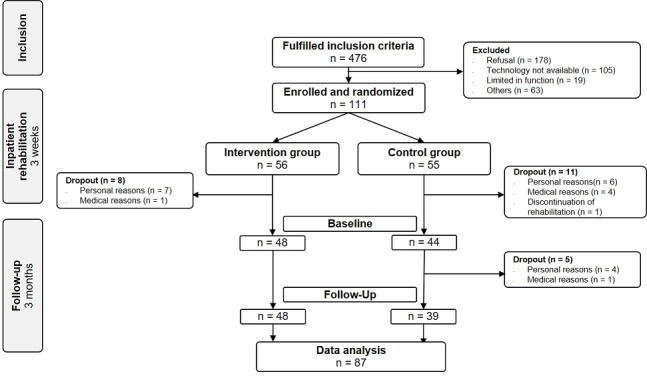
From August 2016 to December 2017, 111 patients (mean 54.9 years old; SD 6.8; 54.3% female) with hip or knee replacement were enrolled in the randomized controlled trial. At discharge from inpatient rehabilitation and after three months, their distance in the 6-minute walk test was assessed as the primary endpoint. Other functional parameters, including health related quality of life, pain, and time to return to work, were secondary endpoints.
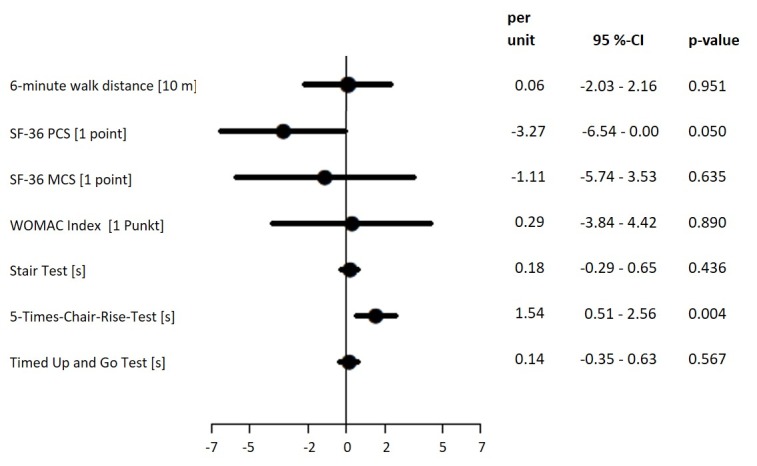
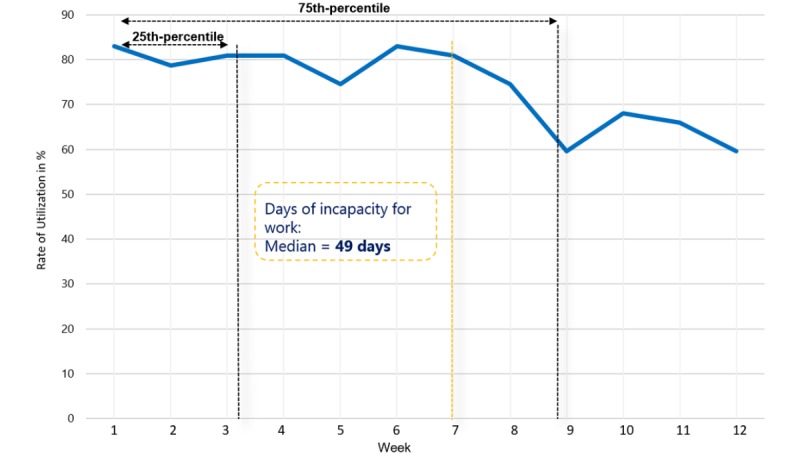
Patients in the intervention group performed telerehabilitation for an average of 55.0 minutes (SD 9.2) per week. Adherence was high, at over 75%, until the 7th week of the three-month intervention phase. Almost all the patients and therapists used the communication options. Both the intervention group (average difference 88.3 m; SD 57.7; P=.95) and the control group (average difference 79.6 m; SD 48.7; P=.95) increased their distance in the 6-minute-walk-test. Improvements in other functional parameters, as well as in quality of life and pain, were achieved in both groups. The higher proportion of working patients in the intervention group (64.6%; P=.01) versus the control group (46.2%) is of note.
The effect of the investigated telerehabilitation therapy in patients following knee or hip replacement was equivalent to the usual aftercare in terms of functional testing, quality of life, and pain. Since a significantly higher return-to-work rate could be achieved, this therapy might be a promising supplement to established aftercare.
German Clinical Trials Register DRKS00010009; https://www.drks.de/drks_web/navigate.do? navigationId=trial.HTML&TRIAL_ID=DRKS00010009.
远程康复有助于维持成功的康复效果,不受地点和时间限制。本研究的目的是调查一种特定的为期三个月的交互式远程康复方案,与典型的术后护理相比,其在协助患者恢复身体功能和重返工作岗位方面的有效性。
本研究的目的是调查一种特定的为期三个月的交互式远程康复方案,与常规术后护理相比,其在功能恢复和重返工作岗位方面的有效性。
2016年8月至2017年12月,111例接受髋关节或膝关节置换术的患者(平均年龄54.9岁;标准差6.8;女性占54.3%)被纳入随机对照试验。在住院康复出院时和三个月后,评估他们在6分钟步行试验中的距离作为主要终点。其他功能参数,包括健康相关生活质量、疼痛和重返工作岗位的时间,为次要终点。
干预组患者每周平均进行55.0分钟(标准差9.2)的远程康复。在为期三个月的干预期的第7周之前,依从性很高,超过75%。几乎所有患者和治疗师都使用了沟通选项。干预组(平均差异88.3米;标准差57.7;P = 0.95)和对照组(平均差异79.6米;标准差48.7;P = 0.95)在6分钟步行试验中的距离均有所增加。两组在其他功能参数以及生活质量和疼痛方面均有改善。值得注意的是,干预组中重返工作岗位的患者比例(64.6%;P = 0.01)高于对照组(46.2%)。
在功能测试、生活质量和疼痛方面,所研究的远程康复治疗对膝关节或髋关节置换术后患者的效果与常规术后护理相当。由于可以实现显著更高的重返工作岗位率,这种治疗可能是现有术后护理的一种有前景的补充。
德国临床试验注册中心DRKS00010009;https://www.drks.de/drks_web/navigate.do? navigationId=trial.HTML&TRIAL_ID=DRKS00010009。