Bethge Matthias, Mattukat Kerstin, Fauser David, Mau Wilfried
Institute for Social Medicine and Epidemiology, University of Lübeck, Ratzeburger Allee 160, 23562, Lübeck, Germany.
Institute for Rehabilitation Medicine, Martin Luther University Halle-Wittenberg, Magdeburger Str. 8, 06112, Halle, Germany.
BMC Public Health. 2017 Jul 14;18(1):22. doi: 10.1186/s12889-017-4588-x.
Back pain is one of the most common chronic diseases in Germany and has a major impact on work ability and social participation. The German Pension Insurance (GPI) is the main provider of medical rehabilitation to improve work ability and prevent disability pensions in Germany. However, over half of the persons granted a disability pension have never used a medical rehabilitation service. Furthermore, evidence on the effects of medical rehabilitation in Germany is inconclusive. Consequently, this study has two aims: first, to determine barriers to using rehabilitation services, and second, to examine the effectiveness of medical rehabilitation in German residents with chronic back pain.
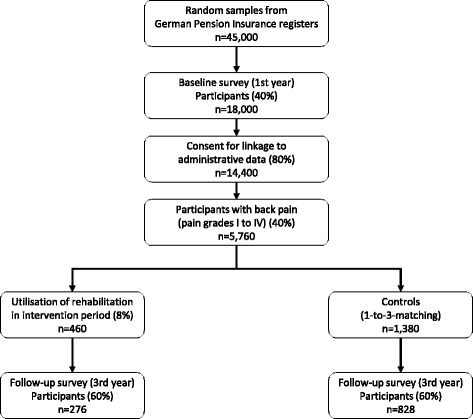
In 2017 a postal questionnaire will be sent to 45,000 persons aged 45 to 59 years whose pension insurance contributions are managed by the GPI North or the GPI Central Germany. In 2019 respondents who report back pain in the first survey (n = 5760 expected) will be sent a second questionnaire. Individuals will be eligible for the first survey if they are employed, have neither used nor applied for a rehabilitation programme during the last 4 years and neither received nor applied for a disability pension. The sample will be drawn randomly from the registers of the GPI North (n = 22,500) and the GPI Central Germany (n = 22,500) and stratified by sex and duration of sickness absence benefits. Barriers to rehabilitation services will be related to socio-demographic and social characteristics, pain and attitudes to pain, health and health behaviour, healthcare utilisation, experiences and cognitions about rehabilitation services and job conditions. Propensity score matched analyses will be used to examine the effectiveness of rehabilitation services. Data on use of medical rehabilitation will be extracted from administrative records. The primary outcome is pain disability. Secondary outcomes are pain intensity and days of disability, pain self-efficacy, fear avoidance beliefs, self-rated health, depression, healthcare utilisation, self-rated work ability and subjective prognosis of employability, sickness absence benefits, and disability pensions.
This study identifies barriers to use of rehabilitation services and determines the effectiveness of medical rehabilitation for patients with chronic back pain.
German Clinical Trials Register ( DRKS00011554 , January 26, 2017).
背痛是德国最常见的慢性病之一,对工作能力和社会参与有重大影响。德国养老保险(GPI)是德国提供医疗康复以提高工作能力和预防残疾养老金的主要机构。然而,超过一半获得残疾养老金的人从未使用过医疗康复服务。此外,关于德国医疗康复效果的证据尚无定论。因此,本研究有两个目的:第一,确定使用康复服务的障碍;第二,检验医疗康复对德国慢性背痛居民的有效性。
2017年,将向45000名年龄在45至59岁之间、养老保险缴款由GPI北部或德国中部GPI管理的人发送邮政调查问卷。2019年,在第一次调查中报告背痛的受访者(预计n = 5760)将收到第二份问卷。如果个体受雇,在过去4年中既未使用也未申请过康复计划,且既未领取也未申请过残疾养老金,则有资格参加第一次调查。样本将从GPI北部(n = 22500)和德国中部GPI(n = 22500)的登记册中随机抽取,并按性别和病假福利持续时间分层。康复服务的障碍将与社会人口学和社会特征、疼痛及对疼痛的态度、健康和健康行为、医疗保健利用、对康复服务的体验和认知以及工作条件相关。倾向得分匹配分析将用于检验康复服务的有效性。医疗康复使用数据将从行政记录中提取。主要结局是疼痛残疾。次要结局包括疼痛强度和残疾天数、疼痛自我效能、恐惧回避信念、自我评定健康、抑郁、医疗保健利用、自我评定工作能力和就业能力主观预后、病假福利和残疾养老金。
本研究确定了使用康复服务的障碍,并确定了医疗康复对慢性背痛患者的有效性。
德国临床试验注册中心(DRKS00011554,2017年1月26日)。