Department of Psychology, University of Alberta, Edmonton, Alberta, Canada.
Office of Research Enterprise, The University of Western Australia, Western Australia, Australia.
PLoS One. 2019 Nov 7;14(11):e0224870. doi: 10.1371/journal.pone.0224870. eCollection 2019.
Cationic arginine-rich peptides (CARPs) have demonstrated neuroprotective and/or behavioural efficacy in ischemic and hemorrhagic stroke and traumatic brain injury models. Therefore, in this study we investigated the safety and neuroprotective efficacy of the CARPs poly-arginine-18 (R18; 18-mer of arginine) and its D-enantiomer R18D given in the acute bleeding phase in an intracerebral hemorrhage (ICH) model.
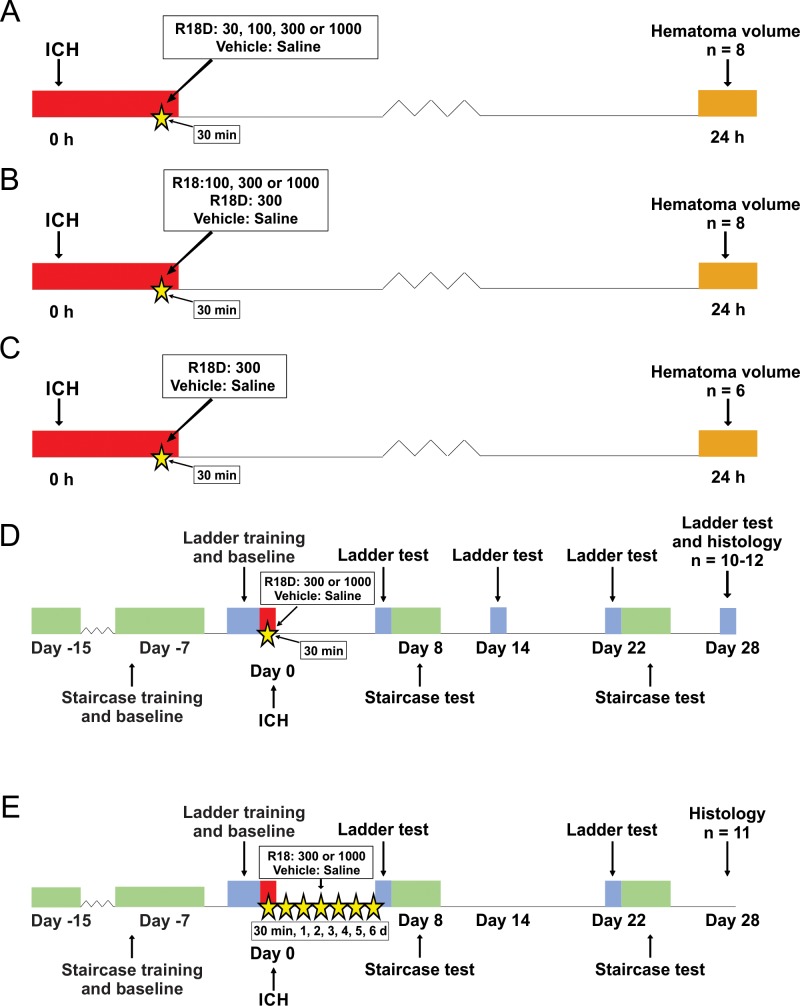
One hundred and fifty-eight male Sprague-Dawley rats received collagenase-induced ICH. Study 1 examined various doses of R18D (30, 100, 300, or 1000 nmol/kg) or R18 (100, 300, 1000 nmol/kg) administered intravenously 30 minutes post-collagenase injection on hemorrhage volume 24 hours after ICH. Study 2 examined R18D (single intravenous dose) or R18 (single intravenous dose, plus 6 daily intraperitoneal doses) at 300 or 1000 nmol/kg commencing 30 minutes post-collagenase injection on behavioural outcomes (Montoya staircase test, and horizontal ladder test) in the chronic post-ICH period. A histological assessment of tissue loss was assessed using a Nissl stain at 28 days after ICH.
When administered during ongoing bleeding, neither R18 or R18D exacerbated hematoma volume or worsened functional deficits. Lesion volume assessment at 28 days post-ICH was not reduced by the peptides; however, animals treated with the lower R18D 300 nmol/kg dose, but not with the higher 1000 nmol/kg dose, demonstrated a statistically increased lesion size compared to saline treated animals.
Overall, both R18 and R18D appeared to be safe when administered during a period of ongoing bleeding following ICH. Neither peptide appears to have any statistically significant effect in reducing lesion volume or improving functional recovery after ICH. Additional studies are required to further assess dose efficacy and safety in pre-clinical ICH studies.
阳离子精氨酸丰富肽(CARPs)已在缺血性和出血性中风以及创伤性脑损伤模型中显示出神经保护和/或行为功效。因此,在这项研究中,我们研究了在脑出血(ICH)模型的急性出血期给予阳离子精氨酸丰富肽聚精氨酸-18(R18;18 个精氨酸)及其 D-对映体 R18D 的安全性和神经保护功效。
158 只雄性 Sprague-Dawley 大鼠接受胶原酶诱导的 ICH。研究 1 检查了 R18D(30、100、300 或 1000 nmol/kg)或 R18(100、300、1000 nmol/kg)的各种剂量,这些剂量在胶原酶注射后 30 分钟静脉内给药,ICH 后 24 小时检查血肿体积。研究 2 在慢性 ICH 后期,检查 R18D(单次静脉内剂量)或 R18(单次静脉内剂量,加 6 次每日腹膜内剂量)在 300 或 1000 nmol/kg 时的行为结果(Montoya 楼梯测试和水平梯测试)。ICH 后 28 天使用 Nissl 染色对组织丢失进行组织学评估。
当在持续出血期间给药时,R18 或 R18D 均不会加重血肿体积或加重功能缺陷。ICH 后 28 天的病变体积评估并未减少肽;然而,用较低的 R18D 300 nmol/kg 剂量治疗的动物,而不是用较高的 1000 nmol/kg 剂量治疗的动物,与生理盐水处理的动物相比,病变大小有统计学上的增加。
总体而言,R18 和 R18D 在 ICH 后持续出血期间给药时似乎是安全的。两种肽都没有在减少 ICH 后病变体积或改善功能恢复方面表现出任何统计学上的显著效果。需要进一步的研究来进一步评估临床前 ICH 研究中的剂量功效和安全性。