MRC Unit for Lifelong and Health Ageing at UCL, Department of Population Health and Experimental Medicine, University College London, London, UK.
Department of Epidemiology and Public Health, University College London, 1-19 Torrington Place, London, WC1E 7HB, UK.
Syst Rev. 2019 Nov 7;8(1):263. doi: 10.1186/s13643-019-1197-z.
The relation between socioeconomic position (SEP) and obesity measured by body mass index (BMI) has been extensively reviewed, but there is less research on the association between SEP and body composition. Fat distribution and muscle quality have been linked to adverse health outcomes such as cardiovascular disease, diabetes and poor physical capability. There is some evidence of secular changes in body composition with increasing fat-mass and reducing muscle quantity and strength, but it is unclear whether there have been secular changes in social inequalities in body composition. The aim is to perform a systematic review of the existing literature on the association between SEP and body composition and to explore any secular changes.
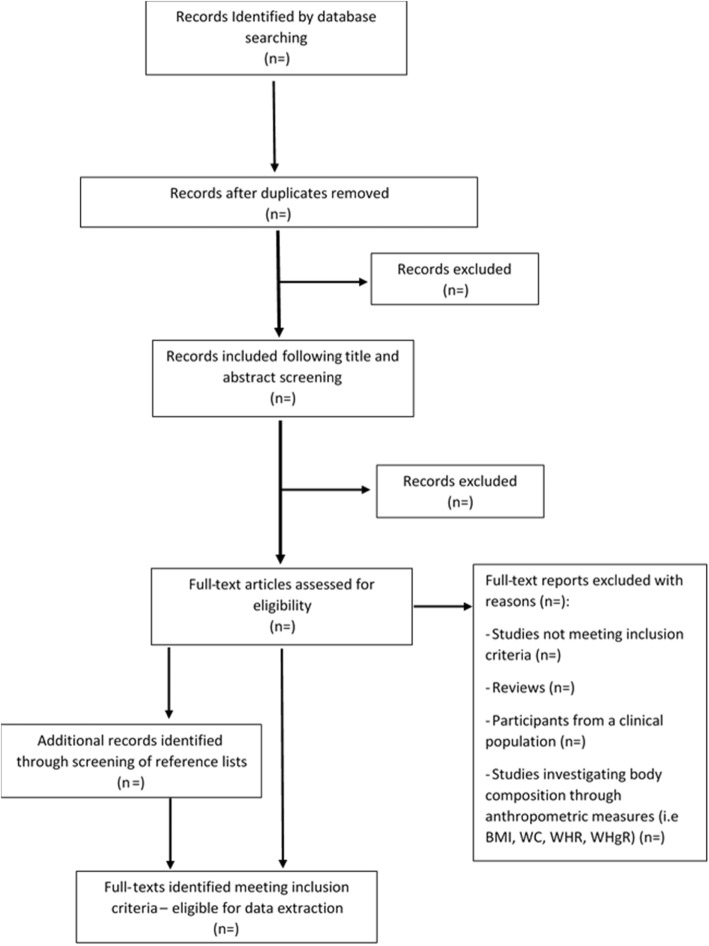
The systematic review will be carried out according to PRISMA guidelines. An electronic search of MEDLINE and Embase Classic + Embase will be conducted using OvidSP as the database interface, as well as SPORTDiscus using EBSCO. Two independently working reviewers will initially screen abstracts to exclude papers that are clearly ineligible, followed by a full-text screening to exclude papers not meeting all inclusion criteria. Any disagreements will be resolved through discussion. Data extraction and quality assessment of eligible papers will be carried out by 2 reviewers using a standardised form. The reference lists of identified papers will be searched for additional papers. Original studies in the English language, which examine the association between SEP at any age and body composition at the same or later age will be included if they use any recognised measures of SEP (e.g. income, occupation, over-crowding) and a recognised measure of body composition (total, proportional or location of fat mass and fat-free mass, using any appropriate methods, excluding anthropometry). Due to expected heterogeneity, a narrative synthesis is expected, with a descriptive summary to be provided in tables. If there is consistency in reporting of associations, a random-effects meta-analysis will be used to provide an overall summary estimate.
The results of the review will summarise the existing evidence on social inequalities in body composition. Findings will identify gaps in knowledge and where further research is required.
PROSPERO CRD42019119937.
社会经济地位(SEP)与身体质量指数(BMI)衡量的肥胖之间的关系已被广泛研究,但关于 SEP 与身体成分之间的关系的研究较少。脂肪分布和肌肉质量与心血管疾病、糖尿病和身体机能差等不良健康结果有关。有一些证据表明,身体成分随着脂肪量的增加和肌肉量和力量的减少而发生了长期变化,但尚不清楚身体成分的社会不平等是否发生了长期变化。目的是对现有关于 SEP 与身体成分之间关系的文献进行系统评价,并探讨任何长期变化。
系统评价将按照 PRISMA 指南进行。将通过 OvidSP 作为数据库接口,在 MEDLINE 和 Embase Classic + Embase 中进行电子搜索,并使用 EBSCO 的 SPORTDiscus 进行搜索。两名独立工作的审查员将首先筛选摘要以排除明显不合格的论文,然后进行全文筛选以排除不符合所有纳入标准的论文。任何分歧将通过讨论解决。两名审查员将使用标准化表格提取合格论文的数据并评估其质量。将搜索确定论文的参考文献列表以获取其他论文。如果原始研究使用任何公认的 SEP 测量方法(例如收入、职业、过度拥挤)和公认的身体成分测量方法(使用任何适当的方法测量总身体成分、比例或脂肪质量和无脂肪质量的位置,排除人体测量),研究任何年龄的 SEP 与同一或以后年龄的身体成分之间的关系,并以英文发表,将包括在内。由于预期存在异质性,预计将进行叙述性综合,并在表格中提供描述性总结。如果报告的关联具有一致性,则将使用随机效应荟萃分析提供总体汇总估计。
审查结果将总结关于身体成分社会不平等的现有证据。研究结果将确定知识差距和需要进一步研究的地方。
PROSPERO CRD42019119937。