Pediatric Endocrinology and Diabetes Unit, Dana-Dwek Children's Hospital, Tel Aviv Sourasky Medical Center, Tel Aviv, Israel.
Sackler Faculty of Medicine, Tel Aviv University, Tel Aviv, Israel.
BMC Pediatr. 2021 May 8;21(1):225. doi: 10.1186/s12887-021-02695-z.
Physical growth during childhood and adolescence is influenced by both genetic and environmental factors. Heritability, the proportion of phenotypic variance explained by genetic factors, has been demonstrated for stature and weight status. The aim of this study was to explore the heritability of body composition.
A real-life, observational study of the children and adolescents referred to the Endocrine Unit in a tertiary medical center. In January 2018, body composition by means of bioimpedance analysis (BIA) was implemented as part of the standard intake assessment of subjects referred for endocrine consultation. The clinic BIA database was searched for subjects with the term "observation of growth" as the sole reason for referral. BIA of 114 triads of healthy subjects aged 5-18 years and their parents were analyzed. The BIA report included the following data: fat mass, fat percentage, truncal fat percentage and muscle mass. Calculated variables included: appendicular skeletal muscle mass (ASMM = the sum of muscle mass of four limbs), muscle-to-fat ratio [MFR = ASMM (kg)/fat mass (kg)] and sarcopenic index [(SI = ASMM(kg)/height (meter)²]. Data collection from medical files included pubertal stage and home address for socioeconomic position grading.
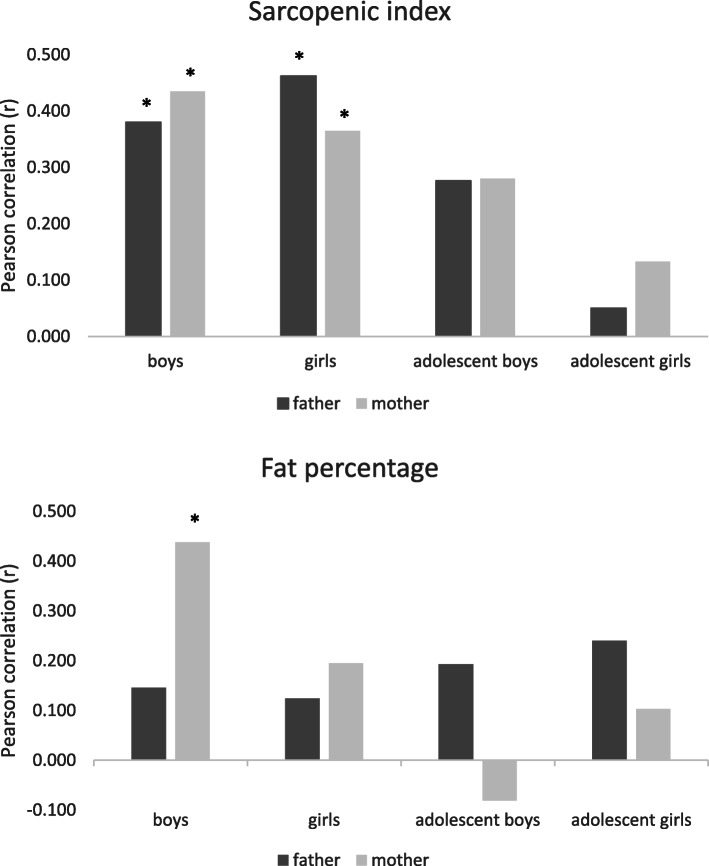
There were sex differences in body composition parameters in both the prepubertal and pubertal subjects. The boys among the prepubertal subjects had a lower fat percentage on average than girls (p = 0.020). Among the adolescents, boys on average had lower fat percentage (p = 0.011), higher sarcopenic index (p = 0.021), and higher muscle-to-fat ratio (p < 0.001), than adolescent girls. Correlation analyses between body composition parameters of all participants revealed significant correlations in the sarcopenic index of prepubertal children and their parents (boys-fathers: r = 0.380, p = 0.050; boys-mothers: r = 0.435, p = 0.026; girls-fathers: r = 0.462, p = 0.012; girls-mothers: r = 0.365, p = 0.050) and adiposity indices (fat percentage, truncal fat percentage and muscle-to-fat ratio) of prepubertal boys and their mothers (r = 0.438, p = 0.025; r = 0.420, p = 0.033, and r = 0.478, p = 0.014, respectively). There were no associations between body composition parameters of adolescents and their parents. Socioeconomic position adversely affected fat percentage in adolescent girls and mothers.
Heritable body composition traits were demonstrated in childhood but not in adolescence, suggesting that environmental influence has a more telling effect during teenage years.
儿童和青少年时期的身体生长受遗传和环境因素的影响。遗传力,即遗传因素解释表型变异的比例,已经在身高和体重状况方面得到了证明。本研究的目的是探讨身体成分的遗传力。
这是一项针对三级医疗中心内分泌科就诊儿童和青少年的真实、观察性研究。2018 年 1 月,通过生物阻抗分析(BIA)实施了身体成分检查,作为内分泌咨询就诊标准摄入评估的一部分。在诊所 BIA 数据库中,搜索以“生长观察”为唯一就诊原因的患者。分析了 114 对年龄在 5-18 岁之间的健康受试者及其父母的 BIA 数据。BIA 报告包括以下数据:体脂肪量、体脂百分比、躯干脂肪百分比和肌肉量。计算的变量包括:四肢骨骼肌量(ASMM=四肢肌肉量之和)、肌肉与脂肪比[MFR=ASMM(kg)/体脂肪量(kg)]和肌少症指数[SI=ASMM(kg)/身高(米)²]。从病历中收集的数据包括青春期阶段和家庭住址,用于社会经济地位分级。
在青春期前和青春期的受试者中,身体成分参数存在性别差异。青春期前的男孩平均体脂百分比低于女孩(p=0.020)。在青少年中,男孩的体脂百分比平均较低(p=0.011),肌少症指数较高(p=0.021),肌肉与脂肪比更高(p<0.001),而青春期女孩则相反。所有参与者的身体成分参数的相关分析显示,青春期前儿童及其父母的肌少症指数存在显著相关性(男孩-父亲:r=0.380,p=0.050;男孩-母亲:r=0.435,p=0.026;女孩-父亲:r=0.462,p=0.012;女孩-母亲:r=0.365,p=0.050)和青春期前男孩及其母亲的肥胖指数(体脂肪百分比、躯干脂肪百分比和肌肉与脂肪比)存在相关性(r=0.438,p=0.025;r=0.420,p=0.033;r=0.478,p=0.014)。青少年的身体成分参数与父母之间没有关联。社会经济地位对青春期女孩和母亲的体脂百分比有不利影响。
在儿童时期表现出可遗传的身体成分特征,但在青春期则没有,这表明环境影响在青少年时期更为重要。