He Jianwen, Guo Huiduo, Zheng Weijiang, Xue Yongqiang, Zhao Ruqian, Yao Wen
1Laboratory of Gastrointestinal Microbiology, Jiangsu Key Laboratory of Gastrointestinal Nutrition and Animal Health, College of Animal Science and Technology, Nanjing Agricultural University, Nanjing, Jiangsu People's Republic of China 210095.
2National Experimental Teaching Center for Animal Science, College of Animal Science and Technology, Nanjing Agricultural University, Nanjing, Jiangsu People's Republic of China 210095.
J Anim Sci Biotechnol. 2019 Nov 4;10:84. doi: 10.1186/s40104-019-0391-0. eCollection 2019.
Heat stress (HS) jeopardizes intestinal barrier functions and augments intestinal permeability in pigs. However, whether HS-induced maternal microbial and metabolic changes in primiparous sows during late gestation remains elusive. We present here, a study investigating the fecal microbial and metabolic responses in late gestational primiparous sows when exposed to HS.
Twelve first-parity Landrace × Large White F1 sows were randomly assigned into two environmental treatments including the thermoneutral (TN) (18-22 °C; = 6) and HS (28-32 °C; = 6) conditions. Both treatments were applied from 85 d of gestation to farrowing. The serum and feces samples were collected on d 107 of gestation, for analyses including intestinal integrity biomarkers, high-throughput sequencing metagenomics, short-chain fatty acid (SCFA) profiles and nontargeted metabolomics.
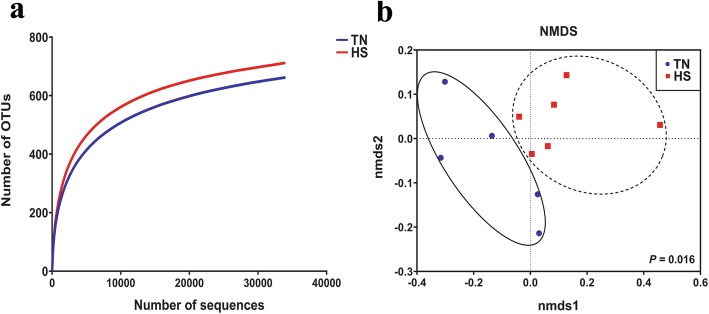
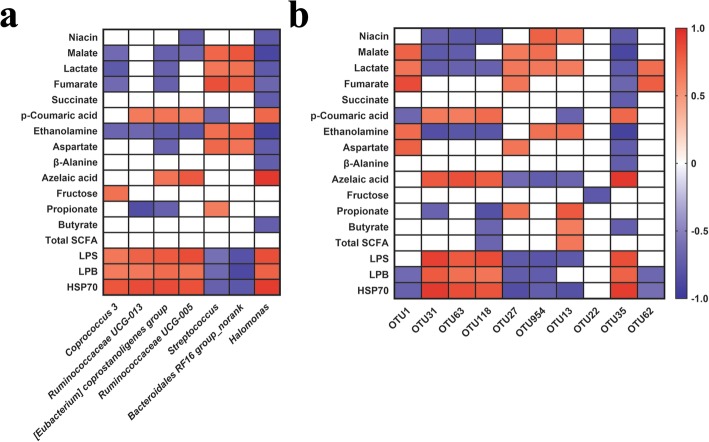
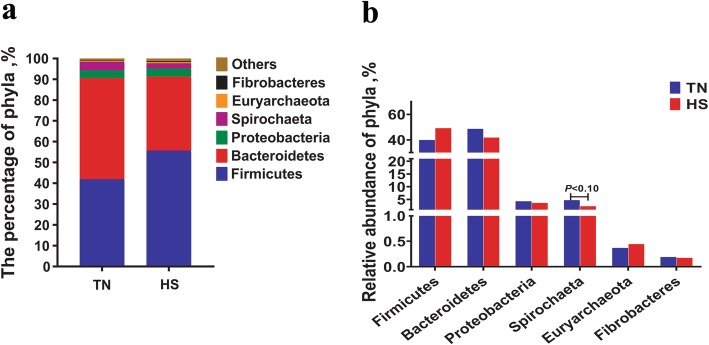
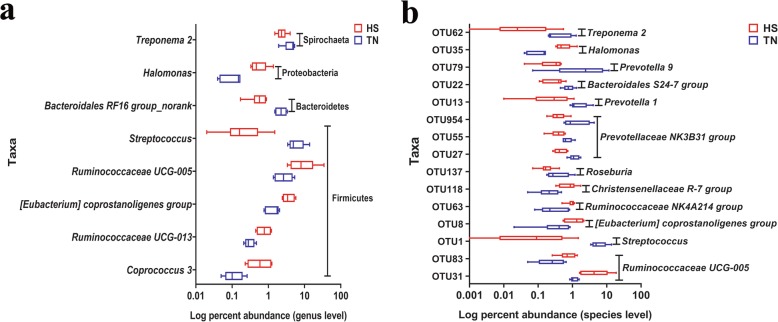
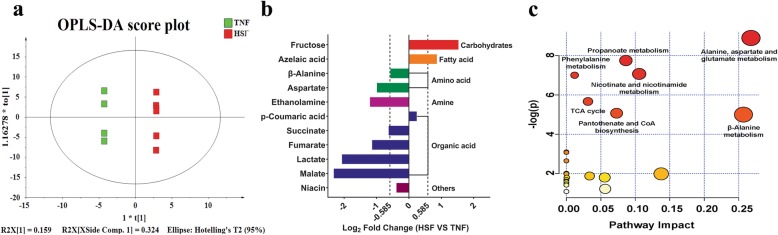
Our results show that HS group has higher serum Heat shock protein 70 (HSP70), lipopolysaccharide (LPS) and lipopolysaccharide-binding protein (LBP) levels. The gut microbial community can be altered upon HS by using β-diversity and taxon-based analysis. In particular, the relative abundance of genera and operational taxonomic units (OTUs) related to Clostridiales and are higher in HS group, the relative abundance of genera and OTUs related to Bacteroidales and , however, are lower in HS group. Results of metabolic analysis reveal that HS lowers the concentrations of propionate, butyrate, total SCFA, succinate, fumarate, malate, lactate, aspartate, ethanolamine, β-alanine and niacin, whereas that of fructose and azelaic acid are higher in HS group. These metabolites mainly affect propanoate metabolism, alanine, aspartate and glutamate metabolism, phenylalanine metabolism, β-alanine metabolism, pantothenate and CoA biosynthesis, tricarboxylic acid cycle (TCA) and nicotinate and nicotinamide metabolism. Additionally, correlation analysis between significant microbes and metabolites indicated that the HS-induced microbiota shift is likely the cause of changes of intestinal metabolism.
Taken together, we reveal characteristic structural and metabolic changes in maternal gut microbiota as a result of late gestational HS, which could potentially provide the basis for further study on offspring gut microbiota and immune programming.
热应激(HS)会损害猪的肠道屏障功能并增加肠道通透性。然而,妊娠后期初产母猪中热应激诱导的母体微生物和代谢变化仍不清楚。在此,我们展示一项研究,调查妊娠后期初产母猪暴露于热应激时的粪便微生物和代谢反应。
将12头第一胎长白×大白F1母猪随机分为两种环境处理组,包括热中性(TN)(18 - 22°C;n = 6)和热应激(HS)(28 - 32°C;n = 6)条件。两种处理从妊娠第85天开始应用至分娩。在妊娠第107天采集血清和粪便样本,用于包括肠道完整性生物标志物、高通量测序宏基因组学、短链脂肪酸(SCFA)谱和非靶向代谢组学的分析。
我们的结果表明,热应激组血清热休克蛋白70(HSP70)、脂多糖(LPS)和脂多糖结合蛋白(LBP)水平较高。通过β - 多样性和基于分类群的分析发现,热应激会改变肠道微生物群落。特别是,热应激组中与梭菌目相关的属和操作分类单元(OTU)的相对丰度较高,而与拟杆菌目相关的属和OTU的相对丰度在热应激组中较低。代谢分析结果显示,热应激会降低丙酸、丁酸、总SCFA、琥珀酸、富马酸、苹果酸、乳酸、天冬氨酸、乙醇胺、β - 丙氨酸和烟酸的浓度,而热应激组中果糖和壬二酸的浓度较高。这些代谢物主要影响丙酸代谢、丙氨酸、天冬氨酸和谷氨酸代谢、苯丙氨酸代谢、β - 丙氨酸代谢、泛酸和辅酶A生物合成、三羧酸循环(TCA)以及烟酸和烟酰胺代谢。此外,显著微生物与代谢物之间的相关性分析表明,热应激诱导的微生物群转移可能是肠道代谢变化的原因。
综上所述,我们揭示了妊娠后期热应激导致母体肠道微生物群的特征性结构和代谢变化,这可能为进一步研究后代肠道微生物群和免疫编程提供基础。