
一项准实验研究,考察在工作场所实施基于健身的健康风险评估和身体活动咨询干预的影响及挑战。
A Quasi-Experimental Study Examining the Impact and Challenges of Implementing a Fitness-Based Health Risk Assessment and a Physical Activity Counseling Intervention in the Workplace Setting.
作者信息
Hamm Naomi C, Kehler D Scott, Hay Jacqueline L, Stammers Andrew N, Strachan Shaelyn M, Bouchard Danielle R, Duhamel Todd A
机构信息
Department of Community Health Sciences, University of Manitoba, McDermot Ave Winnipeg, Manitoba, Canada.
Division of Geriatric Medicine, Dalhousie University Halifax, Nova Scotia, Canada.
出版信息
Health Serv Res Manag Epidemiol. 2019 Oct 31;6:2333392819884183. doi: 10.1177/2333392819884183. eCollection 2019 Jan-Dec.
OBJECTIVES
Few adults participate in enough physical activity for health benefits. The workplace provides a unique environment to deliver heath interventions and can be beneficial to the employee and the employer. The purpose of the study was to explore the use of a physical activity counseling (PAC) program and a fitness-based health risk assessment (fHRA) in the hospital workplace.
METHODS
A workplace-based intervention was developed utilizing a PAC program and an fHRA to improve physical activity levels of employees. Hospital employees were enrolled in a 4-month PAC program and given the option to also enroll in an fHRA program (PAC + fHRA). Physical activity was assessed by accelerometry and measured at baseline, 2 months, and 4 months. Changes in musculoskeletal fitness for those in the fHRA program were assessed at baseline and 2 months.
RESULTS
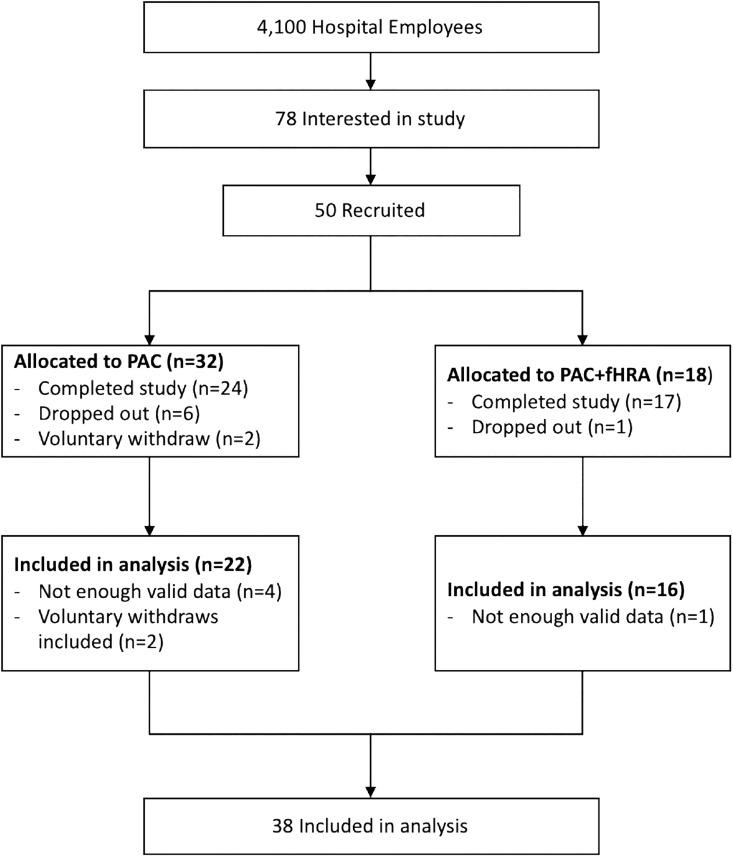
For both groups (PAC n = 22; PAC + fHRA n = 16), total and moderate to vigorous physical activity in bouts of 10 minutes or more increased significantly by 18.8 ( = .004) and 10.2 ( = .048) minutes per week at each data collection point, respectively. Only participants with gym memberships demonstrated increases in light physical activity over time. Those in the fHRA group significantly increased their overall musculoskeletal fitness levels from baseline levels (18.2 vs 21.7, < .001). There was no difference in the change in physical activity levels between the groups.
CONCLUSIONS
A PAC program in the workplace may increase physical activity levels within 4 months. The addition of an fHRA does not appear to further increase physical activity levels; however, it may improve overall employee musculoskeletal fitness levels.
目的
很少有成年人进行足够的体育活动以获得健康益处。工作场所提供了一个独特的环境来实施健康干预措施,对员工和雇主都有益处。本研究的目的是探讨在医院工作场所使用体育活动咨询(PAC)计划和基于健身的健康风险评估(fHRA)的情况。
方法
利用PAC计划和fHRA开发了一项基于工作场所的干预措施,以提高员工的体育活动水平。医院员工参加了为期4个月的PAC计划,并可选择参加fHRA计划(PAC + fHRA)。通过加速度计评估体育活动,并在基线、2个月和4个月时进行测量。对fHRA计划参与者的肌肉骨骼健康变化在基线和2个月时进行评估。
结果
对于两组(PAC组n = 22;PAC + fHRA组n = 16),每次数据收集点时,10分钟或更长时间的总体育活动以及中度至剧烈体育活动每周分别显著增加18.8(P = .004)和10.2(P = .048)分钟。只有拥有健身房会员资格的参与者随着时间的推移轻度体育活动有所增加。fHRA组的参与者总体肌肉骨骼健康水平较基线水平显著提高(18.2对21.7,P < .001)。两组之间体育活动水平的变化没有差异。
结论
工作场所的PAC计划可能在4个月内提高体育活动水平。增加fHRA似乎不会进一步提高体育活动水平;然而,它可能会改善员工的总体肌肉骨骼健康水平。
 Zotero 插件