Population Health Sciences, Bristol Medical School, University of Bristol, Bristol, England.
Bristol Medical School, University of Bristol, Canynge Hall, Whatley Road, Bristol, BS8 2PS, England.
BMC Public Health. 2019 Apr 24;19(1):427. doi: 10.1186/s12889-019-6791-4.
Opportunities for working adults to accumulate recommended physical activity levels (at least 150 min of moderate intensity physical activity in bouts of at least 10 min throughout the week) may include the commute to work. Systematic reviews of interventions to increase active transport suggest studies have tended to be of poor quality, relying on self-report and lacking robust statistical analyses.
We conducted a multi-centre parallel-arm cluster randomised controlled trial, in workplaces in south-west England and south Wales, to assess the effectiveness of a behavioural intervention to increase walking during the commute. Workplace-based Walk to Work promoters were trained to implement a 10-week intervention incorporating key behavioural change techniques: providing information; encouraging intention formation; identifying barriers and solutions; goal setting; self-monitoring; providing general encouragement; identifying social support; reviewing goals, and; relapse prevention. Physical activity outcomes were objectively measured using accelerometers and GPS receivers at baseline and 12-month follow-up. The primary outcome was daily minutes of moderate to vigorous physical activity (MVPA). Secondary outcomes included overall levels of physical activity and modal shift (from private car to walking). Cost-consequences analysis included employer, employee and health service costs and outcomes.
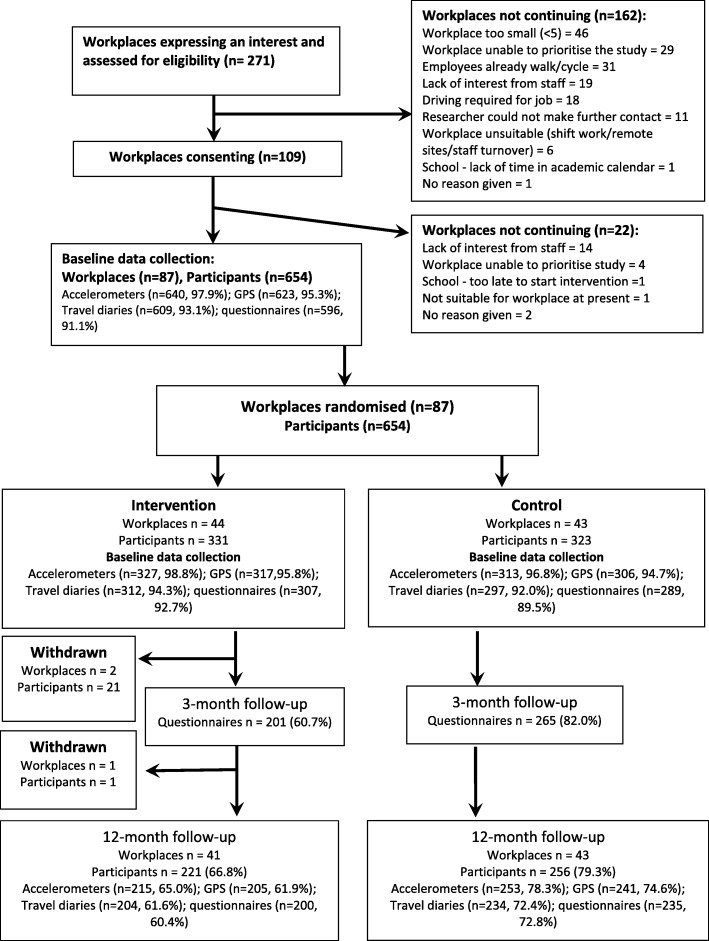
Six hundred fifty-four participants were recruited across 87 workplaces: 10 micro (5-9 employees); 35 small (10-49); 22 medium (50-250); 20 large (250+). The majority of participants lived more than two kilometres from their place of work (89%) and travelled to work by car (65%). At 12-month follow-up, 84 workplaces (41 intervention, 43 control) and 477 employees (73% of those originally recruited) took part in data collection activities. There was no evidence of an intervention effect on MVPA or overall physical activity at 12-month follow-up. The intervention cost on average £181.97 per workplace and £24.19 per participating employee.
The intervention, focusing primarily on individual behaviour change, was insufficient to change travel behaviour. Our findings contribute to the argument that attention should be directed towards a whole systems approach, focusing on interactions between the correlates of travel behaviour.
ISRCTN15009100 . Prospectively registered. (Date assigned: 10/12/2014).
对于工作成年人来说,有机会积累推荐的身体活动水平(每周至少进行 150 分钟中等强度的身体活动,每次至少 10 分钟),包括通勤。系统评价表明,增加积极交通的干预措施往往质量较差,依赖于自我报告,缺乏强有力的统计分析。
我们在英格兰西南部和威尔士的工作场所进行了一项多中心平行臂集群随机对照试验,以评估一种行为干预措施在增加通勤期间步行的效果。培训以工作场所为基础的步行上班促进者实施为期 10 周的干预措施,该措施结合了关键的行为改变技术:提供信息;鼓励意图形成;识别障碍和解决方案;设定目标;自我监测;提供一般鼓励;识别社会支持;审查目标;和防止复发。使用加速度计和 GPS 接收器在基线和 12 个月随访时客观测量身体活动结果。主要结果是每天中等至剧烈体力活动(MVPA)的分钟数。次要结果包括整体身体活动水平和模式转移(从私人汽车到步行)。成本-后果分析包括雇主、员工和卫生服务的成本和结果。
在 87 个工作场所共招募了 654 名参与者:10 个微型(5-9 名员工);35 个小型(10-49 名员工);22 个中型(50-250 名员工);20 个大型(250 名以上员工)。大多数参与者住的地方离工作地点超过两公里(89%),而且乘汽车上班(65%)。在 12 个月的随访中,84 个工作场所(41 个干预组,43 个对照组)和 477 名员工(最初招募的员工的 73%)参加了数据收集活动。在 12 个月的随访中,没有证据表明干预对 MVPA 或整体身体活动有影响。干预的平均成本为每个工作场所 181.97 英镑,每个参与员工 24.19 英镑。
该干预措施主要侧重于个体行为改变,不足以改变出行行为。我们的研究结果有助于证明,应将注意力集中在整个系统的方法上,重点放在出行行为的相关因素之间的相互作用上。
ISRCTN8436534. 前瞻性注册。(分配日期:2014 年 12 月 10 日)。