Departments of Urology, the First Affiliated Hospital of Fujian Medical University, Fuzhou, China.
Mol Genet Genomic Med. 2020 Jan;8(1):e1032. doi: 10.1002/mgg3.1032. Epub 2019 Nov 7.
The aim of this study was to generate a prognostic model to predict survival outcome in pediatric Wilms tumor (WT).
The data including mRNA expression and clinical information of pediatric WT patients were downloaded from the Therapeutically Available Research to Generate Effective Treatments (TARGET) database. The differentially expressed genes were identified and a prognostic signature of pediatric WT was generated according to the results of univariate and multivariate Cox analysis. Receiver operating characteristic (ROC) curve was used to evaluate the five-mRNA signature in pediatric Wilms tumor patients. Bootstrap test with 500 times was used to perform the internal validation.
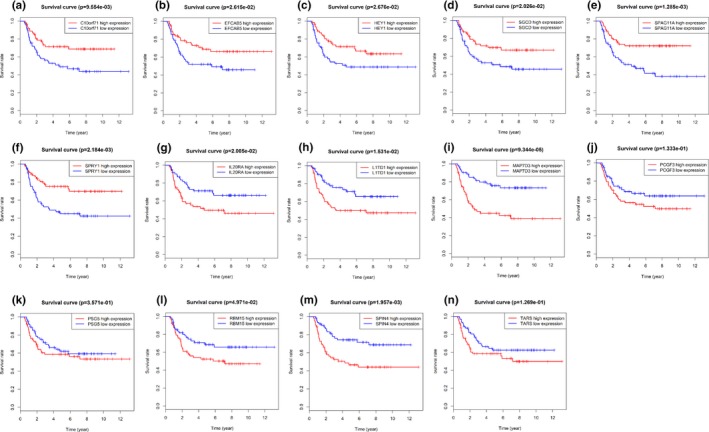
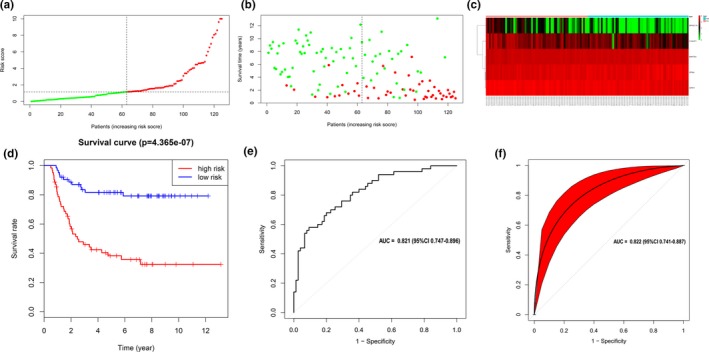
We identified 6,964 differentially expressed mRNAs associated with pediatric WT, including 3,190 downregulated mRNAs and 3,774 up-regulated mRNAs. Univariate and multivariate Cox analysis identified five mRNAs (SPRY1, SPIN4, MAP7D3, C10orf71, and SPAG11A) to establish a predictive model. The risk score formula is as follows: Risk score = 0.3036SPIN4 + 0.8576MAP7D3 -0.1548C10orf71 -0.7335SPRY1 -0.2654*SPAG11A. The pediatric WT patients were divided into low-risk group and high-risk group based on the median risk score (value = 1.1503). The receiver operating characteristic (ROC) curve analysis revealed good performance of the 5-mRNA prognostic model (the area under the curve [AUC] was 0.821). Bootstrap test (Bootstrap resampling times = 500) was used to perform the internal validation and revealed that the AUC was 0.822. REACTOME, KEGG, and BIOCARTA pathway analyses demonstrated that these survival-related genes were mainly enriched in ErbB2 and ErbB3 signaling pathways, and calcium signaling pathway.
The five-mRNA signature can predict the prognosis of patients with pediatric WT. It has significant implication in the understanding of therapeutic targets for pediatric WT patients. However, further study is needed to validate this five-mRNA signature and uncover more novel diagnostic or prognostic mRNAs candidates in pediatric WT patients.
本研究旨在构建预测儿童肾母细胞瘤(WT)生存结局的预后模型。
从 Therapeutically Available Research to Generate Effective Treatments(TARGET)数据库中下载儿童 WT 患者的 mRNA 表达谱和临床信息数据。根据单因素和多因素 Cox 分析结果,鉴定差异表达基因,并构建儿童 WT 的预后签名。采用受试者工作特征(ROC)曲线评估该五基因 mRNA 标志物在儿童 Wilms 肿瘤患者中的表现。通过 500 次重复的 Bootstrap 测试进行内部验证。
我们鉴定出与儿童 WT 相关的 6964 个差异表达的 mRNAs,包括 3190 个下调的 mRNAs 和 3774 个上调的 mRNAs。单因素和多因素 Cox 分析确定了五个 mRNAs(SPRY1、SPIN4、MAP7D3、C10orf71 和 SPAG11A)来建立预测模型。风险评分公式如下:风险评分=0.3036SPIN4+0.8576MAP7D3-0.1548C10orf71-0.7335SPRY1-0.2654*SPAG11A。根据中位数风险评分(值=1.1503),将儿童 WT 患者分为低风险组和高风险组。受试者工作特征(ROC)曲线分析显示,该五基因预后模型具有良好的性能(曲线下面积[AUC]为 0.821)。通过 500 次重复的 Bootstrap 测试进行内部验证,AUC 为 0.822。REACTOME、KEGG 和 BIOCARTA 通路分析表明,这些与生存相关的基因主要富集在 ErbB2 和 ErbB3 信号通路以及钙信号通路中。
该五基因特征可预测儿童 WT 患者的预后,对理解儿童 WT 患者的治疗靶点具有重要意义。然而,需要进一步研究来验证该五基因特征,并发现更多新的儿童 WT 患者的诊断或预后候选基因。