The Sixth Affiliated Hospital of Guangzhou Medical University, Qingyuan, Guangdong 511500, China.
Department of Urology, The Eighth Affiliated Hospital, Sun Yat-sen University, Shenzhen, Guangdong 518033, China.
Dis Markers. 2022 May 7;2022:2651105. doi: 10.1155/2022/2651105. eCollection 2022.
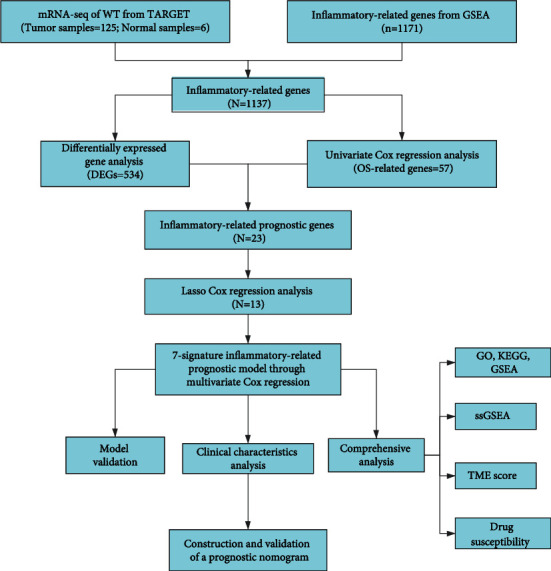
Wilms tumor (WT) is a common pediatric renal cancer, with a poor prognosis and high-risk recurrence in some patients. The inflammatory microenvironment is gradually gaining attention in WT. In this study, novel inflammation-related signatures and prognostic model were explored and integrated using bioinformatics analysis. The mRNA profile of pediatric patients with WT and inflammation-related genes (IRGs) were acquired from Therapeutically Available Research to Generate Effective Treatments (TARGET) and Gene Set Enrichment Analysis (GSEA) databases, respectively. Then, a novel prognostic model founded on 7-IRGs signature (BICC1, CSPP1, KRT8, MYCN, NELFA, NXN, and RNF113A) was established by the least absolute shrinkage and selection operator (LASSO) and multivariate Cox regression to stratify pediatric patients with WT into high- and low-risk groups successfully. And a stable performance of the prognostic risk model was verified in predicting overall survival (OS) by receiver-operating characteristic (ROC) curves, Kaplan-Meier (KM) curves, and independent prognostic analysis ( < 0.05). In addition, a novel nomogram integrating risk scores with good robustness was developed and validated by -index, ROC, and calibration plots. The potential function and pathway were explored via Gene Ontology (GO), Kyoto Encyclopedia of Genes and Genomes (KEGG), and GSEA, with mainly inflammation and immune-related biological processes. The higher-risk scores, the lower immune infiltration, as shown in the single-sample GSEA (ssGSEA) and tumor microenvironment (TME) analysis. The drug sensitivity analysis showed that regulating 7-IRGs signature has a significant correlation with the chemotherapy drugs of WT patients. In summary, this study defined a prognostic risk model and nomogram based on 7-IRGs signature, which may provide novel insights into clinical prognosis and inflammatory study in WT patients. Besides, enhancing immune infiltration based on inflammatory response and regulating 7-IRGs signature are beneficial to ameliorating the efficacy in WT patients.
威尔姆斯瘤(WT)是一种常见的小儿肾母细胞瘤,部分患者预后不良,且有较高的复发风险。炎症微环境在 WT 中逐渐受到关注。本研究通过生物信息学分析,探讨并整合了新的炎症相关特征和预后模型。分别从 Therapeutically Available Research to Generate Effective Treatments(TARGET)和 Gene Set Enrichment Analysis(GSEA)数据库中获取小儿 WT 患者的 mRNA 谱和炎症相关基因(IRGs)。然后,通过最小绝对收缩和选择算子(LASSO)和多变量 Cox 回归建立了一个基于 7-IRGs 特征(BICC1、CSPP1、KRT8、MYCN、NELFA、NXN 和 RNF113A)的新型预后模型,成功地将小儿 WT 患者分为高风险和低风险组。预后风险模型的稳定性通过 ROC 曲线、Kaplan-Meier(KM)曲线和独立预后分析(<0.05)来预测总生存率(OS)得到验证。此外,通过-指数、ROC 和校准图,开发并验证了一个新的整合风险评分的诺莫图,具有良好的稳健性。通过基因本体论(GO)、京都基因与基因组百科全书(KEGG)和 GSEA 进行了潜在功能和途径的探索,主要涉及炎症和免疫相关的生物学过程。单样本 GSEA(ssGSEA)和肿瘤微环境(TME)分析显示,风险评分越高,免疫浸润越低。药物敏感性分析表明,调节 7-IRGs 特征与 WT 患者的化疗药物显著相关。综上所述,本研究基于 7-IRGs 特征定义了一个预后风险模型和诺莫图,可能为 WT 患者的临床预后和炎症研究提供新的见解。此外,基于炎症反应增强免疫浸润和调节 7-IRGs 特征,有利于改善 WT 患者的疗效。