Centre for Genomic Regulation (CRG), The Barcelona Institute of Science and Technology, Barcelona, Spain.
CNAG-CRG, Centre for Genomic Regulation (CRG), Barcelona Institute of Science and Technology (BIST), Barcelona, Spain.
Mol Biol Evol. 2020 Mar 1;37(3):730-756. doi: 10.1093/molbev/msz261.
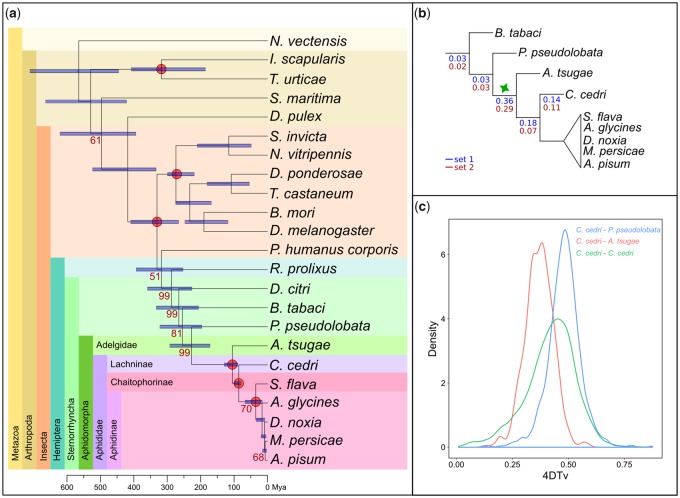
Aphids (Aphidoidea) are a diverse group of hemipteran insects that feed on plant phloem sap. A common finding in studies of aphid genomes is the presence of a large number of duplicated genes. However, when these duplications occurred remains unclear, partly due to the high relatedness of sequenced species. To better understand the origin of aphid duplications we sequenced and assembled the genome of Cinara cedri, an early branching lineage (Lachninae) of the Aphididae family. We performed a phylogenomic comparison of this genome with 20 other sequenced genomes, including the available genomes of five other aphids, along with the transcriptomes of two species belonging to Adelgidae (a closely related clade to the aphids) and Coccoidea. We found that gene duplication has been pervasive throughout the evolution of aphids, including many parallel waves of recent, species-specific duplications. Most notably, we identified a consistent set of very ancestral duplications, originating from a large-scale gene duplication predating the diversification of Aphidomorpha (comprising aphids, phylloxerids, and adelgids). Genes duplicated in this ancestral wave are enriched in functions related to traits shared by Aphidomorpha, such as association with endosymbionts, and adaptation to plant defenses and phloem-sap-based diet. The ancestral nature of this duplication wave (106-227 Ma) and the lack of sufficiently conserved synteny make it difficult to conclude whether it originated from a whole-genome duplication event or, alternatively, from a burst of large-scale segmental duplications. Genome sequencing of other aphid species belonging to different Aphidomorpha and related lineages may clarify these findings.
蚜虫(Aphidoidea)是一类多样化的半翅目昆虫,以植物韧皮部汁液为食。在蚜虫基因组研究中,一个常见的发现是大量重复基因的存在。然而,这些重复发生的时间尚不清楚,部分原因是测序物种之间的高度相似性。为了更好地了解蚜虫重复的起源,我们对鳞翅目蚜科(Lachninae)的早期分支(Cinara cedri)进行了基因组测序和组装。我们对这个基因组与 20 个其他测序基因组进行了系统基因组比较,包括 5 种其他蚜虫的现有基因组,以及两个属于蚜科(与蚜虫密切相关的类群)和蚧总科的物种的转录组。我们发现,基因重复在蚜虫的进化过程中一直很普遍,包括许多最近的、物种特异性的重复浪潮。值得注意的是,我们确定了一组非常古老的重复,这些重复起源于大规模基因重复,早于蚜形亚目(包括蚜虫、叶蝉和蚜科)的多样化。在这个祖先波中重复的基因在与蚜形亚目共享的特征相关的功能中富集,例如与共生菌的关联,以及对植物防御和韧皮部汁液为食的适应。这个重复波的祖先性质(106-227 Ma)和缺乏足够保守的同线性,使得很难确定它是否起源于全基因组复制事件,或者是否起源于大规模的片段重复爆发。对属于不同蚜形亚目和相关谱系的其他蚜虫物种的基因组测序可能会澄清这些发现。