Department of Integrative Biology, University of Colorado, Denver, Colorado, United States of America.
Department of Geography and Environmental Sciences, University of Colorado, Denver, Colorado, United States of America.
PLoS One. 2019 Nov 8;14(11):e0223834. doi: 10.1371/journal.pone.0223834. eCollection 2019.
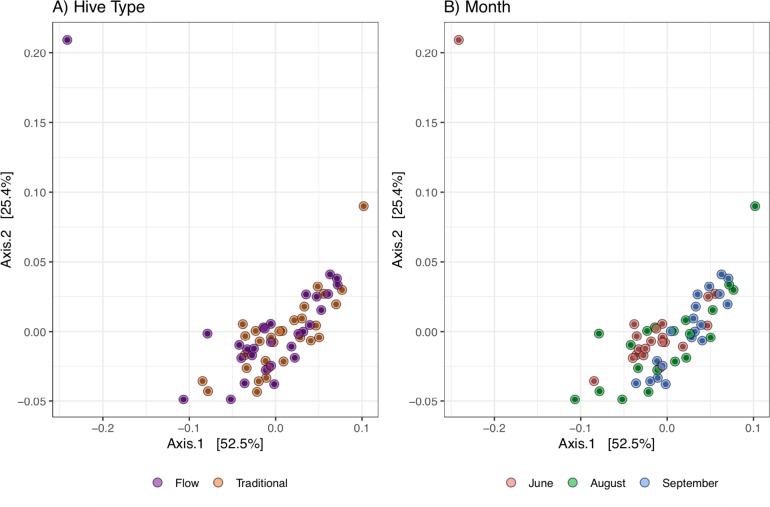
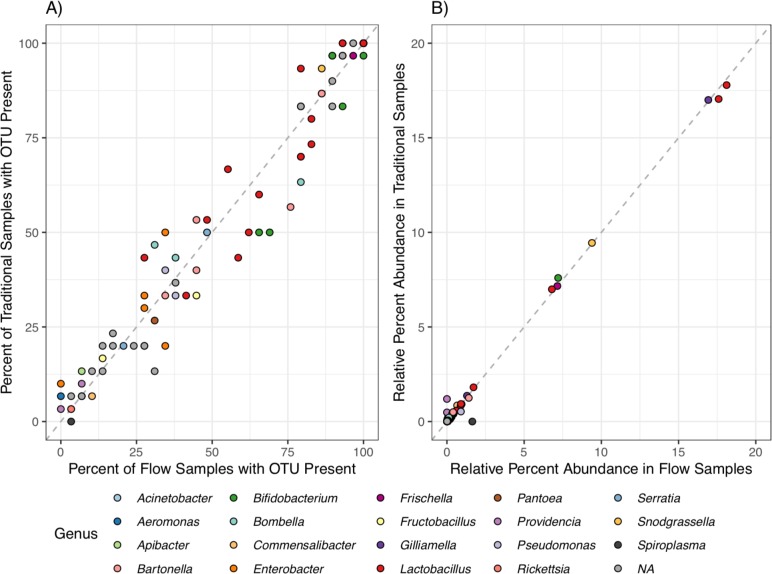
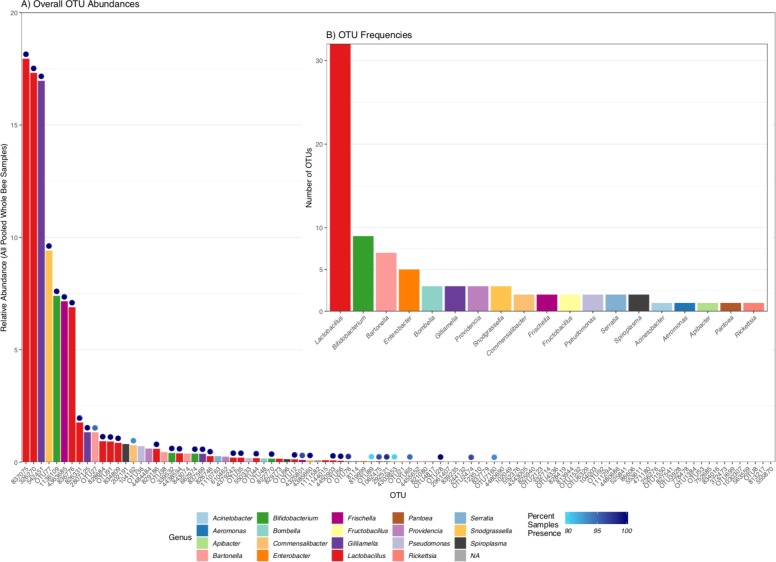
Western honey bees (Apis mellifera) are important pollinators in natural and agricultural ecosystems, and yet are in significant decline due to several factors including parasites, pathogens, pesticides, and habitat loss. A new beehive construction called the FlowTM hive was developed in 2015 to allow honey to be harvested directly from the hive without opening it, resulting in an apparent decrease in stress to the bees. Here, we compared the Flow and traditional Langstroth hive constructions to determine if there were any significant differences in the bee microbiome. The bee-associated bacterial communities did not differ between hive constructions and varied only slightly over the course of a honey production season. Samples were dominated by taxa belonging to the Lactobacillus, Bifidobacterium, Bartonella, Snodgrassella, Gilliamella, and Frischella genera, as observed in previous studies. The top ten most abundant taxa made up the majority of the sequence data; however, many low abundance organisms were persistent across the majority of samples regardless of sampling time or hive type. We additionally compared different preparations of whole bee and dissected bee samples to elaborate on previous bee microbiome research. We found that bacterial sequences were overwhelming derived from the bee guts, and microbes on the bee surfaces (including pollen) contributed little to the overall microbiome of whole bees. Overall, the results indicate that different hive constructions and associated disturbance levels do not influence the bee gut microbiome, which has broader implications for supporting hive health.
西方蜜蜂(Apis mellifera)是自然和农业生态系统中重要的传粉媒介,但由于寄生虫、病原体、杀虫剂和栖息地丧失等多种因素,它们的数量正在显著减少。一种名为 FlowTM 蜂箱的新型蜂箱结构于 2015 年开发出来,可以在不打开蜂箱的情况下直接从蜂箱中收获蜂蜜,从而明显减少对蜜蜂的压力。在这里,我们比较了 Flow 和传统的 Langstroth 蜂箱结构,以确定蜜蜂微生物组是否存在任何显著差异。蜂箱结构之间的蜜蜂相关细菌群落没有差异,并且在一个蜂蜜生产季节内仅略有变化。样本主要由乳杆菌属、双歧杆菌属、巴尔通体属、斯诺德格拉斯氏菌属、吉利亚姆氏菌属和弗里舍拉氏菌属等分类群组成,与之前的研究结果一致。前 10 个最丰富的分类群构成了大部分序列数据;然而,许多低丰度的生物在很大一部分样本中都存在,无论采样时间或蜂箱类型如何。我们还比较了整只蜜蜂和解剖蜜蜂样本的不同制备方法,以详细说明之前的蜜蜂微生物组研究。我们发现细菌序列主要来自蜜蜂肠道,而蜜蜂表面(包括花粉)上的微生物对整只蜜蜂的微生物组贡献很小。总的来说,结果表明不同的蜂箱结构和相关的干扰水平不会影响蜜蜂肠道微生物组,这对支持蜂箱健康具有更广泛的意义。