Beckham George K, Layne Danielle K, Kim Steven B, Martin Eric A, Perez Benjamin G, Adams Kent J
Kinesiology Department, California State University, Monterey Bay, Seaside, CA 93955, USA.
Mathematics and Statistics Department, California State University, Monterey Bay, Seaside, CA 93955, USA.
Sports (Basel). 2019 Nov 7;7(11):230. doi: 10.3390/sports7110230.
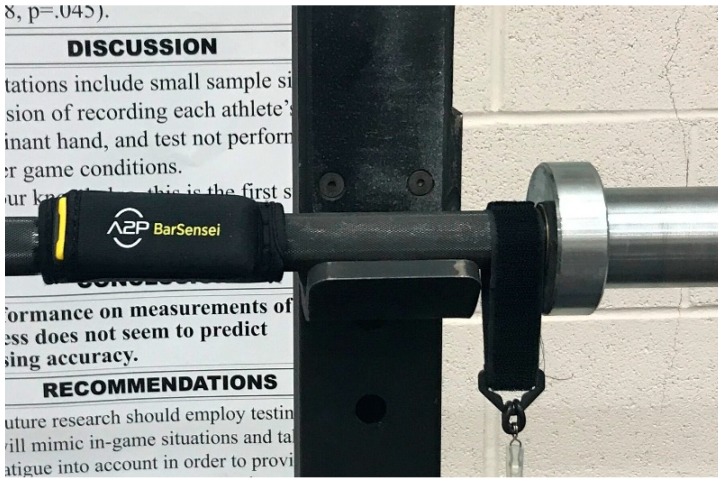
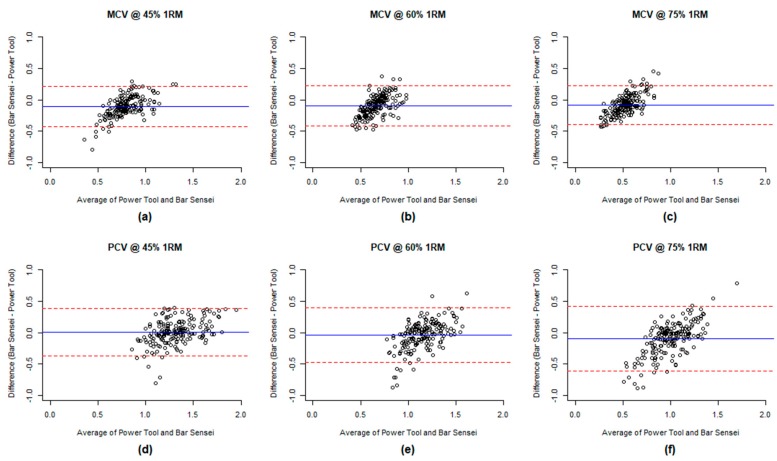
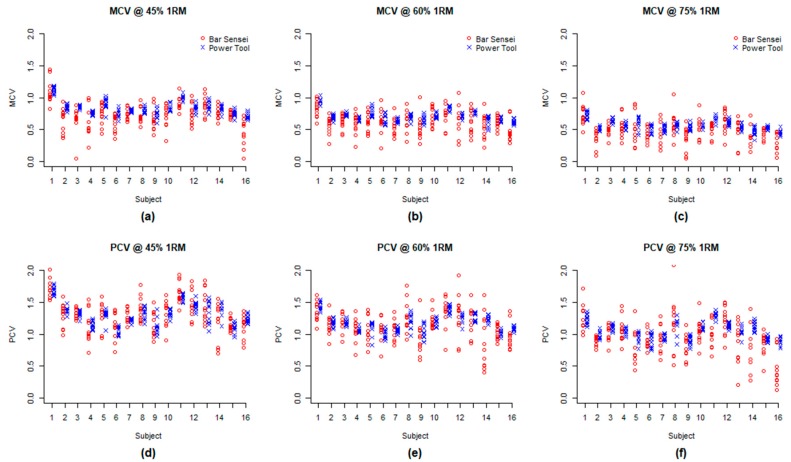
The Assess2Perform Bar Sensei is a device used to measure barbell velocity for velocity-based training that has not yet been validated. The purpose of this study was to determine criterion validity and reliability of the Assess2Perform Bar Sensei in barbell back squats by comparing it against the GymAware PowerTool, a previously validated instrument. Sixteen injury-free, resistance-trained subjects (eleven males and five females) were recruited. Subjects were tested for their back squat one repetition maximum (1RM). Then, on two separate days, subjects performed two sets of three repetitions at loads of 45%, 60% and 75% 1RM. The GymAware PowerTool and Bar Sensei were attached to the barbell in similar locations for concurrent collection of mean concentric velocity (MCV) and peak concentric velocity (PCV). The Bar Sensei and PowerTool showed generally fair to poor agreement for MCV and PCV when subjects lifted 45% of 1RM (intraclass correlation;ICC 0.4-0.59), and they showed poor agreement when subjects lifted 60% and 75% of 1RM (ICC 0.3-0.4). Inter-repetition/within-set reliability for the Bar Sensei ranged between ICC = 0.273-0.451 for MCV and PCV compared to the far more reliable PowerTool (ICC = 0.651-0.793). Currently, the Bar Sensei is not a reliable or valid tool for measuring barbell velocity in back squats.
Assess2Perform杠铃智能教练是一种用于基于速度训练中测量杠铃速度的设备,但其尚未经过验证。本研究的目的是通过将Assess2Perform杠铃智能教练与先前已验证的GymAware PowerTool进行比较,来确定其在杠铃后深蹲中的标准效度和可靠性。招募了16名无伤病、经过抗阻训练的受试者(11名男性和5名女性)。对受试者进行后深蹲一次重复最大值(1RM)测试。然后,在两个不同的日子里,受试者以45%、60%和75%的1RM负荷进行两组,每组三次重复动作。将GymAware PowerTool和杠铃智能教练安装在杠铃的相似位置,以同时收集平均向心速度(MCV)和峰值向心速度(PCV)。当受试者以1RM的45%负荷举起时,杠铃智能教练和PowerTool在MCV和PCV方面的一致性总体上为中等至较差(组内相关系数;ICC为0.4 - 0.59),而当受试者以1RM的60%和75%负荷举起时,它们的一致性较差(ICC为0.3 - 0.4)。与可靠性更高的PowerTool(ICC = 0.651 - 0.793)相比,杠铃智能教练在组内/重复间的可靠性在MCV和PCV方面介于ICC = 0.273 - 0.451之间。目前,杠铃智能教练不是测量后深蹲中杠铃速度的可靠或有效的工具。