Balsalobre-Fernández Carlos, Marchante David, Baz-Valle Eneko, Alonso-Molero Iván, Jiménez Sergio L, Muñóz-López Mario
School of Sports Science, European University of MadridMadrid, Spain.
Department of Research and Development, PowerExplosive CenterMadrid, Spain.
Front Physiol. 2017 Aug 28;8:649. doi: 10.3389/fphys.2017.00649. eCollection 2017.
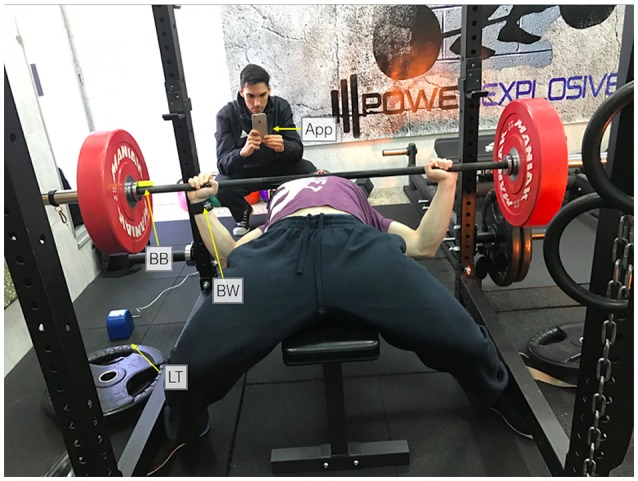
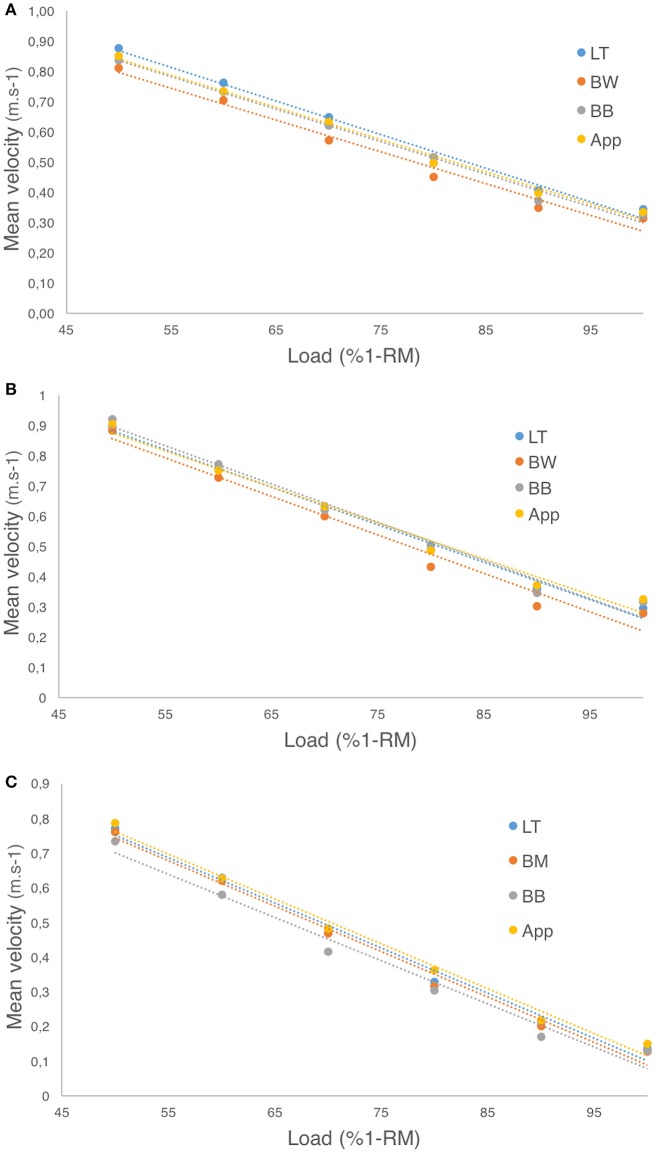
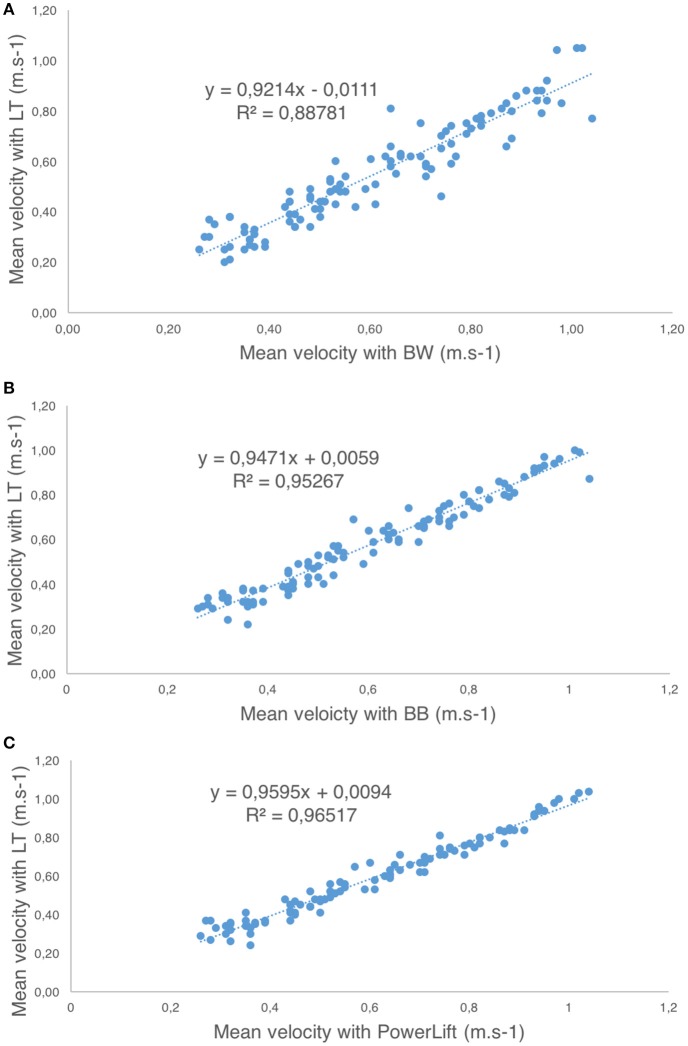
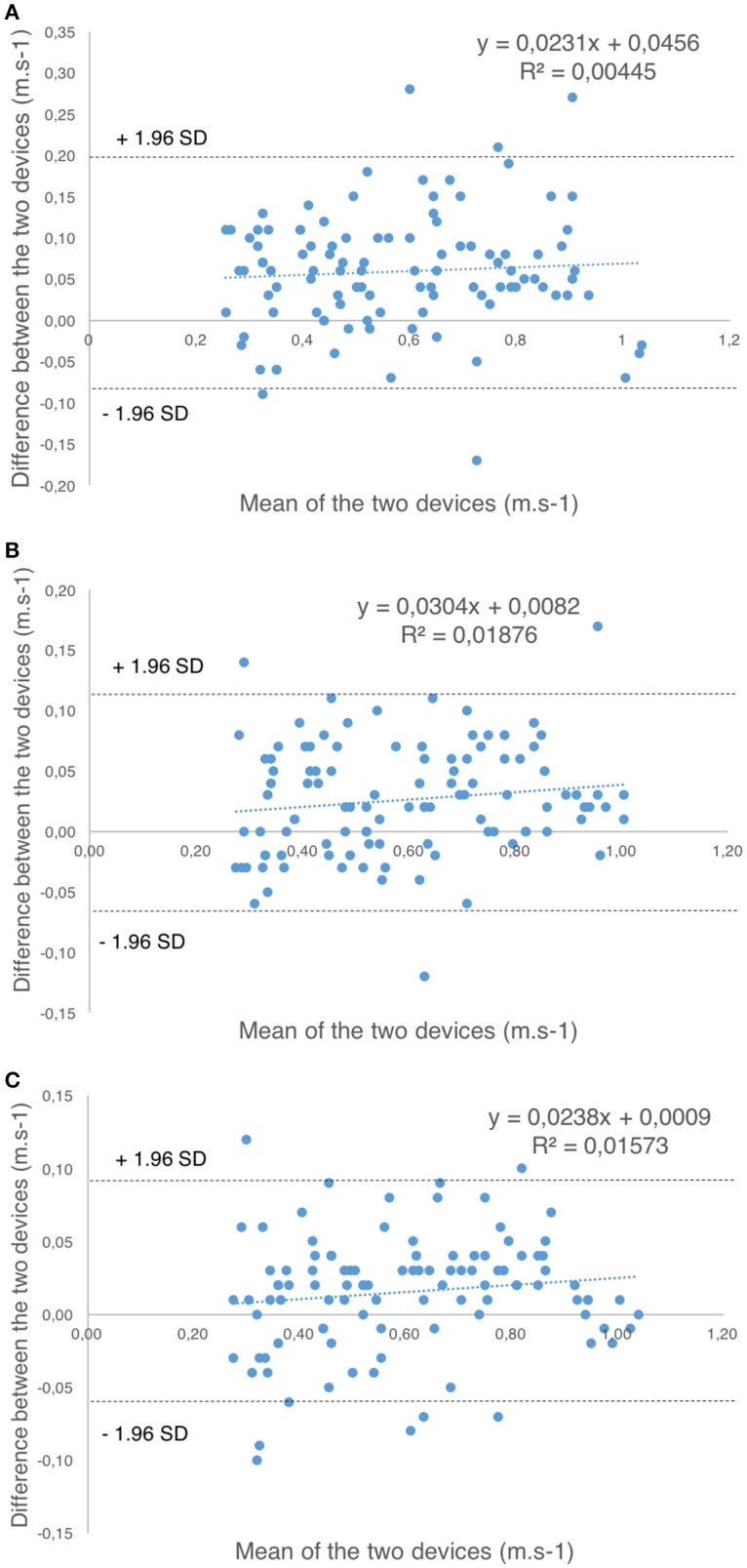
The purpose of this study was to analyze the validity, reliability, and accuracy of new wearable and smartphone-based technology for the measurement of barbell velocity in resistance training exercises. To do this, 10 highly trained powerlifters (age = 26.1 ± 3.9 years) performed 11 repetitions with loads ranging 50-100% of the 1-Repetition maximum in the bench-press, full-squat, and hip-thrust exercises while barbell velocity was simultaneously measured using a linear transducer (LT), two wearable devices (one placed on the subjects' wrist -BW-, and the other one directly attached to the barbell -BB-) and the iOS app. Results showed a high correlation between the LT and BW ( = 0.94-0.98, SEE = 0.04-0.07 m•s), BB ( = 0.97-0.98, SEE = 0.04-0.05 m•s), and the app ( = 0.97-0.98, SEE = 0.03-0.05 m•s) for the measurement of barbell velocity in the three exercises. Paired samples -test revealed systematic biases between the LT and BW, BB and the app in the hip-thrust, between the LT and BW in the full-squat and between the LT and BB in the bench-press exercise ( < 0.001). Moreover, the analysis of the linear regression on the Bland-Altman plots showed that the differences between the LT and BW ( = 0.004-0.03), BB ( = 0.007-0.01), and the app ( = 0.001-0.03) were similar across the whole range of velocities analyzed. Finally, the reliability of the BW (ICC = 0.910-0.988), BB (ICC = 0.922-0.990), and the app (ICC = 0.928-0.989) for the measurement of the two repetitions performed with each load were almost the same than that observed with the LT (ICC = 0.937-0.990). Both the wearable device and the app were highly valid, reliable, and accurate for the measurement of barbell velocity in the bench-press, full-squat, and hip-thrust exercises. These results could have potential practical applications for strength and conditioning coaches who wish to measure barbell velocity during resistance training.
本研究的目的是分析用于测量抗阻训练中杠铃速度的新型可穿戴式和基于智能手机技术的有效性、可靠性和准确性。为此,10名训练有素的力量举运动员(年龄=26.1±3.9岁)在卧推、深蹲和臀推练习中,以1次最大重复量的50%-100%的负荷进行11次重复动作,同时使用线性传感器(LT)、两款可穿戴设备(一款置于受试者手腕 -BW-,另一款直接附着于杠铃 -BB-)以及iOS应用程序测量杠铃速度。结果显示,在三项练习中测量杠铃速度时,LT与BW(=0.94-0.98,标准误=0.04-0.07m•s)、BB(=0.97-0.98,标准误=0.04-0.05m•s)以及应用程序(=0.97-0.98,标准误=0.03-0.05m•s)之间具有高度相关性。配对样本t检验显示,在臀推练习中LT与BW、BB与应用程序之间,深蹲练习中LT与BW之间,以及卧推练习中LT与BB之间存在系统偏差(P<0.001)。此外,Bland-Altman图上的线性回归分析表明,在分析的整个速度范围内,LT与BW(=0.004-0.03)、BB(=0.007-0.01)以及应用程序(=0.001-0.03)之间的差异相似。最后,BW(组内相关系数ICC=0.910-0.988)、BB(ICC=0.922-0.990)以及应用程序(ICC=0.928-0.989)测量每次负荷下两次重复动作的可靠性与LT观察到的可靠性(ICC=0.937-0.990)几乎相同。可穿戴设备和应用程序在卧推、深蹲和臀推练习中测量杠铃速度时均具有高度有效性和可靠性且准确。这些结果对于希望在抗阻训练期间测量杠铃速度的体能教练可能具有潜在的实际应用价值。