Institute of Biochemistry and Cellular Biology - National Research Council (CNR), via Pietro Castellino 111, 80131 Naples, Italy.
Institute of Food Safety, Animal Health and Environment "BIOR", Lejupes street 3, LV-1076 Riga, Latvia.
Sensors (Basel). 2019 Nov 7;19(22):4852. doi: 10.3390/s19224852.
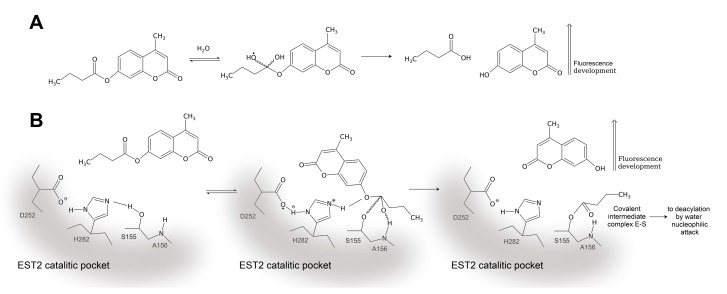
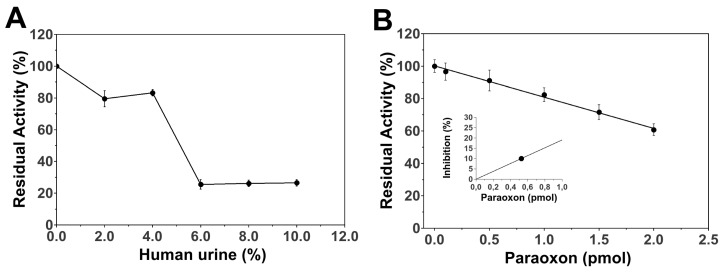
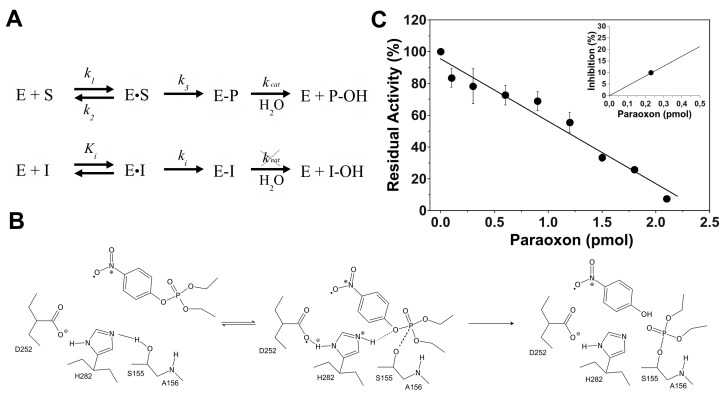
Organophosphate (OP) pesticides are widely used in the agricultural field and in the prevention of pest infestation in private and public areas of cities. Despite their unquestionable utility, several of these compounds demonstrate toxic effects to the environment and human health. In particular, the occurrence of some organophosphate pesticides is correlated to the incidence of nervous system disorders, especially in children. The detection of pesticide residues in the human body represents an important task to preserve human health. In our work we propose the use of esterase-based biosensors as a viable alternative to the expensive and time-consuming systems currently used for their detection in human fluids. Using the esterase-2 activity, coupled with a fluorescence inhibition assay, we are able to detect very low concentration levels of diethyl (4-nitrophenyl) phosphate (paraoxon) in the range of the femtomole (fmol). Method robustness tests indicate the stability of esterase-2 in a diluted solution of 4% human urine, and we are able to accurately determine concentration levels of paraoxon in the range from 0.1 to 2 picomoles (pmol). The system sensitivity for OP detection is calculated at 524 ± 14.15 fmol of paraoxon recognized at 10% of inhibition, with an estimated limit of quantification of 262 ± 8.12 pmol mL. These values are comparable with the most recent analysis methods based on mass spectrometry carried out on human samples for pesticide detection. This research represents a starting point to develop cheap and fast testing methods for a rapid screening of toxic substances in human samples.
有机磷 (OP) 农药广泛应用于农业领域和城市私人和公共区域的害虫防治。尽管它们具有不可否认的效用,但其中一些化合物对环境和人类健康表现出毒性作用。特别是,一些有机磷农药的出现与神经系统疾病的发病率有关,尤其是在儿童中。检测人体中的农药残留是保护人类健康的一项重要任务。在我们的工作中,我们提出使用基于酯酶的生物传感器作为一种可行的替代方法,替代目前用于检测人体液中农药残留的昂贵且耗时的系统。我们利用酯酶-2 的活性,结合荧光抑制测定法,能够在飞摩尔 (fmol) 范围内检测到极低浓度的二乙基 (4-硝基苯基) 磷酸酯 (对氧磷)。方法稳健性测试表明酯酶-2 在 4%人尿稀释溶液中的稳定性,并且我们能够准确地确定对氧磷在 0.1 至 2 皮摩尔 (pmol) 范围内的浓度水平。用于 OP 检测的系统灵敏度计算为 10%抑制时可识别的 524 ± 14.15 fmol 对氧磷,估计定量限为 262 ± 8.12 pmol mL。这些值与最近基于质谱法在人体样本中进行的农药检测分析方法相当。这项研究为开发廉价且快速的人体样本中有毒物质的快速筛选方法提供了一个起点。