From the Department of Clinical Neuroscience (S.B., K.A.M., J.H., A.M.), Department of Medicine Solna (P.B.), and Karolinska Neuroimmunology & Multiple Sclerosis Centre and Centre for Molecular Medicine (A.M.) Karolinska Institutet, Stockholm, Sweden, Odense University Hospital (S.B.), Department of Neurology, Denmark; and Karolinska University Hospital (J.H.), Stockholm, Sweden.
Neurology. 2019 Dec 10;93(24):e2216-e2223. doi: 10.1212/WNL.0000000000008617. Epub 2019 Nov 8.
Depression is common in multiple sclerosis (MS), but its impact on disability worsening has not yet been determined. We explored the risk of disability worsening associated with depression in a nationwide longitudinal cohort.
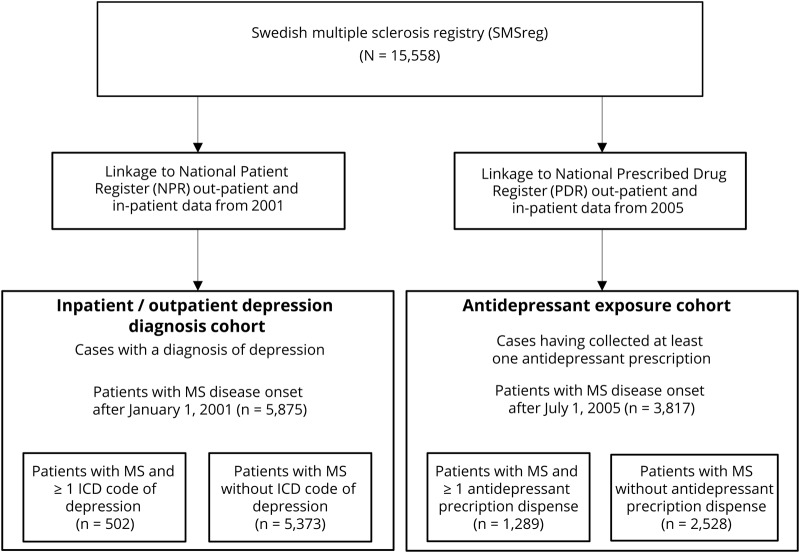
This retrospective cohort study used linked data from 3 Swedish nationwide registries: the MS Register, National Patient Register, and Prescribed Drug Register. Two incident cohorts were developed: cohort 1 included all registered cases of MS in the MS Registry (2001-2014) with depression defined as ≥1 ICD-10 code for depression; and cohort 2 comprised all cases of MS in the MS Registry (2005-2014) with depression defined as ≥1 prescription filled for an antidepressant. Cox regression models were used to compare the risk of reaching sustained disability milestone scores of 3.0, 4.0, and 6.0 on the Expanded Disability Status Scale (EDSS) between persons with MS with and without depression.
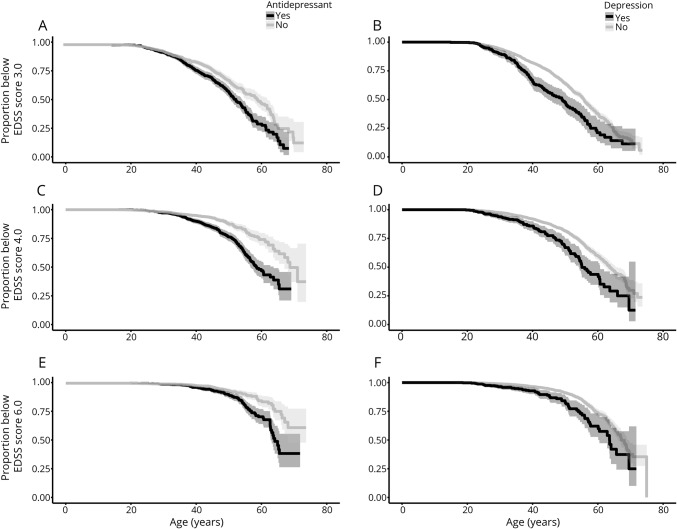
Cohort 1 included 5,875 cases; 502 (8.5%) had depression. Cohort 2 had 3,817 cases; 1,289 (33.8%) were prescribed an antidepressant. Persons with depression were at a significantly higher risk of reaching sustained EDSS scores of 3.0, 4.0, and 6.0, with hazard ratios of 1.50 (95% confidence interval [CI] 1.20-1.87), 1.79 (95% CI 1.40-2.29), and 1.89 (95% CI 1.38-2.57), respectively. A similar increased risk among persons exposed to antidepressants was observed, with hazard ratios of 1.37 (95% CI 1.18-1.60), 1.93 (95% CI 1.61-2.31), and 1.86 (95% CI 1.45-2.40) for sustained EDSS scores of 3.0, 4.0, and 6.0, respectively.
Persons with MS and comorbid depression had a significantly increased risk of disability worsening. This finding highlights the need for early recognition and appropriate treatment of depression in persons with MS.
多发性硬化症(MS)患者中常出现抑郁,但抑郁对残疾恶化的影响尚未确定。我们在一项全国性纵向队列中探讨了与抑郁相关的残疾恶化风险。
本回顾性队列研究使用了来自瑞典 3 个全国性登记处(MS 登记处、国家患者登记处和处方药物登记处)的数据进行链接。建立了 2 个发病队列:队列 1 包括 MS 登记处中所有登记的 MS 病例(2001-2014 年),将≥1 个抑郁 ICD-10 编码定义为抑郁;队列 2 包括 MS 登记处中所有 MS 病例(2005-2014 年),将≥1 种抗抑郁药处方定义为抑郁。使用 Cox 回归模型比较了 MS 患者中有无抑郁的患者在扩展残疾状况量表(EDSS)上达到 3.0、4.0 和 6.0 持续残疾里程碑评分的风险。
队列 1 包括 5875 例患者;其中 502 例(8.5%)有抑郁。队列 2 有 3817 例患者;其中 1289 例(33.8%)开了抗抑郁药。抑郁患者达到 EDSS 3.0、4.0 和 6.0 持续评分的风险显著增加,风险比分别为 1.50(95%置信区间[CI]1.20-1.87)、1.79(95% CI 1.40-2.29)和 1.89(95% CI 1.38-2.57)。在暴露于抗抑郁药的人群中也观察到类似的风险增加,达到 EDSS 3.0、4.0 和 6.0 持续评分的风险比分别为 1.37(95% CI 1.18-1.60)、1.93(95% CI 1.61-2.31)和 1.86(95% CI 1.45-2.40)。
患有 MS 合并抑郁的患者残疾恶化的风险显著增加。这一发现强调了在 MS 患者中早期识别和适当治疗抑郁的必要性。