Division of Psychological Medicine and Clinical Neurosciences, School of Medicine, Cardiff University, Cardiff, UK.
Department of Neurology, Royal Gwent Hospital, Newport, UK.
Neuroepidemiology. 2024;58(3):218-226. doi: 10.1159/000536427. Epub 2024 Feb 20.
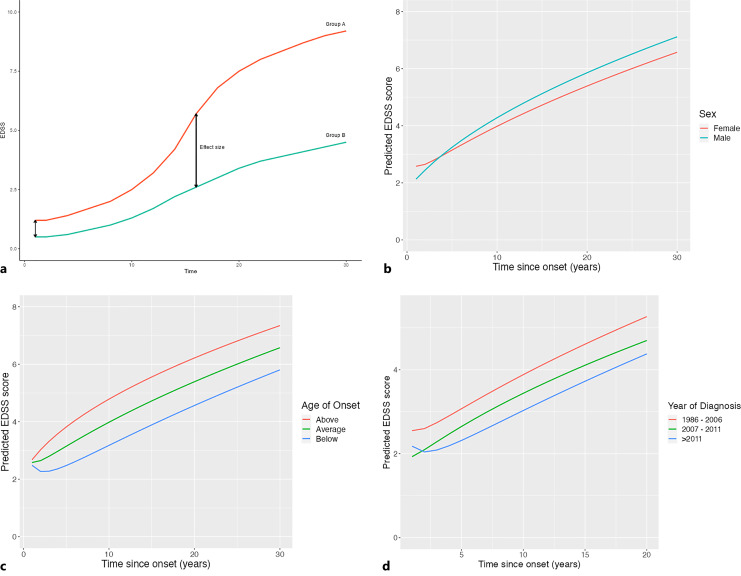
The objective of this study was to model multiple sclerosis (MS) disease progression and compare disease trajectories by sex, age of onset, and year of diagnosis.
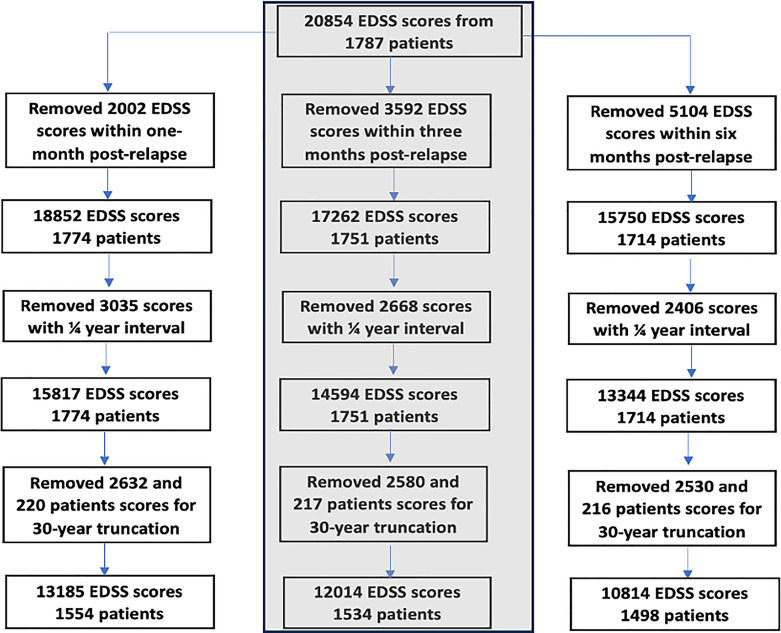
Longitudinal EDSS scores (20,854 observations) were collected for 1,787 relapse-onset MS patients at MS clinics in South Wales and modelled using a multilevel model (MLM). The MLM adjusted for covariates (sex, age of onset, year of diagnosis, and disease-modifying treatments), and included interactions between baseline covariates and time variables.
The optimal model was truncated at 30 years after disease onset and excluded EDSS recorded within 3 months of relapse. As expected, older age of onset was associated with faster disease progression at 15 years (effect size (ES): 0.75; CI: 0.63, 0.86; p: <0.001) and female-sex progressed more slowly at 15 years (ES: -0.43; CI: -0.68, -0.18; p: <0.001). Patients diagnosed more recently (defined as 2007-2011 and >2011) progressed more slowly than those diagnosed historically (<2006); (ES: -0.46; CI: -0.75, -0.16; p: 0.006) and (ES: -0.95; CI: -1.20, -0.70; p: <0.001), respectively.
We present a novel model of MS outcomes, accounting for the non-linear trajectory of MS and effects of baseline covariates, validating well-known risk factors (sex and age of onset) associated with disease progression. Also, patients diagnosed more recently progressed more slowly than those diagnosed historically.
本研究旨在建立多发性硬化症(MS)疾病进展模型,并按性别、发病年龄和诊断年份比较疾病轨迹。
在威尔士南部的 MS 诊所收集了 1787 例复发缓解型 MS 患者的纵向 EDSS 评分(20854 次观察),并使用多层次模型(MLM)进行建模。该 MLM 调整了协变量(性别、发病年龄、诊断年份和疾病修正治疗),并包括基线协变量和时间变量之间的交互作用。
最佳模型在发病后 30 年截断,并排除了复发后 3 个月内记录的 EDSS。正如预期的那样,发病年龄较大与 15 年内疾病进展较快相关(效应大小(ES):0.75;CI:0.63,0.86;p:<0.001),女性发病较慢(ES:-0.43;CI:-0.68,-0.18;p:<0.001)。与历史诊断相比,最近诊断(定义为 2007-2011 年和>2011 年)的患者进展较慢(ES:-0.46;CI:-0.75,-0.16;p:0.006)和(ES:-0.95;CI:-1.20,-0.70;p:<0.001)。
我们提出了一种新的 MS 结局模型,该模型考虑了 MS 的非线性轨迹和基线协变量的影响,验证了与疾病进展相关的已知风险因素(性别和发病年龄)。此外,最近诊断的患者进展较慢。