Laboratory of Genetics and Molecular Cardiology, Heart Institute (InCor) of University of São Paulo Medical School, Avenue Dr. Enéas de Carvalho, Aguiar, 44 Cerqueira César, São Paulo, SP, 05403-000, Brazil.
Heart Transplant Department, Heart Institute (InCor) of University of São Paulo Medical School, São Paulo, Brazil.
BMC Cardiovasc Disord. 2019 Nov 9;19(1):251. doi: 10.1186/s12872-019-1226-9.
Heart failure (HF) is a major public health problem with increasing prevalence worldwide. It is associated with high mortality and poor quality of life due to recurrent and costly hospital admissions. Several studies have been conducted to describe HF risk predictors in different races, countries and health systems. Nonetheless, understanding population-specific determinants of HF outcomes remains a great challenge. We aim to evaluate predictors of 1-year survival of individuals with systolic heart failure from the GENIUS-HF cohort.
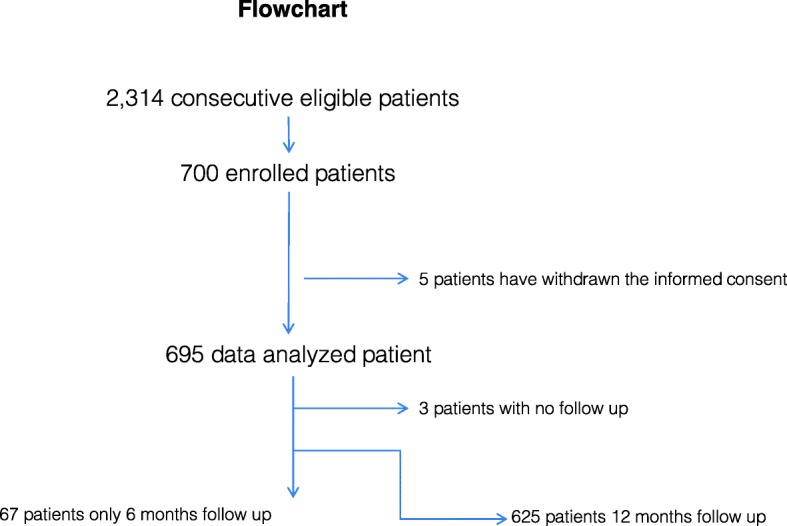
We enrolled 700 consecutive patients with systolic heart failure from the SPA outpatient clinic of the Heart Institute, a tertiary health-center in Sao Paulo, Brazil. Inclusion criteria were age between 18 and 80 years old with heart failure diagnosis of different etiologies and left ventricular ejection fraction ≤50% in the previous 2 years of enrollment on the cohort. We recorded baseline demographic and clinical characteristics and followed-up patients at 6 months intervals by telephone interview. Study data were collected and data quality assurance by the Research Electronic Data Capture tools. Time to death was studied using Cox proportional hazards models adjusted for demographic, clinical and socioeconomic variables and medication use.
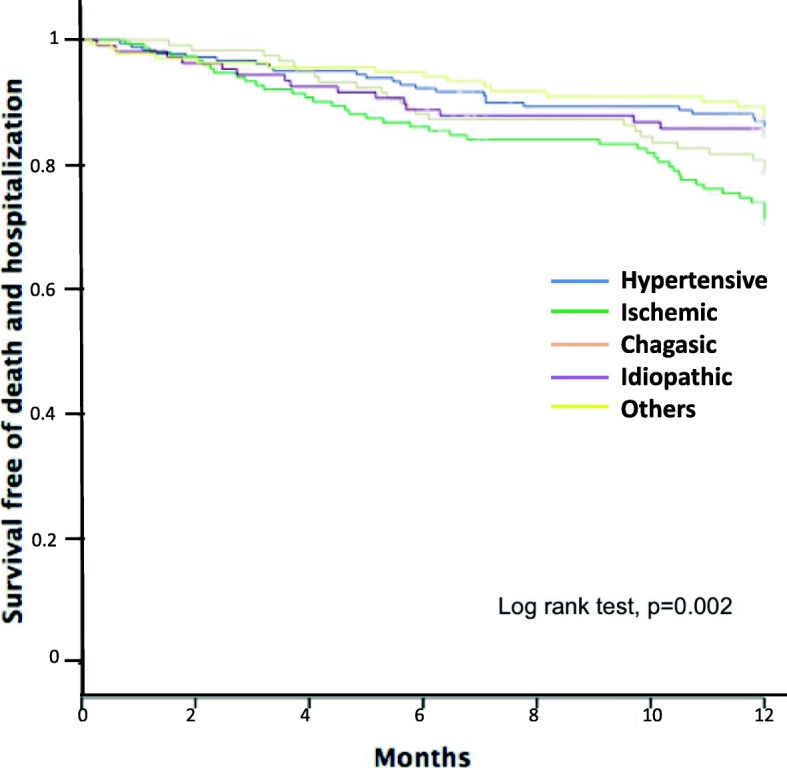
We screened 2314 consecutive patients for eligibility and enrolled 700 participants. The overall mortality was 6.8% (47 patients); the composite outcome of death and hospitalization was 17.7% (123 patients) and 1% (7 patients) have been submitted to heart transplantation after one year of enrollment. After multivariate adjustment, baseline values of blood urea nitrogen (HR 1.017; CI 95% 1.008-1.027; p < 0.001), brain natriuretic peptide (HR 1.695; CI 95% 1.347-2.134; p < 0.001) and systolic blood pressure (HR 0.982;CI 95% 0.969-0.995; p = 0.008) were independently associated with death within 1 year. Kaplan Meier curves showed that ischemic patients have worse survival free of death and hospitalization compared to other etiologies.
High levels of BUN and BNP and low systolic blood pressure were independent predictors of one-year overall mortality in our sample.
Current Controlled Trials NTC02043431, retrospectively registered at in January 23, 2014.
心力衰竭(HF)是一个日益严重的全球公共卫生问题,其患病率不断上升。由于反复住院和费用高昂,HF 与高死亡率和生活质量差有关。已经进行了多项研究来描述不同种族、国家和卫生系统的 HF 风险预测因素。然而,了解人群特异性 HF 结局的决定因素仍然是一个巨大的挑战。我们旨在评估来自 GENIUS-HF 队列的收缩性心力衰竭患者的 1 年生存率的预测因素。
我们从巴西圣保罗的心脏研究所 SPA 门诊连续纳入 700 例收缩性心力衰竭患者。纳入标准为年龄在 18 至 80 岁之间,有不同病因的心力衰竭诊断,在队列纳入前 2 年内左心室射血分数≤50%。我们记录了基线人口统计学和临床特征,并通过电话访谈每 6 个月随访一次患者。使用 Cox 比例风险模型研究了死亡时间,该模型调整了人口统计学、临床和社会经济变量以及药物使用情况。
我们对 2314 例连续患者进行了筛选,以确定其是否符合入选标准,最终纳入 700 例患者。总的死亡率为 6.8%(47 例);死亡和住院的复合结局为 17.7%(123 例),1%(7 例)在纳入后 1 年接受了心脏移植。多变量调整后,基线血尿素氮(HR 1.017;95%CI 1.008-1.027;p<0.001)、脑钠肽(HR 1.695;95%CI 1.347-2.134;p<0.001)和收缩压(HR 0.982;95%CI 0.969-0.995;p=0.008)值与 1 年内死亡独立相关。Kaplan-Meier 曲线显示,与其他病因相比,缺血性患者的死亡和住院率更高。
在我们的样本中,高 BUN 和 BNP 水平以及低收缩压是 1 年全因死亡率的独立预测因素。
当前对照试验 NTC02043431,于 2014 年 1 月 23 日回顾性注册。