Meyer Mark J, Mordukhovich Irina, Wellenius Gregory A, Mittleman Murray A, McCracken John P, Coull Brent A, McNeely Eileen
Department of Mathematics and Statistics, Georgetown University, Washington, DC, United States.
SHINE in the Department of Environmental Health, Harvard T.H. Chan School of Public Health, Boston, MA, United States.
Front Physiol. 2019 Oct 24;10:1339. doi: 10.3389/fphys.2019.01339. eCollection 2019.
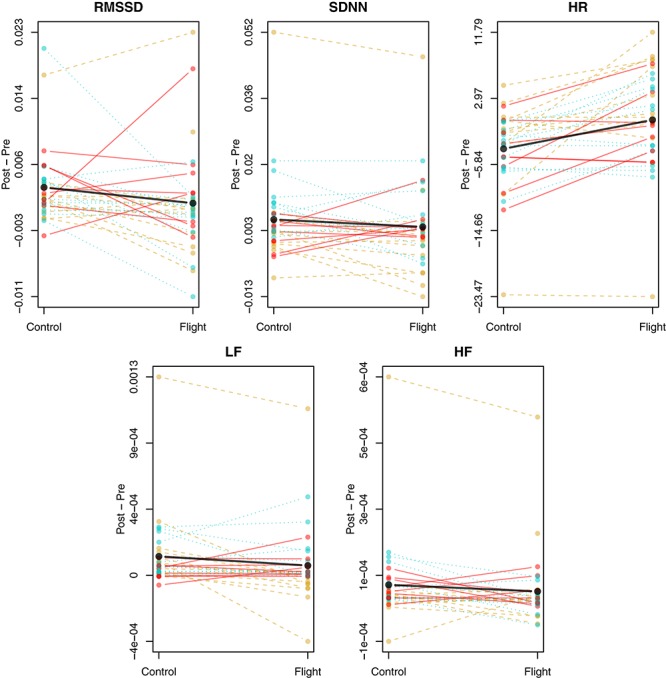
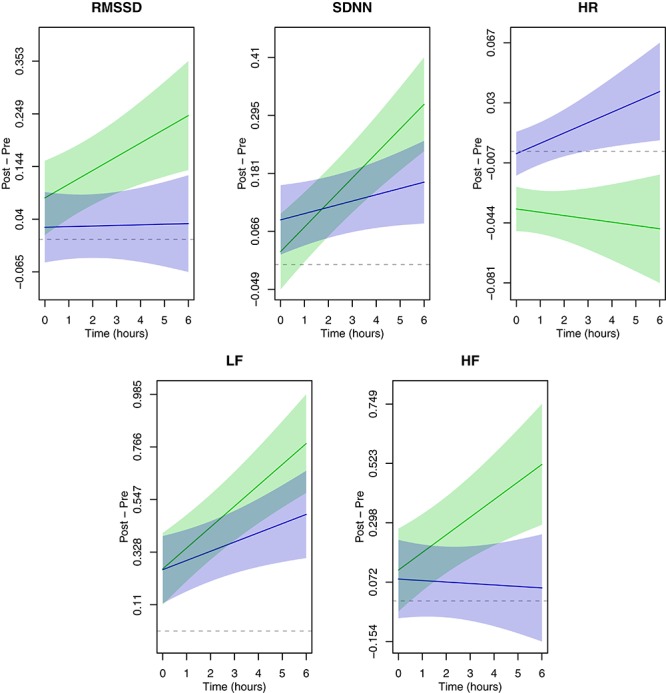
Elderly passengers and those with preexisting disease are flying with increasing frequency and in-flight cardiac emergencies are a more frequent occurrence. We conducted a study of the physiological effects of simulated cabin altitudes and resulting lower oxygen levels among such passengers. We monitored 41 participants in a hypobaric chamber for 2 days, one at an equivalent of 7,000 feet altitude (regulations limit pressurization to 8,000 feet) for a 4-5 h simulated flight and the other at ground level using generalized least squares models to account for repeated measures. We evaluated associations between simulated flight, heart rate (HR) and measures of heart rate variability(HRV) (root mean square of successive R-R interval differences [RMSSD], standard deviation of normal-to-normal intervals [SDNN], high-frequency power [HF], and low-frequency power [LF]). Heart rate was 3.9% (95% CI: 2.1, 5.8) higher on simulated flight days compared with non-flight days. The RMSSD was 10.6% (95% CI: -21.3, 0.05) lower during simulated flight days, indicative of reduced HRV. The remaining HRV measures were also lower on simulated flight days, though associations were less precise. We report that typical simulated flight conditions elicit changes in cardiac autonomic control, suggesting sympathetic arousal or reductions in parasympathetic drive. Our findings, if confirmed, may suggest the need for guidelines to protect vulnerable passengers including prescreens, symptom evaluation after air travel, the use of oxygen concentrators, and education about healthy behaviors in flight.
老年乘客以及患有基础疾病的乘客乘坐飞机的频率越来越高,飞行过程中心脏急症的发生也更为频繁。我们针对此类乘客进行了一项研究,以探究模拟机舱高度及由此导致的低氧水平所产生的生理影响。我们在一个低压舱内对41名参与者进行了为期2天的监测,一天处于相当于7000英尺高度(规定将增压限制在8000英尺)进行4 - 5小时的模拟飞行,另一天处于地面水平,使用广义最小二乘法模型来处理重复测量数据。我们评估了模拟飞行、心率(HR)以及心率变异性(HRV)指标(连续R - R间期差值的均方根[RMSSD]、正常到正常间期的标准差[SDNN]、高频功率[HF]和低频功率[LF])之间的关联。与非飞行日相比,模拟飞行日的心率高出3.9%(95%置信区间:2.1,5.8)。模拟飞行日期间,RMSSD降低了10.6%(95%置信区间:-21.3,0.05),表明HRV降低。其余HRV指标在模拟飞行日也较低,尽管关联不太精确。我们报告称,典型的模拟飞行条件会引起心脏自主控制的变化,提示交感神经兴奋或副交感神经驱动减弱。我们的研究结果若得到证实,可能意味着需要制定相关指南来保护易受影响的乘客,包括预检、飞行后症状评估、使用氧气浓缩器以及开展关于飞行中健康行为的教育。