Speer Jennifer E, Wang Yuli, Fallon John K, Smith Philip C, Allbritton Nancy L
1Department of Chemistry, University of North Carolina, Chapel Hill, NC 27599 USA.
3Division of Pharmacoengineering and Molecular Pharmaceutics, Eshelman School of Pharmacy, University of North Carolina at Chapel Hill, NC 27599, USA and North Carolina State University, Raleigh, NC 27607 USA.
J Biol Eng. 2019 Nov 4;13:82. doi: 10.1186/s13036-019-0212-1. eCollection 2019.
The intestinal epithelium is a major site of drug metabolism in the human body, possessing enterocytes that house brush border enzymes and phase I and II drug metabolizing enzymes (DMEs). The enterocytes are supported by a porous extracellular matrix (ECM) that enables proper cell adhesion and function of brush border enzymes, such as alkaline phosphatase (ALP) and alanyl aminopeptidase (AAP), phase I DMEs that convert a parent drug to a more polar metabolite by introducing or unmasking a functional group, and phase II DMEs that form a covalent conjugate between a functional group on the parent compound or sequential metabolism of phase I metabolite. In our effort to develop an in vitro intestinal epithelium model, we investigate the impact of two previously described simple and customizable scaffolding systems, a gradient cross-linked scaffold and a conventional scaffold, on the ability of intestinal epithelial cells to produce drug metabolizing proteins as well as to metabolize exogenously added compounds. While the scaffolding systems possess a range of differences, they are most distinguished by their stiffness with the gradient cross-linked scaffold possessing a stiffness similar to that found in the in vivo intestine, while the conventional scaffold possesses a stiffness several orders of magnitude greater than that found in vivo.
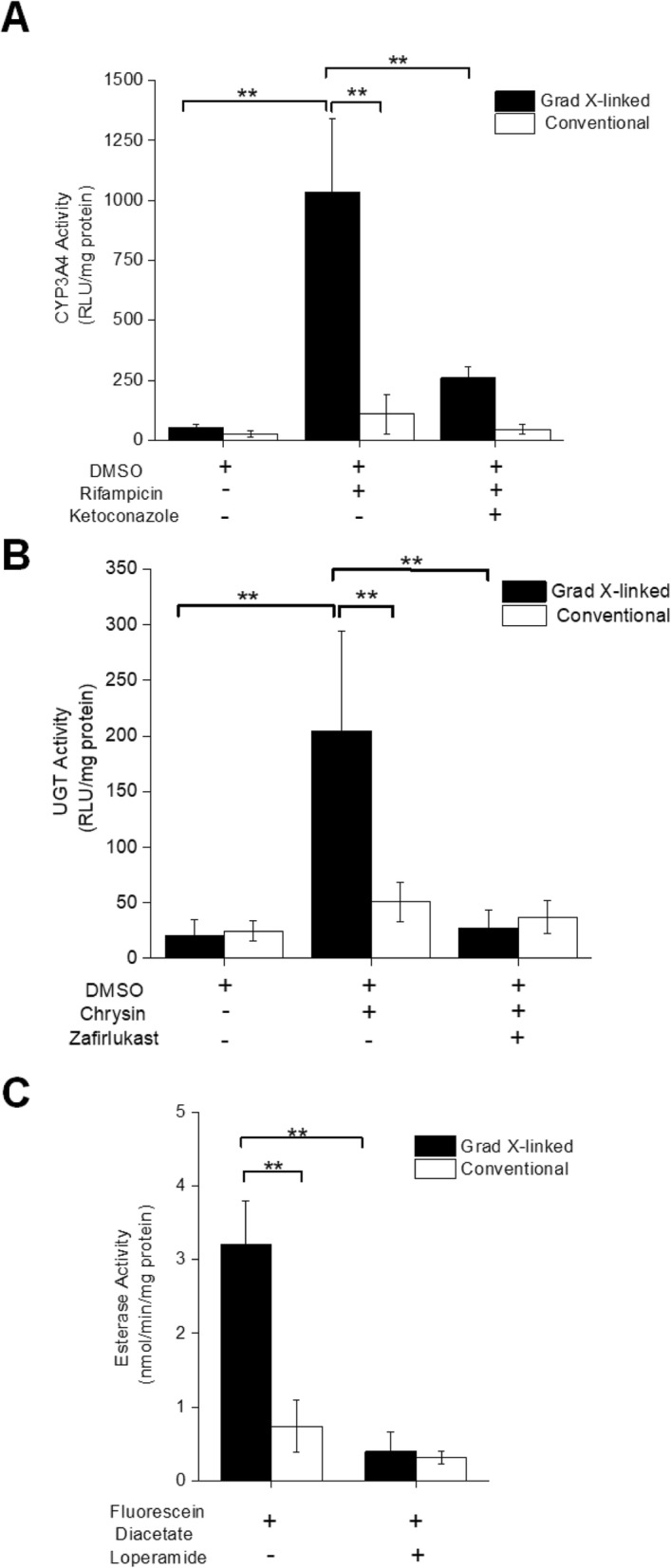
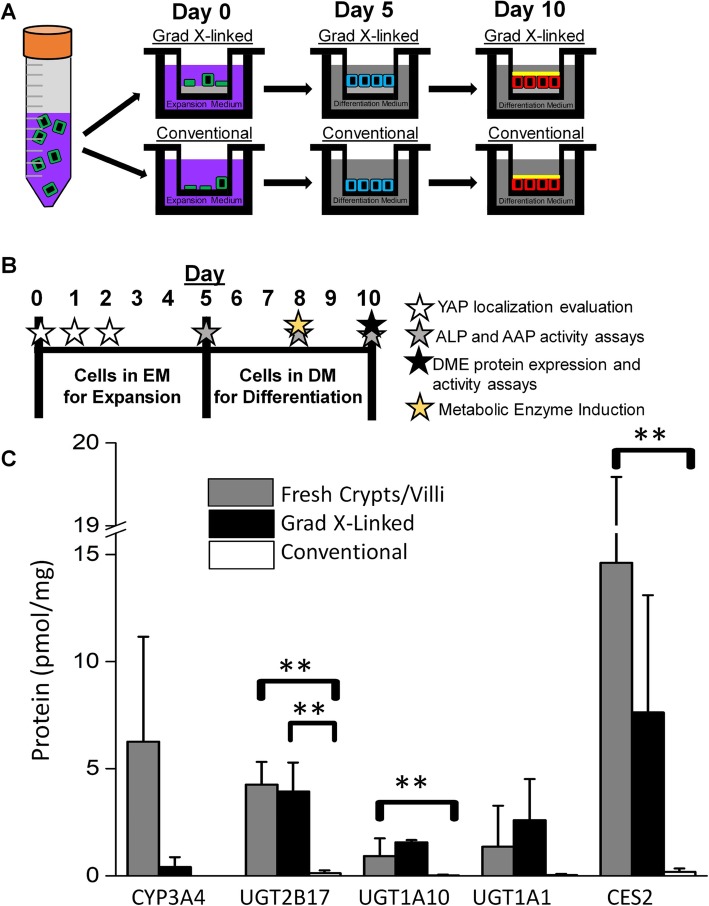
The monolayers on the gradient cross-linked scaffold expressed CYP3A4, UGTs 2B17, 1A1 and 1A10, and CES2 proteins at a level similar to that in fresh crypts/villi. The monolayers on the conventional scaffold expressed similar levels of CYP3A4 and UGTs 1A1 and 1A10 DMEs to that found in fresh crypts/villi but significantly decreased expression of UGT2B17 and CES2 proteins. The activity of CYP3A4 and UGTs 1A1 and 1A10 was inducible in cells on the gradient cross-linked scaffold when the cells were treated with known inducers, whereas the CYP3A4 and UGT activities were not inducible in cells grown on the conventional scaffold. Both monolayers demonstrate esterase activity but the activity measured in cells on the conventional scaffold could not be inhibited with a known CES2 inhibitor. Both monolayer culture systems displayed similar ALP and AAP brush border enzyme activity. When cells on the conventional scaffold were incubated with a yes-associated protein (YAP) inhibitor, CYP3A4 activity was greatly enhanced suggesting that mechano-transduction signaling can modulate drug metabolizing enzymes.
The use of a cross-linked hydrogel scaffold for expansion and differentiation of primary human intestinal stem cells dramatically impacts the induction of CYP3A4 and maintenance of UGT and CES drug metabolizing enzymes in vitro making this a superior substrate for enterocyte culture in DME studies. This work highlights the influence of mechanical properties of the culture substrate on protein expression and the activity of drug metabolizing enzymes as a critical factor in developing accurate assay protocols for pharmacokinetic studies using primary intestinal cells.
肠上皮是人体药物代谢的主要部位,其中的肠上皮细胞含有刷状缘酶以及Ⅰ相和Ⅱ相药物代谢酶(DME)。肠上皮细胞由多孔的细胞外基质(ECM)支撑,该基质能使细胞正确黏附,并维持刷状缘酶(如碱性磷酸酶(ALP)和丙氨酰氨基肽酶(AAP))、通过引入或暴露官能团将母体药物转化为极性更强代谢物的Ⅰ相DME以及在母体化合物上的官能团之间形成共价缀合物或对Ⅰ相代谢物进行顺序代谢的Ⅱ相DME的功能。在我们开发体外肠上皮模型的过程中,我们研究了两种先前描述的简单且可定制的支架系统——梯度交联支架和传统支架,对肠上皮细胞产生药物代谢蛋白以及代谢外源性添加化合物能力的影响。虽然这两种支架系统存在一系列差异,但最显著的区别在于它们的硬度,梯度交联支架的硬度与体内肠道相似,而传统支架的硬度比体内硬度大几个数量级。
梯度交联支架上的单层细胞表达CYP3A4、UGT 2B17、1A1和1A10以及CES2蛋白的水平与新鲜隐窝/绒毛中的水平相似。传统支架上的单层细胞表达的CYP3A4以及UGT 1A1和1A10 DME的水平与新鲜隐窝/绒毛中的相似,但UGT2B17和CES2蛋白的表达显著降低。当用已知诱导剂处理时,梯度交联支架上细胞中的CYP3A4以及UGT 1A1和1A10的活性是可诱导的,而在传统支架上生长的细胞中,CYP3A4和UGT的活性不可诱导。两种单层细胞均表现出酯酶活性,但在传统支架上细胞中测得的活性不能被已知的CES2抑制剂抑制。两种单层培养系统显示出相似的ALP和AAP刷状缘酶活性。当用Yes相关蛋白(YAP)抑制剂处理传统支架上的细胞时,CYP3A4活性大大增强,这表明机械转导信号可以调节药物代谢酶。
使用交联水凝胶支架对原代人肠干细胞进行扩增和分化,会显著影响体外CYP3A4的诱导以及UGT和CES药物代谢酶的维持,使其成为药物代谢酶(DME)研究中肠上皮细胞培养的优质底物。这项工作强调了培养底物的机械性能对蛋白表达和药物代谢酶活性的影响,这是使用原代肠细胞开发准确的药代动力学研究检测方案的关键因素。