Liu Xue, Li Lingling, Liu Jincong, Qiao Jianjun, Zhao Guang-Rong
1Frontier Science Center for Synthetic Biology and Key Laboratory of Systems Bioengineering (Ministry of Education), School of Chemical Engineering and Technology, Tianjin University, Yaguan Road 135, Jinnan District, Tianjin, 300350 China.
2SynBio Research Platform, Collaborative Innovation Centre of Chemical Science and Engineering (Tianjin), Tianjin University, Yaguan Road 135, Jinnan District, Tianjin, 300350 China.
Biotechnol Biofuels. 2019 Nov 6;12:261. doi: 10.1186/s13068-019-1601-x. eCollection 2019.
Icariside D2 is a plant-derived natural glycoside with pharmacological activities of inhibiting angiotensin-converting enzyme and killing leukemia cancer cells. Production of icariside D2 by plant extraction and chemical synthesis is inefficient and environmentally unfriendly. Microbial cell factory offers an attractive route for economical production of icariside D2 from renewable and sustainable bioresources.
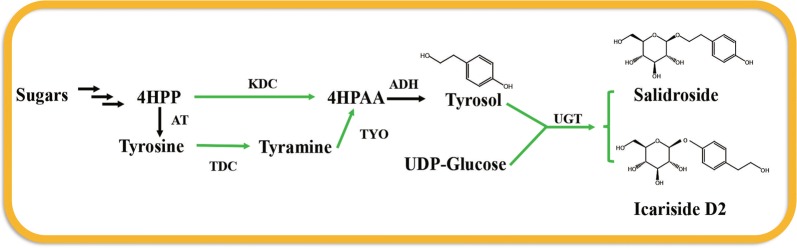
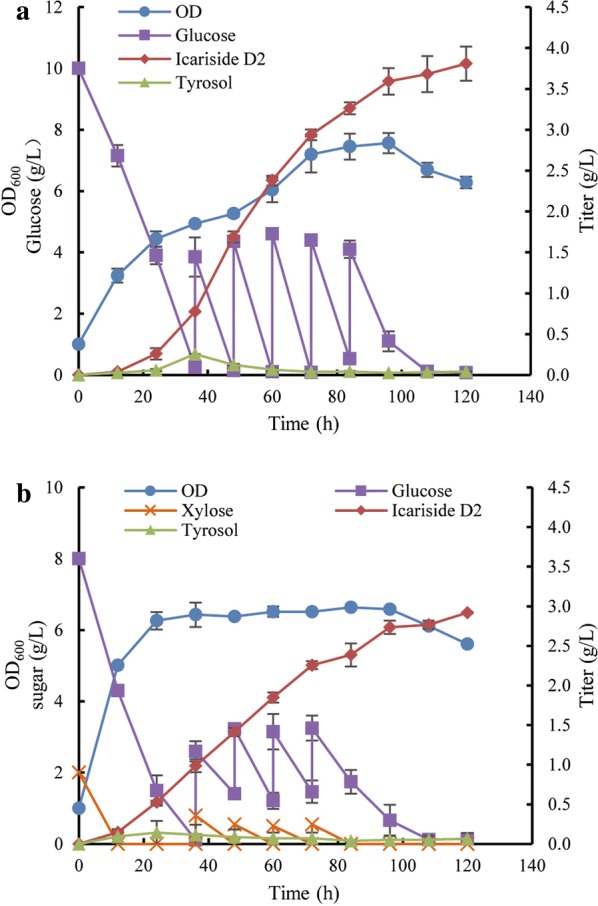
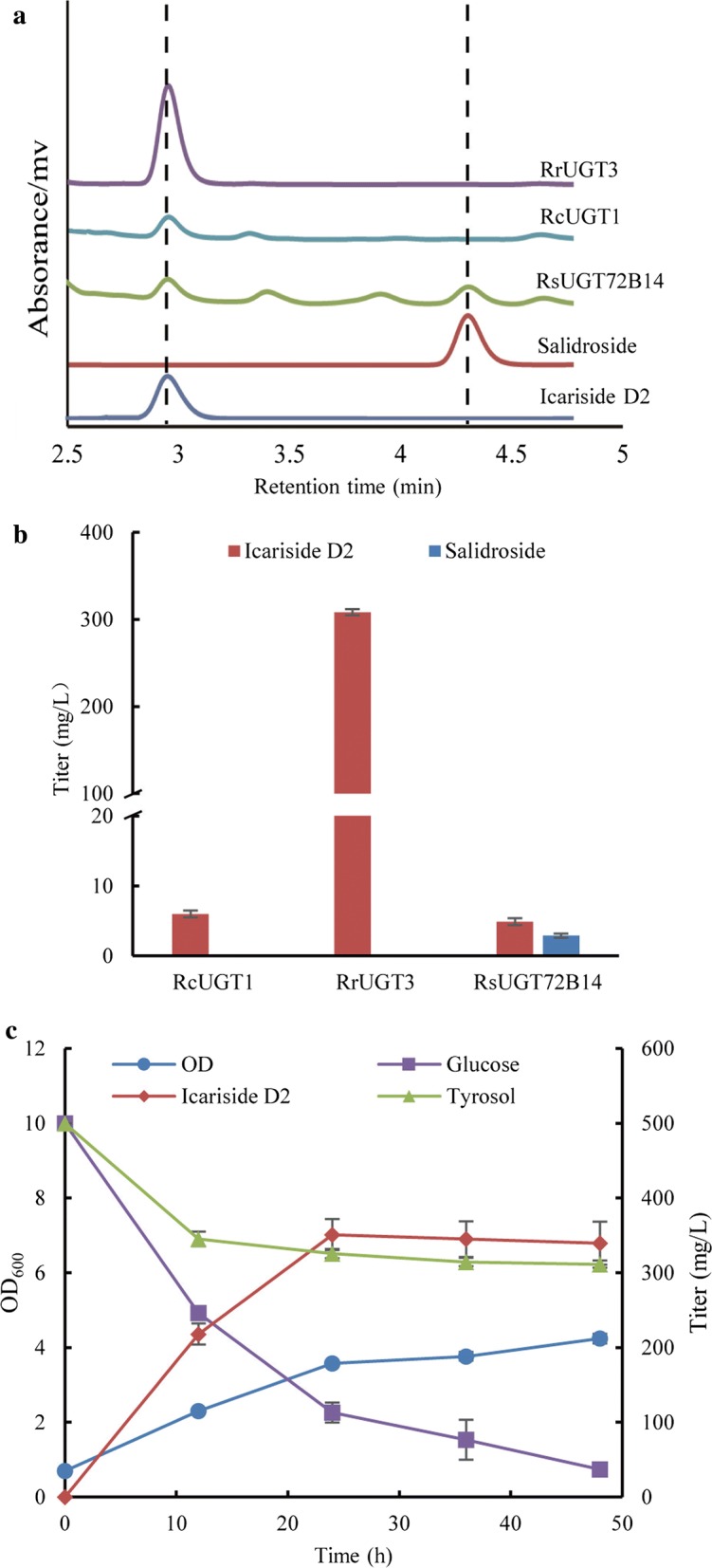
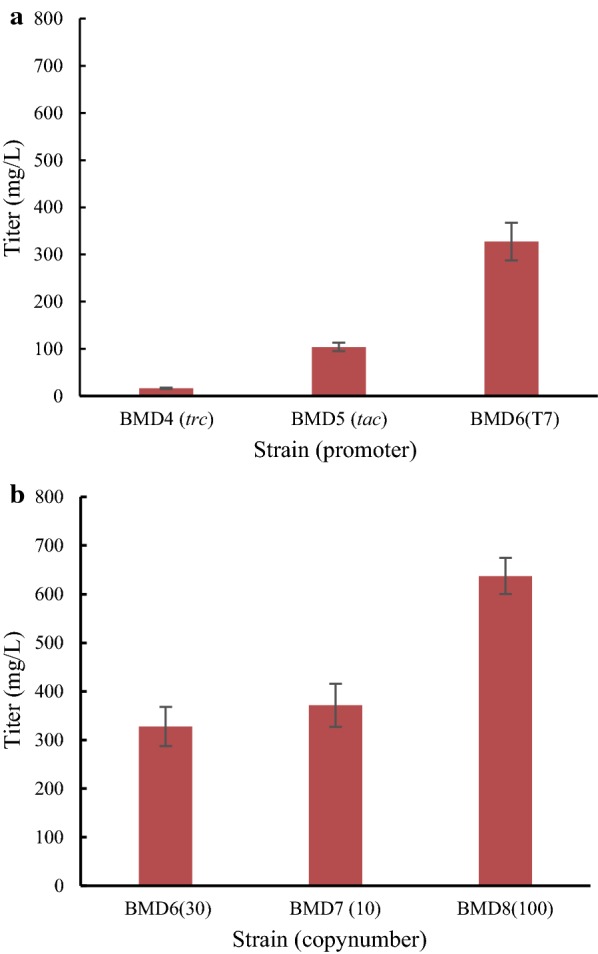
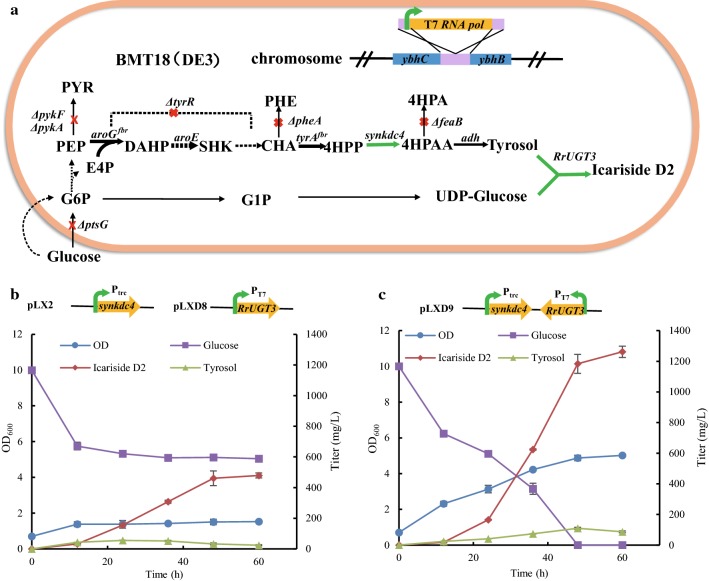
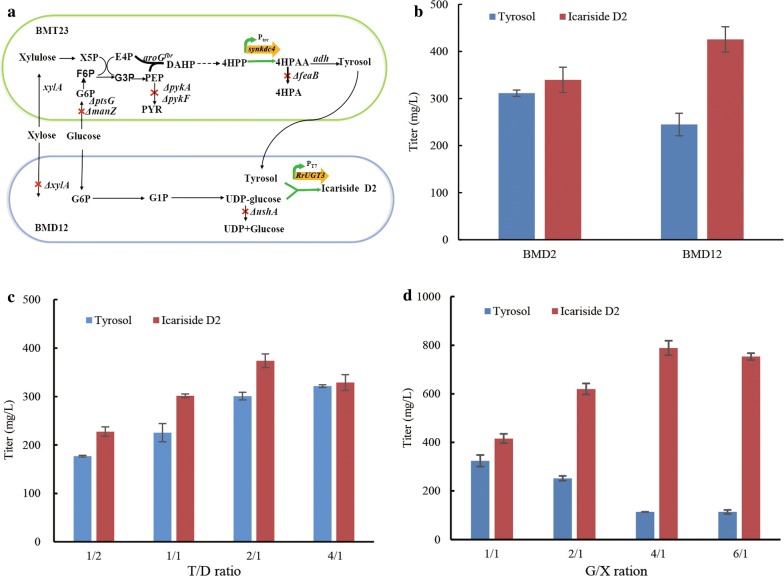
We metabolically constructed the biosynthetic pathway of icariside D2 in engineered . We screened the uridine diphosphate glycosyltransferases (UGTs) and obtained an active RrUGT3 that regio-specifically glycosylated tyrosol at phenolic position to exclusively synthesize icariside D2. We put heterologous genes in cell for the de novo biosynthesis of icariside D2. By fine-tuning promoter and copy number as well as balancing gene expression pattern to decrease metabolic burden, the BMD10 monoculture was constructed. Parallelly, for balancing pathway strength, we established the BMT23-BMD12 coculture by distributing the icariside D2 biosynthetic genes to two strains BMT23 and BMD12, responsible for biosynthesis of tyrosol from preferential xylose and icariside D2 from glucose, respectively. Under the optimal conditions in fed-batch shake-flask fermentation, the BMD10 monoculture produced 3.80 g/L of icariside D2 using glucose as sole carbon source, and the BMT23-BMD12 coculture produced 2.92 g/L of icariside D2 using glucose-xylose mixture.
We for the first time reported the engineered for the de novo efficient production of icariside D2 with gram titer. It would be potent and sustainable approach for microbial production of icariside D2 from renewable carbon sources. - coculture approach is not limited to glycoside production, but could also be applied to other bioproducts.
淫羊藿苷D2是一种植物源天然糖苷,具有抑制血管紧张素转换酶和杀死白血病癌细胞的药理活性。通过植物提取和化学合成生产淫羊藿苷D2效率低下且不环保。微生物细胞工厂为从可再生和可持续生物资源经济生产淫羊藿苷D2提供了一条有吸引力的途径。
我们在工程化的[具体微生物名称未给出]中代谢构建了淫羊藿苷D2的生物合成途径。我们筛选了尿苷二磷酸糖基转移酶(UGTs),并获得了一种活性RrUGT3,它能在酚羟基位置对酪醇进行区域特异性糖基化,专门合成淫羊藿苷D2。我们将异源基因导入[具体微生物名称未给出]细胞中用于淫羊藿苷D2的从头生物合成。通过微调启动子和拷贝数以及平衡基因表达模式以减轻代谢负担,构建了BMD10单培养物。同时,为了平衡途径强度,我们通过将淫羊藿苷D2生物合成基因分别分配到两种[具体微生物名称未给出]菌株BMT23和BMD12中,建立了BMT23 - BMD12共培养物,这两种菌株分别负责从优先利用的木糖生物合成酪醇以及从葡萄糖生物合成淫羊藿苷D2。在补料分批摇瓶发酵的最佳条件下,BMD10单培养物以葡萄糖为唯一碳源生产了3.80 g/L的淫羊藿苷D2,而BMT23 - BMD12共培养物以葡萄糖 - 木糖混合物生产了2.92 g/L的淫羊藿苷D2。
我们首次报道了工程化的[具体微生物名称未给出]用于从头高效生产克级产量的淫羊藿苷D2。这将是一种从可再生碳源微生物生产淫羊藿苷D2的有效且可持续的方法。共培养方法不仅限于糖苷生产,还可应用于其他生物产品。