Wang Na, Huang Xin, Chen Lihang, Yang Jinyue, Li Xin, Ma Jiayuan, Bao Ying, Li Fei, Yin Qiuxiang, Hao Hongxun
National Engineering Research Center of Industrial Crystallization Technology, School of Chemical Engineering and Technology, Tianjin University, Tianjin 300072, People's Republic of China.
Collaborative Innovation Center of Chemical Science and Engineering, Tianjin 300072, People's Republic of China.
IUCrJ. 2019 Oct 9;6(Pt 6):1064-1073. doi: 10.1107/S2052252519012363. eCollection 2019 Nov 1.
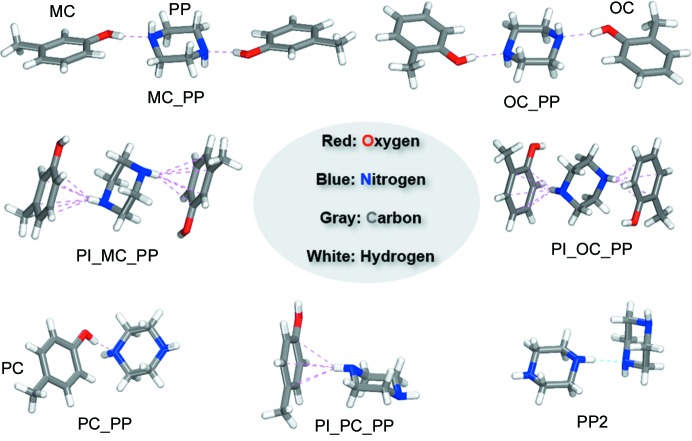
The disposition of functional groups can induce variations in the nature and type of interactions and hence affect the molecular recognition and self-assembly mechanism in cocrystals. To better understand the formation of cocrystals on a molecular level, the effects of disposition of functional groups on the formation of cocrystals were systematically and comprehensively investigated using cresol isomers (-, -, -cresol) as model compounds. Consistency and variability in these cocrystals containing positional isomers were found and analyzed. The structures, molecular recognition and self-assembly mechanism of supramolecular synthons in solution and in their corresponding cocrystals were verified by a combined experimental and theoretical calculation approach. It was found that the heterosynthons (heterotrimer or heterodimer) combined with O-H⋯N hydrogen bonding played a significant role. Hirshfeld surface analysis and computed interaction energy values were used to determine the hierarchical ordering of the weak interactions. The quantitative analyses of charge transfers and molecular electrostatic potential were also applied to reveal and verify the reasons for consistency and variability. Finally, the molecular recognition, self-assembly and evolution process of the supramolecular synthons in solution were investigated. The results confirm that the supramolecular synthon structures formed initially in solution would be carried over to the final cocrystals, and the supramolecular synthon structures are the precursors of cocrystals and the information memory of the cocrystallization process, which is evidence for classical nucleation theory.
官能团的排布可引发相互作用的性质和类型的变化,进而影响共晶体中的分子识别和自组装机制。为了在分子水平上更好地理解共晶体的形成,以甲酚异构体(邻甲酚、间甲酚、对甲酚)作为模型化合物,系统且全面地研究了官能团排布对共晶体形成的影响。发现并分析了这些含有位置异构体的共晶体中的一致性和变异性。通过实验与理论计算相结合的方法,验证了溶液及其相应共晶体中超分子合成子的结构、分子识别和自组装机制。结果发现,由O-H⋯N氢键结合而成的杂合合成子(异三聚体或异二聚体)发挥了重要作用。利用 Hirshfeld 表面分析和计算得到的相互作用能值来确定弱相互作用的层级排序。还应用电荷转移和分子静电势的定量分析来揭示和验证一致性和变异性的原因。最后,研究了溶液中超分子合成子的分子识别、自组装和演化过程。结果证实,最初在溶液中形成的超分子合成子结构会延续到最终的共晶体中,超分子合成子结构是共晶体的前体以及共结晶过程的信息存储器,这为经典成核理论提供了证据。