Ponomarev Aleksandr V, Shubina Irina Zh
N.N. Blokhin National Medical Research Center of Oncology, Moscow, Russia.
Front Oncol. 2019 Oct 25;9:1115. doi: 10.3389/fonc.2019.01115. eCollection 2019.
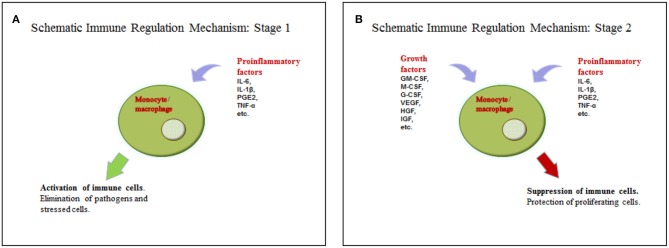
A large number of studies have presented a great deal of information about tumor and immune system interaction. Nevertheless, the problem of tumor evasion from the immune reaction is still difficult to resolve. Understanding the ways in which immunosuppressive tumor microenvironment develops and maintains its potential is of utmost importance to ensure the best use of the suppressed immune functions. The study presents a review covering the data on tumor-associated antigens, mechanisms of tumor evasion from the immune reactions, and search for common immunosuppressive processes of tumor growth and normal wound healing. The study discusses the important role of monocytes/macrophages in the regulation of immune system reactions. We suggest that the simultaneous actions of growth factors and pro-inflammatory cytokines may result in the suppression of the immune system. The study describes intracellular signaling molecules that take part in the regulation of the myeloid cell functions. If the hypothesis is proved correct, the indicated interaction of cytokines could be regarded as a prospective target for antitumor therapy.
大量研究已经提供了关于肿瘤与免疫系统相互作用的大量信息。然而,肿瘤逃避免疫反应的问题仍然难以解决。了解免疫抑制性肿瘤微环境形成并维持其潜能的方式对于确保充分利用被抑制的免疫功能至关重要。该研究发表了一篇综述,涵盖了肿瘤相关抗原的数据、肿瘤逃避免疫反应的机制,以及对肿瘤生长和正常伤口愈合中常见免疫抑制过程的探索。该研究讨论了单核细胞/巨噬细胞在免疫系统反应调节中的重要作用。我们认为生长因子和促炎细胞因子的同时作用可能导致免疫系统受到抑制。该研究描述了参与髓样细胞功能调节的细胞内信号分子。如果该假设被证明是正确的,那么所指出的细胞因子相互作用可被视为抗肿瘤治疗的一个潜在靶点。